

Tuesday 25 March 2025
The quest for better autonomous driving has long been plagued by a fundamental problem: limited sensing ranges and occlusions can lead to catastrophic outcomes on the road. To address this, researchers have turned to collaborative perception, where vehicles share their sensor data to create a more comprehensive view of the environment.
But there’s a catch: with so many vehicles on the road, managing the flood of data can be a daunting task. That’s why a team of scientists has developed a new algorithm that optimizes the scheduling of communication links between vehicles and roadside units (RSUs) for maximum perceptual accuracy.
The approach relies on deep reinforcement learning (DRL), which uses artificial neural networks to learn complex decision-making strategies. In this case, the network is trained to select the most informative collaborators based on factors like channel state information (CSI) and semantic importance.
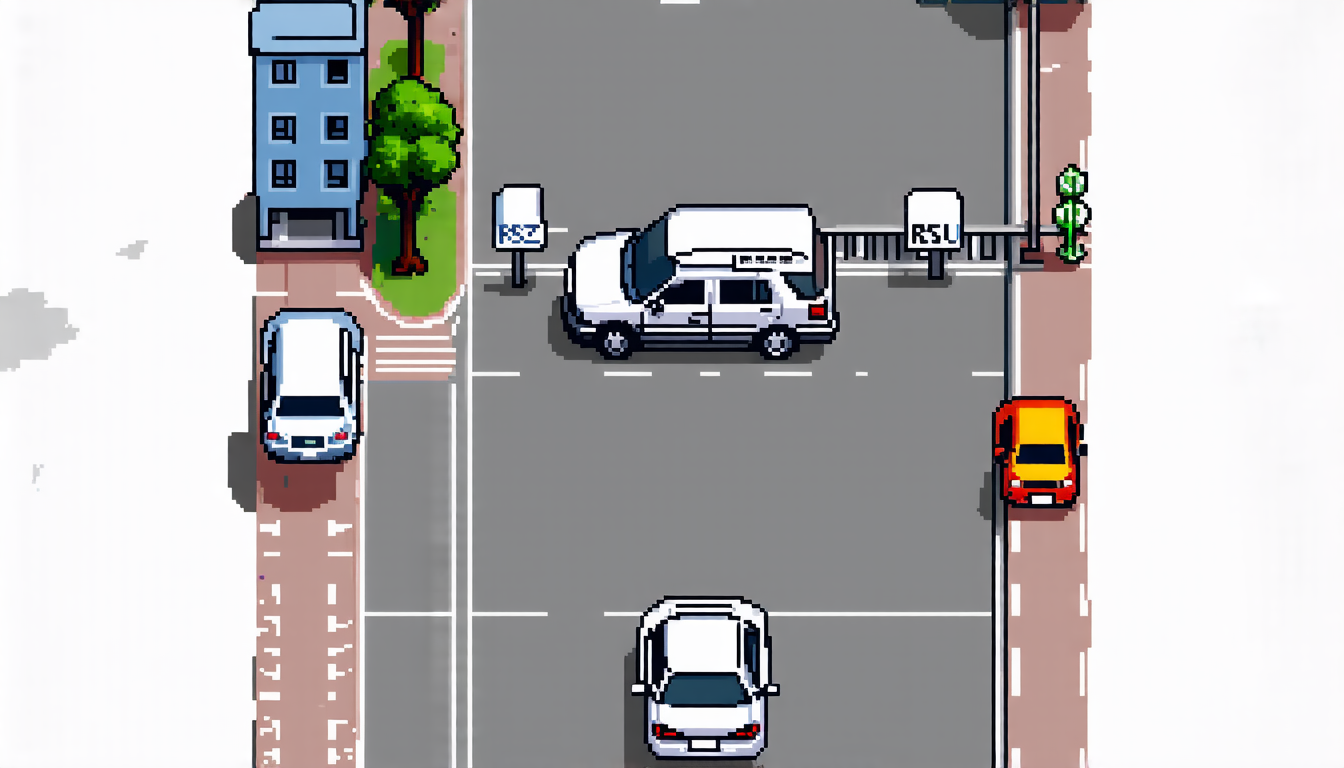
To test their algorithm, the researchers simulated a busy intersection with four vehicles and an RSU, all equipped with sensors capable of detecting objects within a certain range. They then evaluated the performance of their DRL-based scheduling strategy against three traditional methods: nearest neighbor, round-robin, and maximum rate allocation.
The results were striking. While the traditional approaches struggled to detect all objects in the scene, the DRL-based algorithm successfully identified every vehicle, even those partially occluded by other cars or buildings. What’s more, it did so while minimizing transmission rates and reducing the risk of collisions.
So how does it work? The algorithm begins by analyzing the CSI for each potential collaborator, assessing factors like signal strength and noise levels. It then uses this information to compute a spatial confidence map, which ranks collaborators based on their ability to provide useful data.
Next, the DRL network selects the top-ranked collaborators, taking into account both CSI and semantic importance. This ensures that the most informative data is transmitted first, while also minimizing the risk of collisions by prioritizing links with better channel conditions.
The researchers validated their approach using a custom-built dataset, which included 3D point clouds, camera images, and sensor readings from various vehicles and RSUs. They also tested their algorithm on real-world datasets, demonstrating its ability to adapt to changing environmental conditions and varying traffic scenarios.
While there’s still much work to be done before autonomous driving becomes a reality, this breakthrough could represent a major step forward in the development of more accurate and reliable perception systems.
Cite this article: “Optimizing Collaborative Perception for Autonomous Driving Through Deep Reinforcement Learning”, The Science Archive, 2025.
Autonomous Driving, Collaborative Perception, Deep Reinforcement Learning, Drl, Sensor Data, Roadside Units, Csi, Semantic Importance, Spatial Confidence Map, 3D Point Clouds, Camera Images, Sensor Readings





