

Tuesday 25 March 2025
A team of researchers has developed a new approach to safely relocate satellites in space, using a combination of control barrier functions and differential collision detection. The method, which was tested through simulations and animations, shows promise for tackling complex satellite servicing missions.
The challenge of relocating satellites is that it requires precise calculations and careful maneuvering to avoid collisions with other objects in space. Current methods rely on manual intervention, which can be slow and unreliable. To overcome this, the researchers used control barrier functions (CBFs) – mathematical formulas that define a safe region around an object – and differential collision detection (DCOL), which detects potential collisions between objects.
The team developed a hybrid approach that switches between CBFs and DCOL depending on the situation. When two satellites are approaching each other, the system uses CBFs to ensure they don’t collide. However, when one satellite is moving towards a stationary object, such as a space station or another satellite, the system switches to DCOL to prevent collisions.
The researchers used simulations to test their approach, simulating the movement of multiple satellites and testing for safety violations. The results showed that the hybrid approach was effective in preventing collisions, with only 5 out of 500 simulated runs resulting in safety violations. These violations were minor, occurring when two satellites came close but didn’t actually collide.
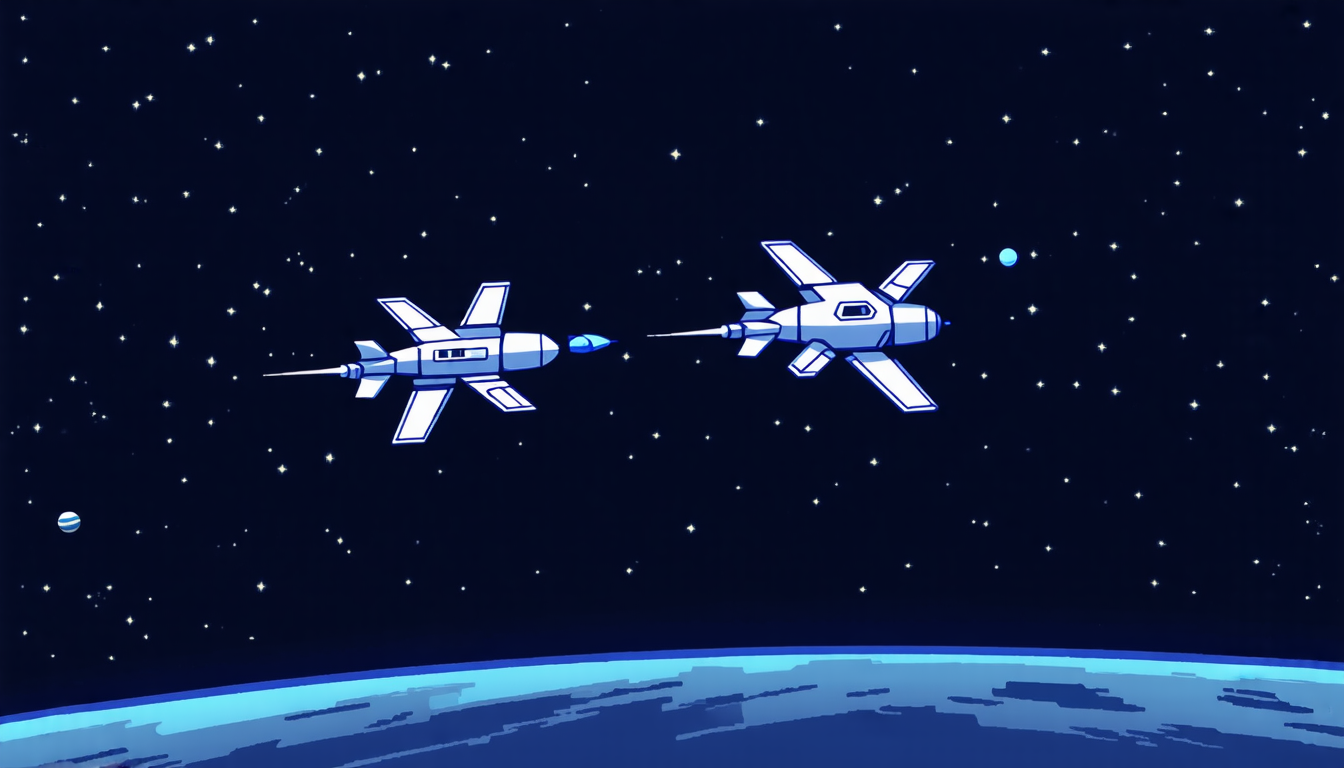
The team also created animations to visualize their approach, showing how the system navigates complex scenarios and keeps satellites safe. The animations demonstrate the potential for this method to be used in real-world satellite servicing missions, such as repairing or refueling satellites that are no longer functioning properly.
The development of this new approach has significant implications for the space industry. It could enable more efficient and reliable satellite servicing, reducing the need for manual intervention and minimizing the risk of collisions. This could lead to a greater number of satellites being maintained and repaired in orbit, extending their lifespan and increasing our ability to collect data from space.
The researchers’ work also highlights the potential for CBFs and DCOL to be used in other areas of robotics and automation. These mathematical formulas can be applied to a wide range of situations where safety is critical, such as autonomous vehicles or industrial robots.
Overall, this new approach demonstrates the power of combining advanced mathematics with simulation and animation to develop innovative solutions for complex problems. As space exploration continues to push the boundaries of what is possible, methods like this could play a crucial role in ensuring the safe and efficient operation of satellites in orbit.
Cite this article: “Safe Satellite Relocation through Hybrid Control Barrier Functions and Differential Collision Detection”, The Science Archive, 2025.
Satellites, Relocation, Space, Control Barrier Functions, Differential Collision Detection, Simulation, Animation, Satellite Servicing, Robotics, Automation





