

Tuesday 25 March 2025
A team of astronomers has made a remarkable discovery about the early universe, shedding new light on how galaxies formed and evolved over billions of years.
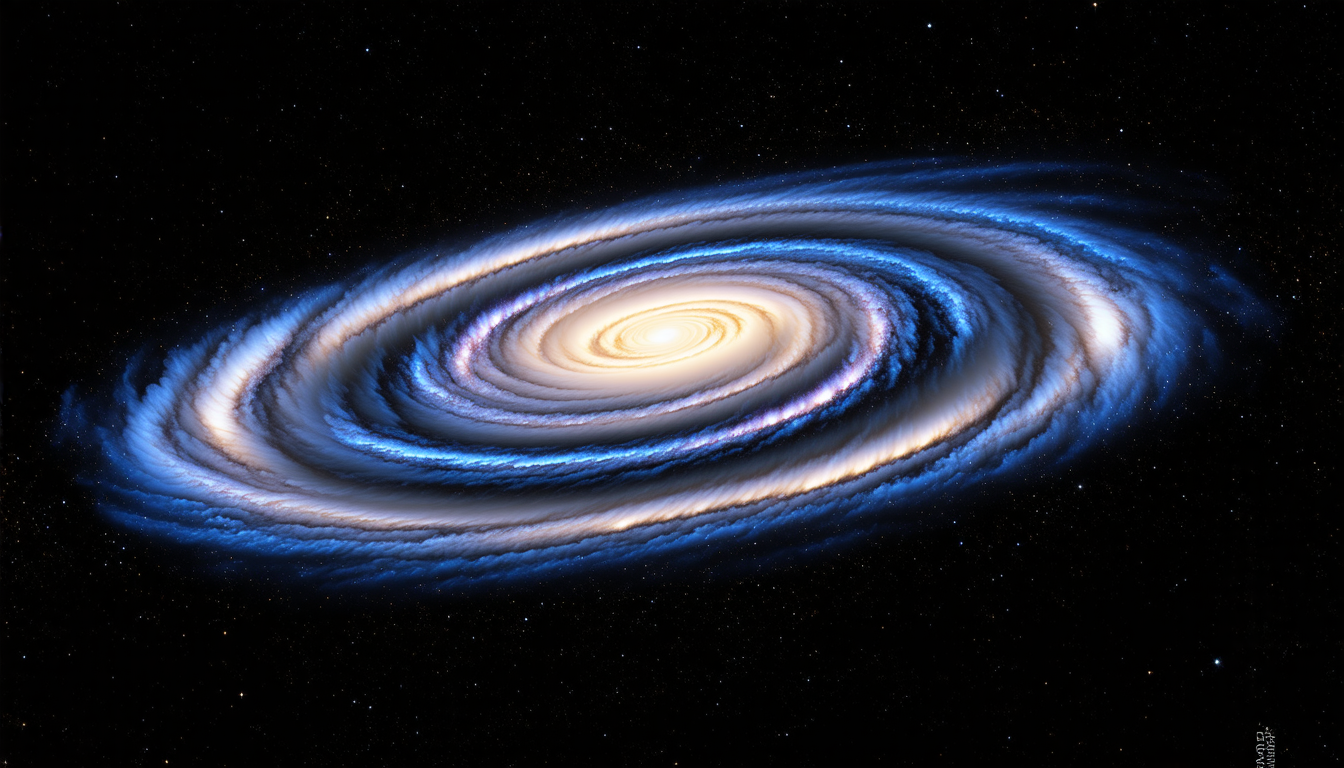
In a distant corner of the cosmos, there’s a galaxy called W2246-0526 that’s been hiding secrets from us for eons. Located 12 billion light-years away, this galaxy is a hotbed of activity, with stars and gas swirling together in a cosmic dance. By studying the dust within this galaxy, scientists have gained insight into its inner workings.
Using the powerful Atacama Large Millimeter/submillimeter Array (ALMA) telescope, researchers were able to observe the galaxy’s dust emissions across multiple wavelengths. The data revealed that W2246-0526 is a hot dust-obscured galaxy, meaning it’s shrouded in a thick veil of warm dust that blocks our view.
As they delved deeper into the data, scientists discovered that this galaxy is in the midst of a massive merger with other galaxies. The resulting chaos has created a complex web of gas and dust that’s being heated by the intense radiation from newly formed stars.
The most striking finding was the detection of hot dust temperatures reaching as high as 110 Kelvin (or -163°C) within the galaxy. This is much hotter than the typical temperatures found in other galaxies, suggesting that the quasar at its center is playing a significant role in heating up the surrounding dust.
The team also observed that the dust temperature decreases with distance from the quasar, indicating that the heat emanating from the central region is responsible for warming the surrounding material. This finding has significant implications for our understanding of galaxy evolution and the role of quasars in shaping their environments.
Furthermore, the study revealed that W2246-0526 is likely to be a hyper-luminous galaxy, meaning it’s emitting an enormous amount of energy from its core. This could be due to the intense activity of the quasar or the merger itself.
The discovery of W2246-0526 provides a unique opportunity for scientists to study the early universe in unprecedented detail. By analyzing the properties of this galaxy, researchers can gain insights into the formation and evolution of galaxies during the first few billion years after the Big Bang.
The findings from ALMA’s observations have opened doors to new avenues of research, allowing scientists to better understand how galaxies grew and changed over time. This knowledge will ultimately help us unravel the mysteries of the universe and our place within it.
Cite this article: “Unveiling the Secrets of the Early Universe: The Discovery of W2246-0526”, The Science Archive, 2025.
Galaxies, Universe, Formation, Evolution, Alma, Quasars, Dust, Temperature, Mergers, Cosmology





