

Tuesday 25 March 2025
Scientists have made a significant breakthrough in understanding how to create ultra-fast charge separation on the nanoscale, potentially paving the way for the development of new technologies such as petahertz switching.
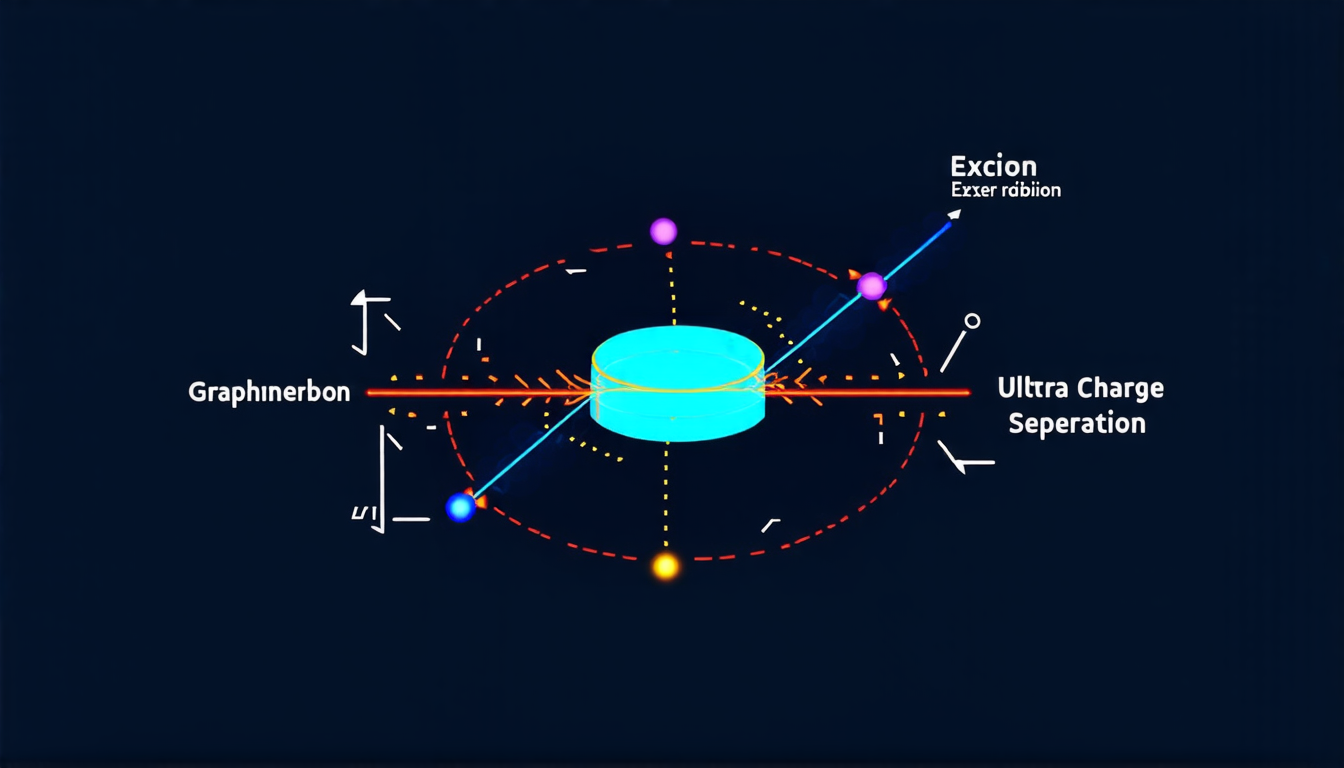
By using a spatially uniform laser pulse, researchers were able to excite targeted areas of small graphene nanoribbon heterostructures and induce strongly localized carrier excitations. This led to the formation of excitons, which are tightly bound pairs of electrons and holes that can be used to store information.
The team used a combination of theoretical modeling and simulations to understand the underlying mechanisms behind this phenomenon. They found that the existence of pronounced space-dependent density of states with isolated states in finite graphene clusters was crucial for achieving charge separation on such a small scale.
One of the key findings was that the dominant fraction of localized electrons were bound in excitons, which is significant because it allows for optical coupling and information storage. The researchers also discovered that the charge separation persisted for at least 30 femtoseconds, which is an incredibly short period of time.
The ability to control charge separation on such a small scale could have significant implications for the development of new technologies. For example, it could be used to create ultra-fast switching devices that could revolutionize fields such as computing and communication.
The researchers also explored the role of surface screening in their simulations, finding that it played an important role in determining the behavior of the charge separation. This is important because it highlights the need for careful consideration of the substrate material and its interactions with the graphene nanoribbons.
The study’s findings have significant implications for our understanding of the behavior of electrons at the nanoscale. By better understanding how to control and manipulate charge separation, researchers can develop new materials and technologies that could have a major impact on fields such as computing, energy storage and generation, and more.
One of the most exciting aspects of this research is its potential to enable the development of petahertz switching devices. These devices would be capable of processing information at incredibly high speeds, potentially revolutionizing fields such as computing and communication.
The researchers are now working to further explore the properties of these excitons and how they can be used to develop new technologies. This includes studying their behavior under different conditions and exploring ways to manipulate them for specific applications.
Overall, this research has significant implications for our understanding of the behavior of electrons at the nanoscale and could potentially lead to the development of new technologies with significant impacts on a wide range of fields.
Cite this article: “Unlocking Ultra-Fast Charge Separation at the Nanoscale”, The Science Archive, 2025.
Graphene, Nanoribbons, Charge Separation, Ultra-Fast Switching, Petahertz, Excitons, Density Of States, Carrier Excitations, Spatially Uniform Laser Pulse, Nanoscale.





