

Tuesday 25 March 2025
A fascinating study has recently been published, delving into the world of ecological oscillators and their behavior on dynamically rewired small-world networks. For those unfamiliar with these terms, ecological oscillators are mathematical models that mimic the cycles of population growth and decline found in natural ecosystems. Small-world networks, on the other hand, are a type of network where most nodes are connected to their immediate neighbors, but a few long-range connections exist to facilitate communication between distant parts of the network.
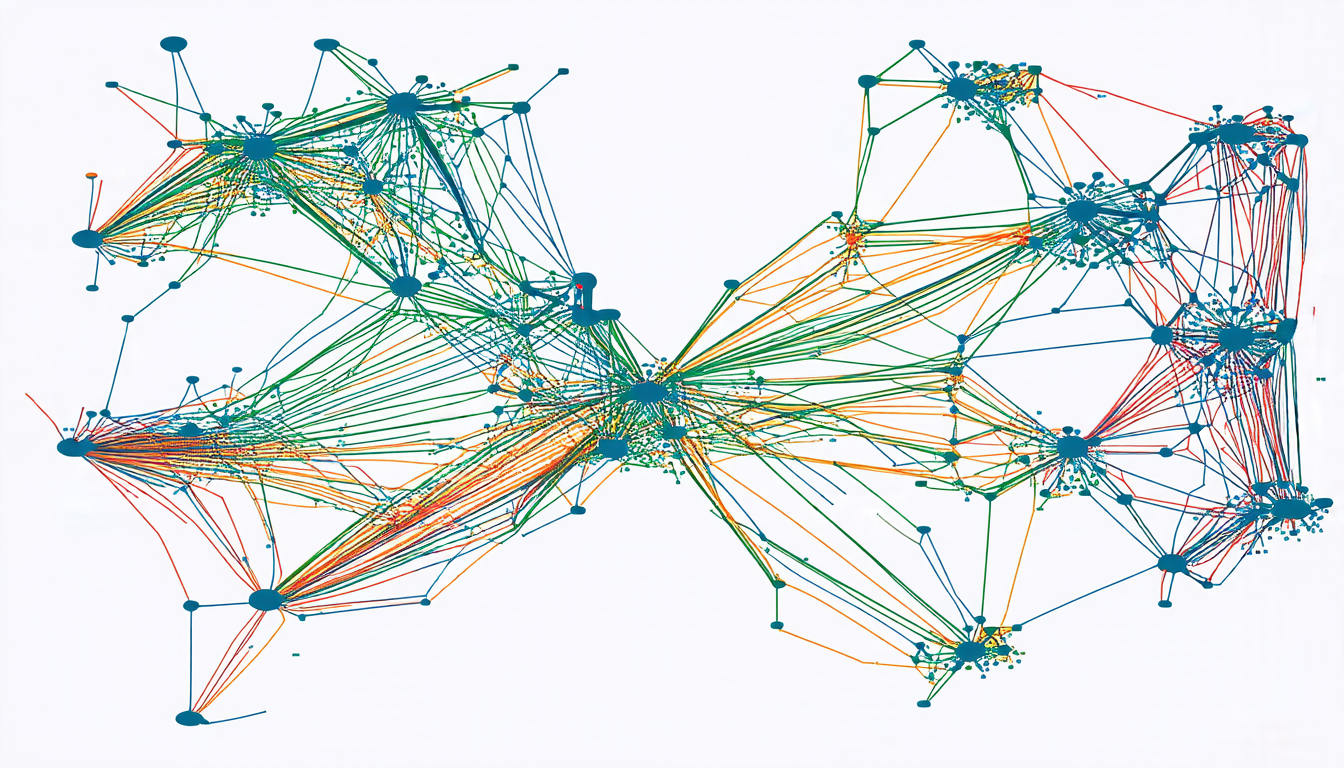
The researchers behind this study used a combination of these concepts to create a complex system that exhibits fascinating behavior. They started by creating an ecological oscillator model, which consists of coupled populations with a two-cycle dynamics. This means that each population oscillates between high and low levels every two generations. The researchers then introduced a small-world network structure into the system, where each node represents a population, and edges represent interactions between them.
The team found that when they rewired the connections in the network, introducing occasional long-range interactions between distant populations, the system exhibited a phase transition from disordered to ordered behavior. In other words, the oscillations of the populations became synchronized across the network, with all populations reaching high levels at the same time and then declining together.
This phenomenon is significant because it suggests that even in systems where most interactions are local, occasional long-range connections can have a profound impact on the overall behavior of the system. This has important implications for our understanding of how ecosystems function and how they respond to changes such as climate change or habitat destruction.
The researchers also explored the properties of this phase transition, finding that it falls into the mean-field universality class. In simple terms, this means that the critical point at which the phase transition occurs is characterized by a power-law behavior in the correlation length, which is a measure of how far apart the synchronized populations are.
One of the most interesting aspects of this study is its potential applications to real-world ecosystems. The researchers suggest that their findings could be used to improve our understanding and management of ecological systems, particularly in cases where populations are fragmented or isolated from one another.
The use of dynamically rewired small-world networks also opens up new avenues for research into complex systems and network science. By studying how these systems respond to changes in the network structure, researchers can gain a better understanding of how to design and optimize complex systems for maximum efficiency and resilience.
Cite this article: “Synchronizing Ecological Oscillators on Dynamically Rewired Networks”, The Science Archive, 2025.
Ecological Oscillators, Small-World Networks, Network Science, Complex Systems, Phase Transitions, Synchronization, Population Dynamics, Ecosystem Behavior, Climate Change, Habitat Destruction.





