

Tuesday 25 March 2025
A recent breakthrough in artificial intelligence has shed new light on the capabilities of large language models. Researchers have developed a novel mechanism, dubbed Synaptic Resonance, which enhances the ability of these models to maintain coherence and contextual relevance across extended interactions.
Large language models are trained on vast amounts of text data, allowing them to generate human-like responses to questions and prompts. However, they often struggle with long-range dependencies, where the model’s understanding of a context is lost as it processes subsequent tokens in the sequence. This limitation can lead to coherence fragmentation, where the output becomes disjointed and lacks consistency.
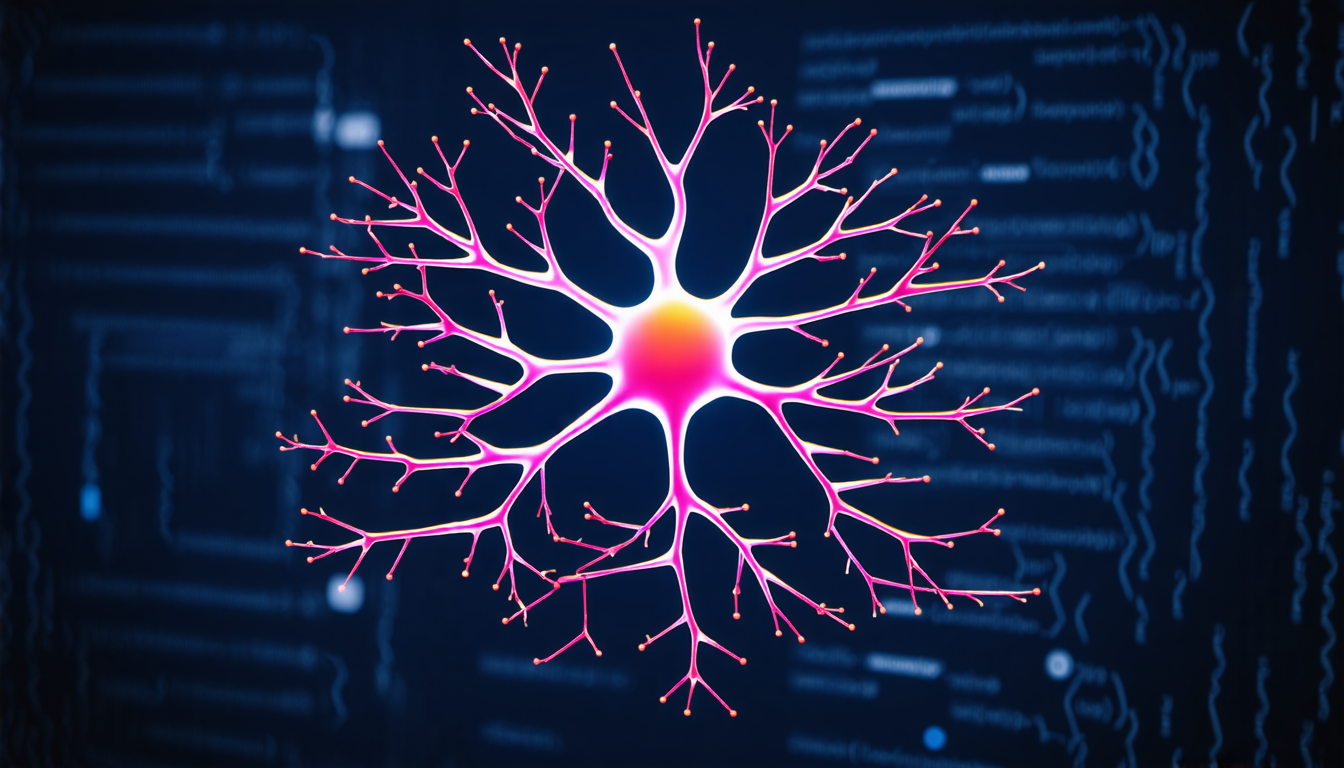
Synaptic Resonance addresses this issue by introducing a dynamic reinforcement mechanism that adjusts the strength of internal connections within the model based on contextual relevance. The approach draws inspiration from neurobiological principles, where synaptic plasticity enables neurons to adapt and strengthen their connections in response to repeated activation patterns.
In essence, Synaptic Resonance allows the large language model to learn from its own mistakes, reinforcing pathways that lead to coherent outputs while discarding those that do not. This adaptive process enables the model to retain contextual information more effectively, even as it processes extended sequences of tokens.
Experimental results demonstrate significant improvements in long-range dependency modeling, with reduced perplexity and increased accuracy in coherence-sensitive tasks. The mechanism also exhibits robustness to noisy input data, a critical aspect for real-world applications where imperfect data is common.
The implications of Synaptic Resonance extend beyond immediate performance gains, offering a foundation for more human-like memory systems in artificial intelligence. As the field continues to evolve, this breakthrough has the potential to revolutionize our understanding of context-dependent processing and its applications in natural language generation.
In practical terms, Synaptic Resonance could enable more accurate and consistent summaries, improved dialogue generation, and enhanced machine translation capabilities. The mechanism’s ability to mitigate coherence fragmentation also opens up new possibilities for information retrieval and knowledge integration tasks.
While the potential benefits are substantial, further research is needed to fully understand the mechanisms underlying Synaptic Resonance and its limitations. Nevertheless, this breakthrough represents a significant step forward in our quest to develop more sophisticated artificial intelligence models that can learn, reason, and interact with humans in a more human-like manner.
Cite this article: “Unlocking Coherent Contextual Understanding with Synaptic Resonance”, The Science Archive, 2025.
Artificial Intelligence, Large Language Models, Synaptic Resonance, Contextual Relevance, Coherence Fragmentation, Neural Networks, Natural Language Generation, Machine Learning, Information Retrieval, Knowledge Integration.





