

Tuesday 25 March 2025
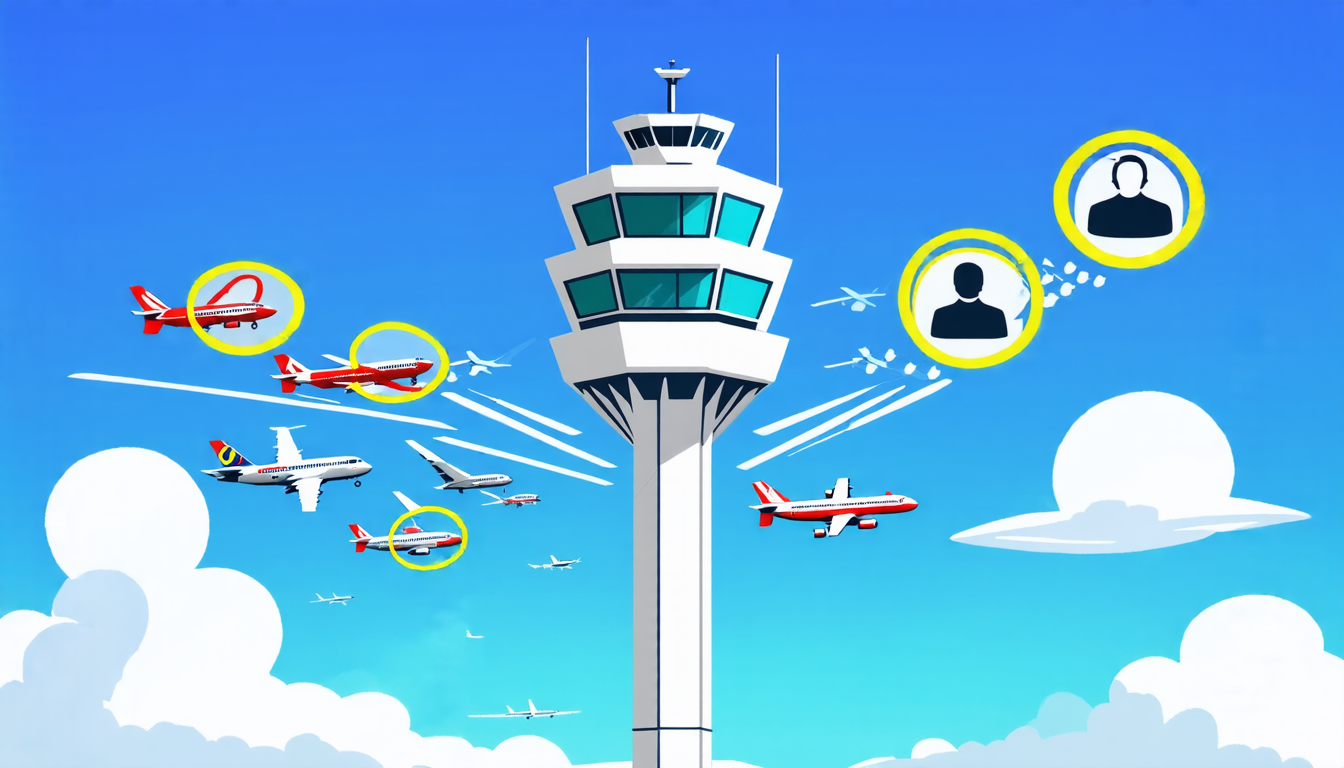
Air traffic control is a complex and critical job that requires controllers to make quick decisions in high-pressure situations. But what goes through their minds when they’re juggling multiple aircraft at once? A team of researchers has been working on developing a machine learning-based framework to explain air traffic situations, and the results are fascinating.
The framework uses a multi-agent trajectory model that captures both individual aircraft behavior and interaction patterns between them. Think of it like trying to understand how a bunch of cars move through an intersection – each car has its own path, but they’re all interacting with each other in complex ways. The researchers used actual air traffic surveillance data from the terminal airspace surrounding Incheon International Airport in South Korea to train their model.
The goal is to identify which aircraft are most influential in a given situation and why. By analyzing the interactions between planes, the framework can provide insights into how air traffic controllers make decisions. For example, if an aircraft is approaching for landing, the controller might need to adjust the trajectory of other planes in the area to ensure safe separation.
The researchers chose to focus on explaining air traffic situations from a single aircraft’s perspective, but they also developed a way to view the situation from a specific location in airspace. This allows them to see how multiple aircraft are interacting with each other and with the controller.
One fascinating aspect of this research is its ability to identify changes in traffic flow by visualizing shifts in attention scores. These scores represent the degree to which one aircraft is paying attention to another, and they can reveal important information about how controllers prioritize their decisions. For instance, if an aircraft is diverting from its planned path, the controller might need to re-route other planes to accommodate the change.
The framework has already demonstrated its effectiveness in explaining dynamic air traffic scenarios, and it has the potential to help controllers make more informed decisions. By better understanding how they interact with each other and with their environment, controllers can respond more quickly and effectively to changing situations. This could ultimately lead to safer and more efficient air travel.
The researchers are planning to take this work further by exploring ways to uncover the complex decision-making patterns of air traffic controllers. This could involve developing models that mimic controller behavior or analyzing large datasets to identify trends and correlations. The ultimate goal is to create a system that can anticipate and respond to changing air traffic conditions, making it easier for controllers to manage the skies.
Cite this article: “Deciphering Air Traffic Control: A Machine Learning Framework Reveals Decision-Making Secrets”, The Science Archive, 2025.
Air Traffic Control, Machine Learning, Aircraft Trajectory, Airspace, Multi-Agent Model, Decision-Making, Controller Behavior, Traffic Flow, Attention Scores, Air Travel Efficiency
Reference: Hong-ah Chai, Seokbin Yoon, Keumjin Lee, “Learning to Explain Air Traffic Situation” (2025).





