

Wednesday 26 March 2025
For decades, roboticists have been working towards creating humanoid robots that can move and behave like humans. One of the biggest challenges in achieving this is getting these robots to safely recover from falls. Humans have a remarkable ability to get up from a prone position without hurting themselves, but current robots are not as agile or adaptable.
A team of researchers has made significant progress in solving this problem by developing an AI-powered system that enables humanoid robots to learn how to get up from various situations, including lying face-up and face-down, on different types of terrain. The system, called HUMANUP, uses a two-stage learning approach to train the robot’s movements.
In the first stage, the system generates a wide range of possible motions for the robot to try out in simulation. This is done by applying random perturbations to the robot’s joints and control parameters, allowing it to discover new ways to move that might not have been considered before. The system then rewards or penalizes the robot based on its performance, encouraging it to adapt and refine its movements.
Once the robot has learned a set of basic motions in simulation, it is deployed in real-world environments to further fine-tune its skills. This second stage of training involves gradually introducing more realistic scenarios, such as rough terrain and varied lighting conditions, to help the robot generalize its learning.
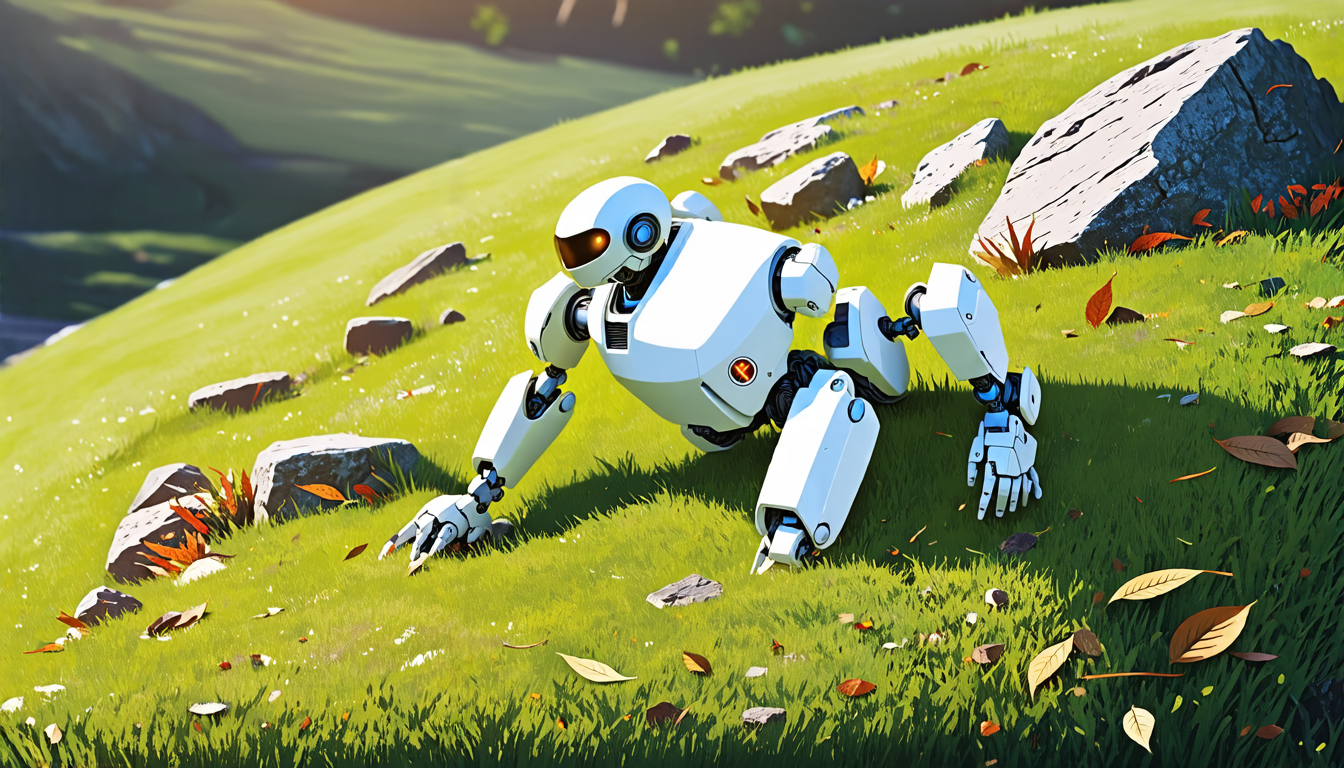
The results are impressive: HUMANUP-enabled robots can get up from a prone position on flat surfaces, slopes, and even slippery surfaces with ease. They can also adjust their movements to accommodate different types of falls, such as rolling over or getting up quickly after a sudden drop.
What’s more, the system is designed to be highly adaptable, allowing it to learn from its mistakes and adapt to new situations. This means that if a robot encounters an unexpected obstacle or terrain feature during training, it can adjust its movements on the fly to avoid injury or damage.
The potential applications of HUMANUP are vast. Imagine deploying humanoid robots in search and rescue missions, where they could navigate challenging environments and recover from falls without putting themselves or others at risk. Or picture a robot assistant that can safely get up after tripping or falling, reducing the need for human intervention and minimizing the risk of injury.
The development of HUMANUP is an important step towards creating more autonomous and versatile humanoid robots.
Cite this article: “Robotics Breakthrough: AI-Powered System Enables Humanoid Robots to Safely Recover from Falls”, The Science Archive, 2025.
Robotics, Humanoid Robots, Ai-Powered System, Humanup, Learning Approach, Simulation, Real-World Environments, Adaptability, Search And Rescue Missions, Autonomous Robots





