

Wednesday 26 March 2025
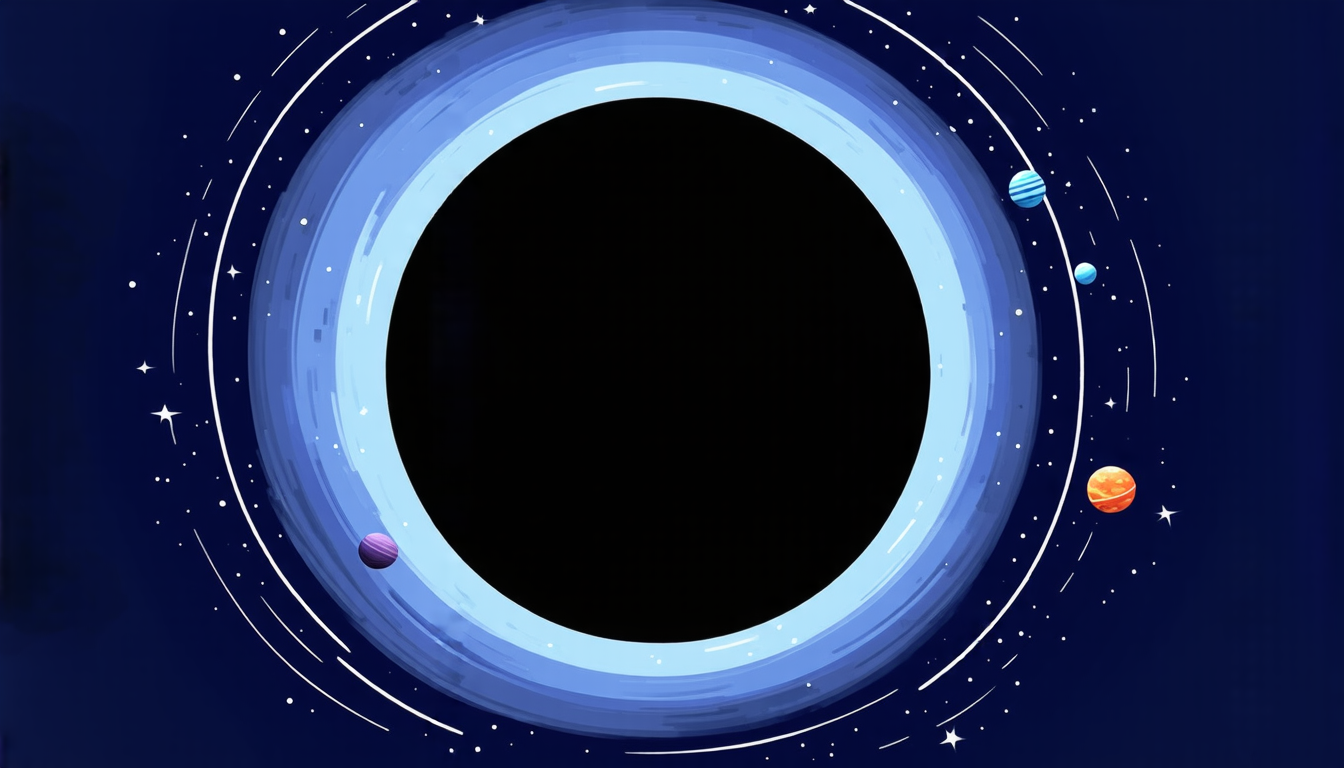
For decades, physicists have been fascinated by the mysteries of black holes. These cosmic phenomena are characterized by their incredibly strong gravitational pull, which warps space and time around them. One of the most intriguing aspects of black holes is the way they affect the motion of objects near them.
Researchers have long known that circular orbits around a black hole can be either co-rotating or counter-rotating. However, it was thought that these orbits were limited to a specific range of distances from the black hole’s event horizon – the point of no return beyond which anything that enters cannot escape. But what if there are actually smaller orbits possible?
A new study suggests that this might be the case. Using advanced mathematical techniques, scientists have discovered a lower bound on the radii of circular orbits around an extremal Kerr black hole – a type of black hole with zero electric charge and maximum rotation.
The researchers found that these orbits are restricted to a region outside the event horizon, but surprisingly, they can be much closer than previously thought. In fact, the study reveals that there is a non-trivial lower bound on the radii of circular orbits, which depends on the mass ratio between the black hole and the orbiting particle.
This discovery has significant implications for our understanding of black holes and their behavior in extreme environments. For example, it could help us better understand how matter behaves near the event horizon, where the gravitational pull is so strong that not even light can escape.
The study also highlights the importance of the Thorne hoop conjecture – a hypothesis proposed by physicist Kip S. Thorne in the 1970s. The conjecture suggests that any object with mass and energy will be engulfed by an event horizon if it is placed inside a ring whose circumference is less than or equal to four times its total energy.
The new research provides evidence for this conjecture, showing that circular orbits around an extremal Kerr black hole are indeed restricted to a region where the Thorne hoop condition is satisfied. This finding has important implications for our understanding of the behavior of matter in extreme environments and could help us better understand the properties of black holes.
Overall, this study sheds new light on the mysteries of black holes and their behavior near the event horizon. By exploring these cosmic phenomena, scientists can gain a deeper understanding of the fundamental laws of physics that govern our universe.
Cite this article: “Unveiling the Secrets of Black Hole Orbits”, The Science Archive, 2025.
Black Holes, Gravity, Orbits, Event Horizon, Extremal Kerr Black Hole, Thorne Hoop Conjecture, Circular Motion, Mass Ratio, Energy, Physics





