

Wednesday 26 March 2025
The math behind curves and cycles has just gotten a whole lot more interesting. Researchers have made significant strides in understanding the intricacies of double ramification loci, a concept that’s been puzzling mathematicians for decades.
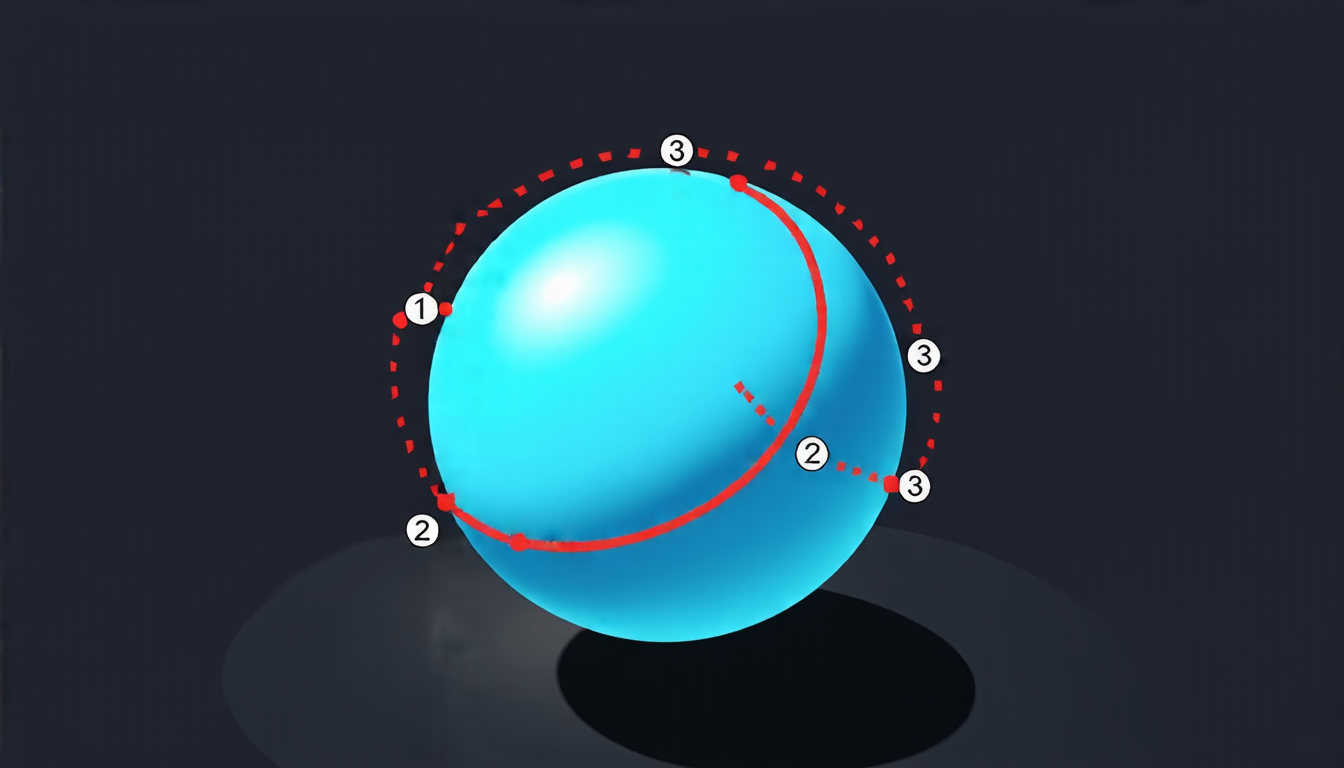
For those who aren’t familiar, double ramification loci are a type of mathematical object that describes how curves and surfaces intersect. Think of it like trying to draw a circle on a sphere – you’ll get multiple intersection points where the curve meets the surface. The problem is, these intersections can be really tricky to work with, especially when dealing with higher-dimensional objects.
The new research focuses on the orbifold Euler characteristics of double ramification loci in genus one, which is essentially the math behind how curves and cycles interact in two-dimensional spaces. By cracking this nut, researchers hope to gain a better understanding of the underlying geometry and topology of these complex mathematical structures.
One of the key breakthroughs comes from Luca Battistella and Navid Nabijou, who have developed a closed formula for calculating the orbifold Euler characteristics of higher rank double ramification loci. This is no small feat – it’s like trying to solve a puzzle with thousands of pieces that all need to fit together just right.
The math behind this achievement involves some seriously advanced concepts, including modular forms and symplectic geometry. But basically, Battistella and Nabijou have found a way to simplify the process of calculating these orbifold Euler characteristics by breaking it down into smaller, more manageable parts.
This might seem like abstract math-y stuff, but the implications are significant for fields like algebraic geometry and number theory. By better understanding how curves and cycles interact, researchers can gain insights into some of the most fundamental properties of mathematics itself – things like symmetry and structure that underlie all sorts of complex systems.
The work also has potential applications in areas like cryptography and computer science, where secure data transmission relies on complex mathematical algorithms. So, while this research might not have immediate practical uses, it’s laying the groundwork for future breakthroughs that could have real-world impact.
In short, Battistella and Nabijou’s achievement is a major milestone in the ongoing quest to understand the intricacies of double ramification loci. By cracking open the math behind these complex objects, they’re helping to pave the way for new discoveries and innovations that will shape the future of mathematics and beyond.
Cite this article: “Breaking New Ground in Double Ramification Loci Research”, The Science Archive, 2025.
Mathematics, Geometry, Topology, Curves, Cycles, Algebraic Geometry, Number Theory, Modular Forms, Symplectic Geometry, Cryptography





