

Wednesday 26 March 2025
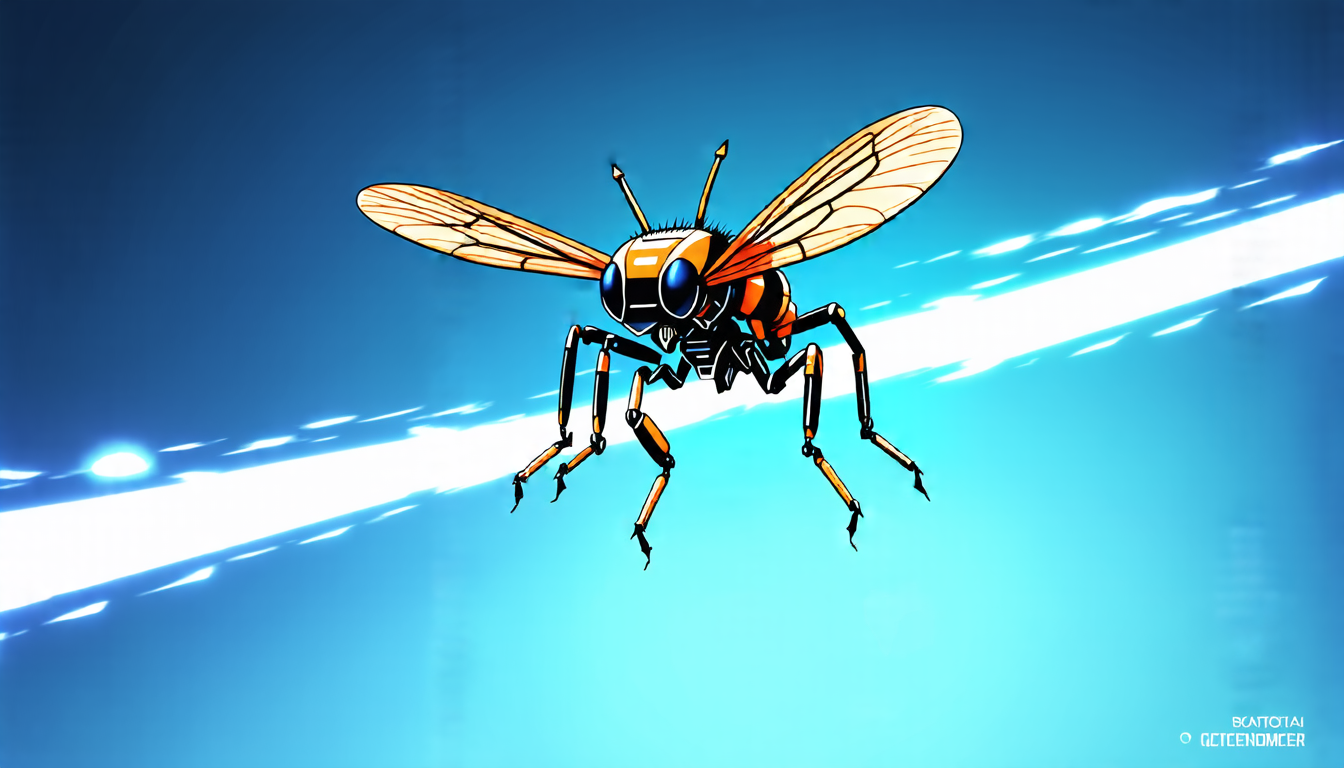
A team of researchers has made a significant breakthrough in the field of robotics, developing a deep reinforcement learning-based controller that enables insect-scale aerial robots to fly stably and autonomously for extended periods of time.
The controller, which is designed specifically for soft-actuated robots, uses a combination of behavior cloning and proximal policy optimization to learn optimal control policies from expert demonstrations. This approach allows the robot to adapt to changing environmental conditions and uncertainties, making it more robust and reliable in real-world scenarios.
In simulations, the controller was able to improve the mean reward by 75% compared to baseline behavior cloning methods, and further fine-tuning with proximal policy optimization led to a 62% increase in performance. The team also deployed the controller on two distinct soft-actuated robots, achieving successful hovering flights of up to 50 seconds.
One of the key challenges in developing this technology is the need to bridge the simulation-to-reality gap. Soft-actuated robots are highly sensitive to environmental conditions and uncertainties, making it difficult to translate simulated results directly to real-world applications. The team’s approach addresses this challenge by incorporating domain-randomized expert demonstrations during behavior cloning, which allows the robot to learn from a diverse range of scenarios.
The controller’s ability to adapt to changing environmental conditions is also a major advantage in real-world applications. Unlike traditional model-based control methods, which rely on accurate predictions of system dynamics, the deep reinforcement learning-based controller can adjust its policy based on real-time feedback and observations.
This technology has significant implications for the development of autonomous aerial robots, particularly those designed for search-and-rescue missions or environmental monitoring. Soft-actuated robots offer several advantages over traditional rigid-wing designs, including increased agility and maneuverability, as well as improved resistance to collisions and damage.
In addition to its potential applications in robotics, this technology also has implications for the broader field of artificial intelligence. The ability to learn complex control policies from expert demonstrations and adapt to changing environments is a key area of research in AI, with significant potential for application in areas such as autonomous vehicles, healthcare, and finance.
Overall, this breakthrough represents a major step forward in the development of autonomous aerial robots, and has significant implications for the broader field of artificial intelligence.
Cite this article: “Autonomous Insect-Scale Aerial Robots Take Flight with Deep Reinforcement Learning Controller”, The Science Archive, 2025.
Robotics, Deep Reinforcement Learning, Autonomous Aerial Robots, Soft-Actuated Robots, Behavior Cloning, Proximal Policy Optimization, Simulation-To-Reality Gap, Domain-Randomized Expert Demonstrations, Artificial Intelligence, Control Policies





