

Wednesday 26 March 2025
Researchers have been working on a new type of computer architecture that’s specifically designed for handling irregular workloads, like those found in machine learning and data analytics. These types of workloads are notoriously difficult to optimize because they often involve sparse or irregular patterns, which can lead to poor performance.
The problem is that traditional computing architectures aren’t well-suited for these kinds of tasks. They’re designed to handle dense, regular patterns, and as a result, they tend to waste resources on unnecessary calculations. This can lead to slow performance and high energy consumption.
To address this issue, researchers have been exploring new types of computer architecture that are specifically designed for irregular workloads. One promising approach is the use of reconfigurable architectures, which allow the computing hardware to adapt to changing patterns in real-time.
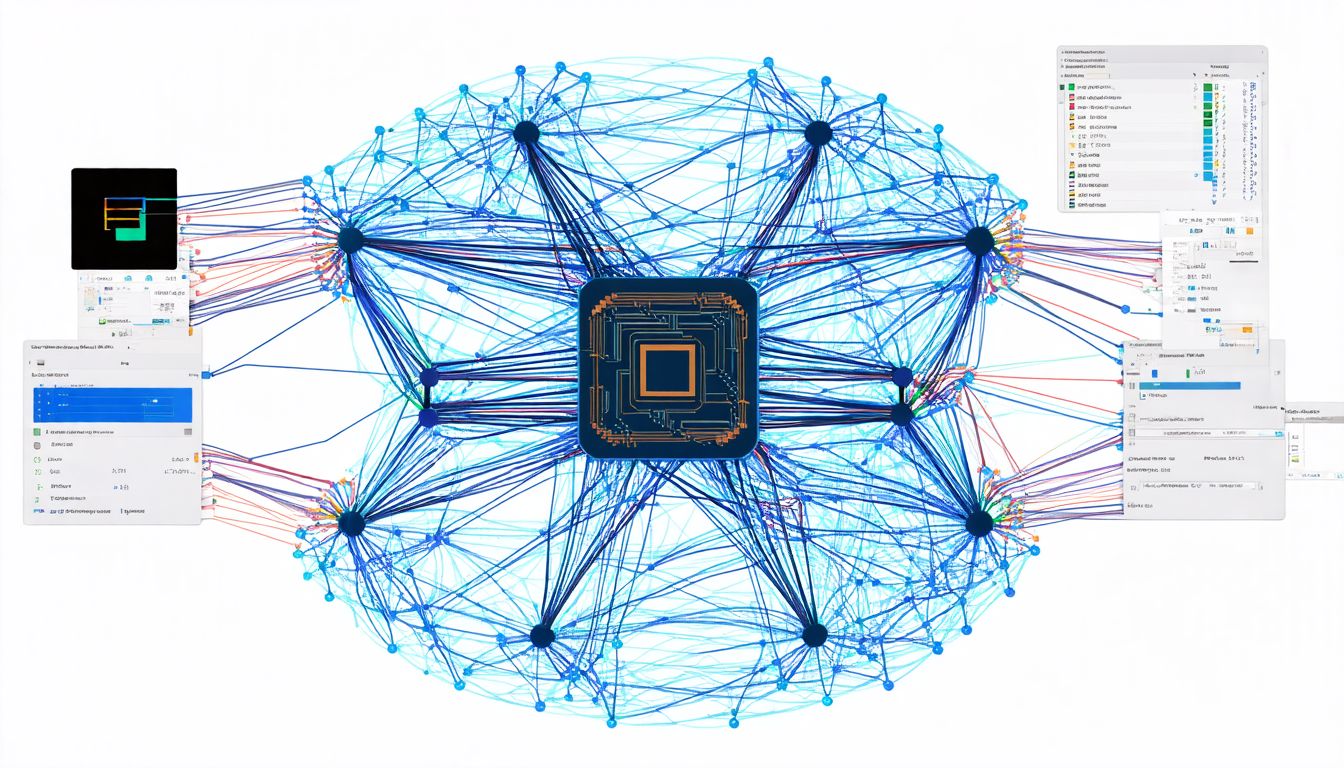
The Nexus Machine is a recent example of this type of architecture. It’s a novel reconfigurable architecture that’s designed to efficiently handle irregular workloads by distributing sparse tensors across its fabric and employing active messages that morph instructions based on dynamic control flow.
In traditional computing architectures, each processing element (PE) is responsible for executing a specific set of instructions. However, in the Nexus Machine, PEs can dynamically reconfigure themselves to execute different sets of instructions depending on the workload. This allows the architecture to adapt to changing patterns and optimize performance accordingly.
The Nexus Machine also employs an innovative approach to data movement, using a combination of spatial and temporal locality to minimize data transfer between PEs. This reduces energy consumption and improves overall performance.
To test the effectiveness of the Nexus Machine, researchers implemented it on a range of irregular workloads, including sparse linear algebra and graph analytics. The results were impressive: the Nexus Machine achieved an average performance gain of 1.5x compared to state-of-the-art reconfigurable architectures, while also reducing power consumption by 20%.
The implications of this research are significant. As more and more applications rely on machine learning and data analytics, there’s a growing need for computing architectures that can efficiently handle irregular workloads. The Nexus Machine represents an important step towards meeting this need, offering a promising solution for accelerating these types of workloads in the future.
In addition to its performance benefits, the Nexus Machine also has potential applications in fields such as artificial intelligence and natural language processing, where sparse or irregular patterns are common.
Cite this article: “Reconfigurable Architecture Breakthrough for Efficient Handling of Irregular Workloads”, The Science Archive, 2025.
Computer Architecture, Machine Learning, Data Analytics, Reconfigurable Architectures, Irregular Workloads, Sparse Tensors, Active Messages, Dynamic Control Flow, Power Consumption, Performance Optimization





