

Wednesday 26 March 2025
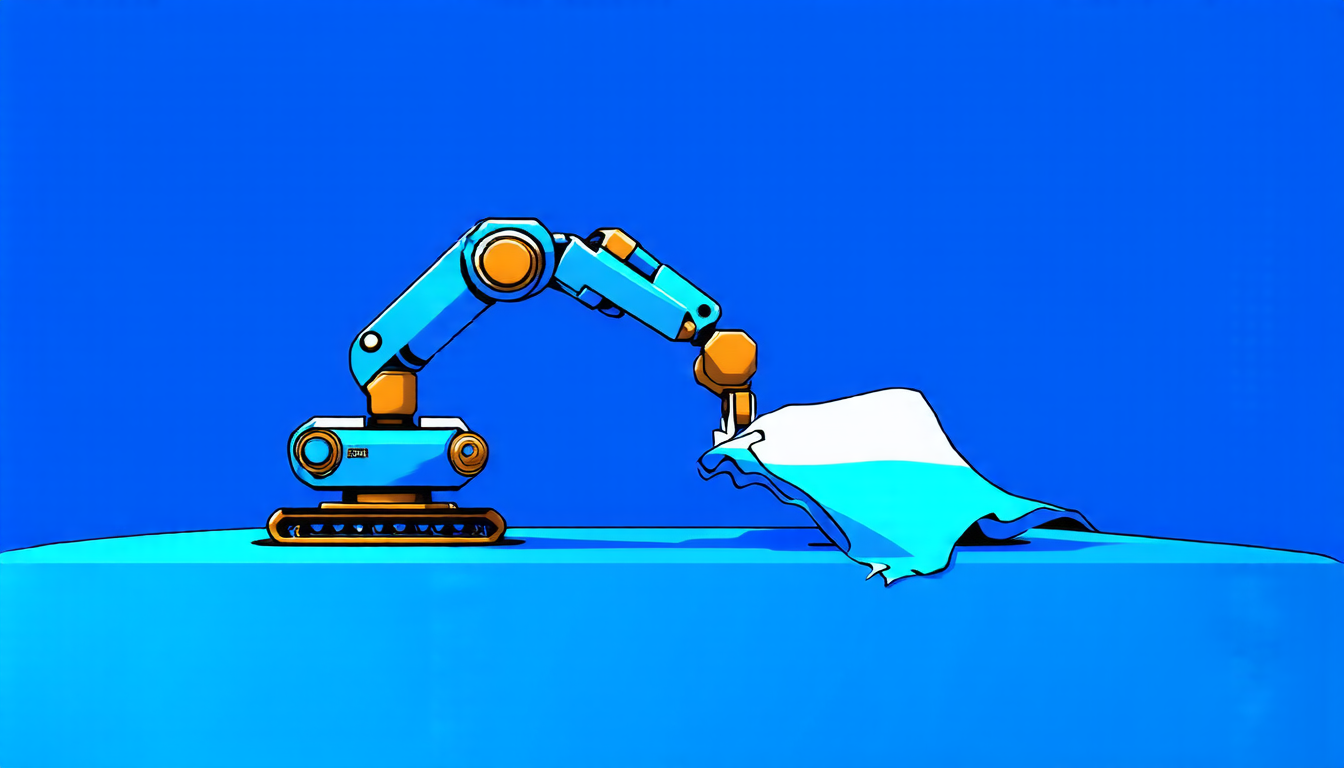
Researchers have made significant progress in developing a robotic system that can effectively wipe surfaces, such as tables or car surfaces, using reinforcement learning and visual-language models. The system, designed to work on various types of surfaces, including those with different curvatures and textures, has shown impressive results in simulations.
The team’s approach combines two key innovations: a bounded reward formulation and a visual-language model-based curriculum learning method. The former allows the system to learn more efficiently by providing a clear goal for the robot to achieve, while the latter enables it to adapt to new situations and improve its performance over time.
In traditional reinforcement learning approaches, the robot is rewarded for completing tasks quickly and accurately. However, this can lead to suboptimal behavior if the rewards are not well-defined or if the environment is complex. The bounded reward formulation addresses this issue by providing a clear goal for the robot to achieve, such as wiping a specific surface area.
The visual-language model-based curriculum learning method takes it a step further by incorporating human-like language understanding and generation capabilities into the system. This allows the robot to learn from natural language instructions and adapt its behavior accordingly.
In simulations, the robotic system was able to successfully wipe surfaces with different curvatures and textures, including those with varying levels of friction. The results show that the system is able to learn quickly and adapt to new situations, making it a promising approach for real-world applications.
One of the key advantages of this approach is its ability to generalize well across different environments and tasks. This means that the robot can be trained on one type of surface or task and then apply what it has learned to other similar scenarios.
The potential applications of this technology are vast, from industrial manufacturing to healthcare settings where surfaces need to be cleaned effectively and efficiently. The system’s ability to learn quickly and adapt to new situations makes it well-suited for use in a wide range of environments.
Overall, the combination of bounded reward formulation and visual-language model-based curriculum learning has led to significant advancements in robotic surface wiping. With further development, this technology could have a major impact on industries that rely heavily on surface cleaning and manipulation tasks.
Cite this article: “Robotic Surface Wiping System Demonstrates Improved Efficiency and Adaptability”, The Science Archive, 2025.
Robotics, Reinforcement Learning, Visual-Language Models, Surface Wiping, Bounded Reward Formulation, Curriculum Learning, Natural Language Instructions, Industrial Manufacturing, Healthcare Settings, Efficient Cleaning.





