

Wednesday 26 March 2025
Seismologists have long struggled to extract meaningful information from short-aperture seismic recordings, where the distance between sensors is less than half a wavelength of the signal being recorded. This limitation has forced researchers to rely on longer arrays or more complex processing techniques, both of which can be time-consuming and costly.
Now, however, scientists have developed a new approach that allows them to effectively extend the width of their recording arrays, effectively doubling the amount of data they can collect from a single seismic event. By using a technique called data-driven extrapolation, researchers can take the existing short-aperture recordings and use them to generate synthetic data that fills in the gaps between sensors.
The process begins by analyzing the recorded seismic signals and identifying the characteristic time-shifts between adjacent sensors. These time-shifts are then used to create virtual data points that mimic the signal as it propagates across the extended array. By concatenating this virtual data with the original recordings, researchers can effectively double the width of their arrays, allowing them to extract more accurate information about the seismic event.
One key advantage of this approach is its simplicity and speed. Unlike traditional methods, which require complex processing algorithms or longer recording arrays, data-driven extrapolation can be applied quickly and easily to existing datasets. This makes it an attractive option for researchers working with limited resources or tight deadlines.
The technique has already been tested on real-world seismic data, including recordings from a Falcon 9 rocket launch and synthetic data generated using a geophone configuration at Vandenberg Space Force Base. In each case, the results have demonstrated significant improvements in the accuracy and reliability of the extracted information.
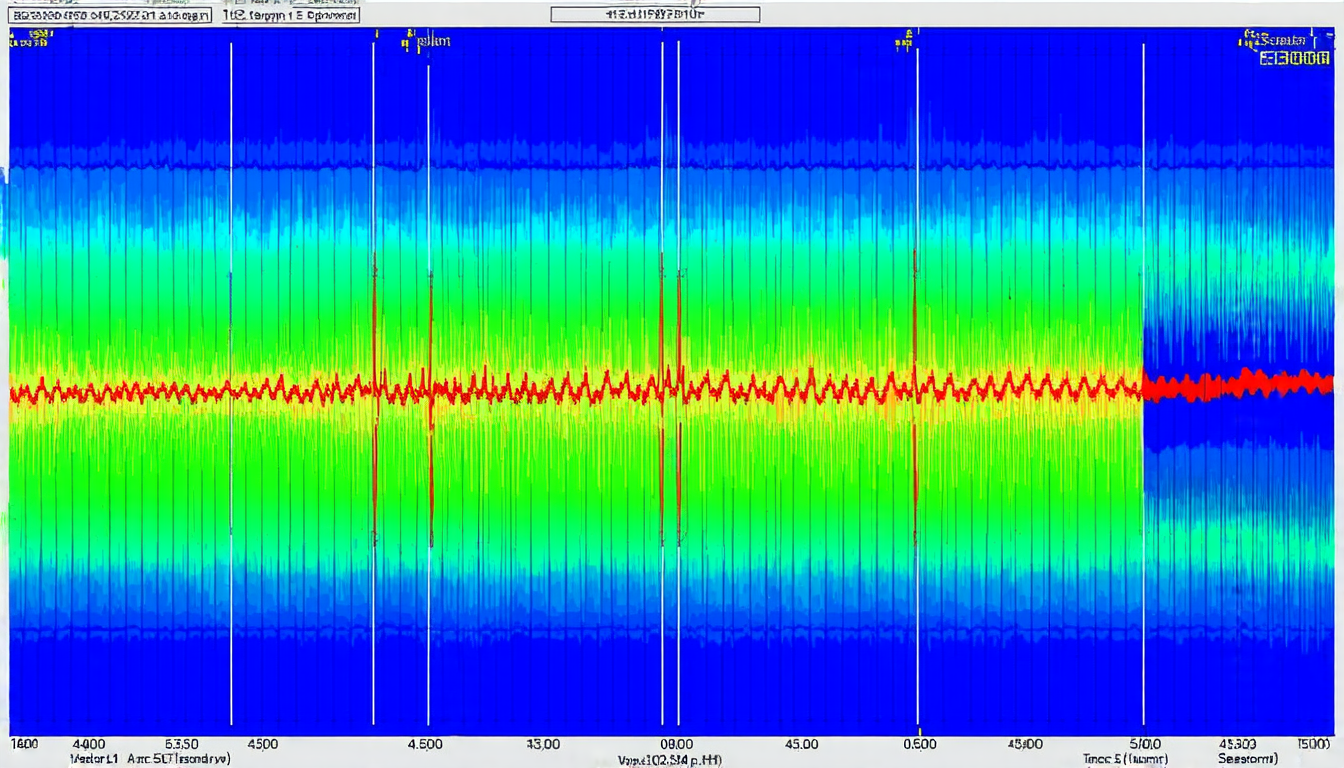
For example, in the case of the Falcon 9 launch, researchers were able to extract more accurate estimates of apparent velocity from short-aperture recordings by extrapolating the data using their new technique. This allowed them to better understand the behavior of seismic waves generated by the rocket’s engines, which has important implications for our understanding of earthquake dynamics.
Similarly, in the case of the synthetic data, researchers were able to demonstrate the effectiveness of their approach by generating a semblance image that showed significant reductions in variance compared to traditional methods. This suggests that data-driven extrapolation could be a powerful tool for improving the accuracy and reliability of seismic imaging techniques.
Overall, the development of data-driven extrapolation represents an important step forward in our ability to extract meaningful information from short-aperture seismic recordings.
Cite this article: “Unlocking New Insights from Short-Aperture Seismic Recordings”, The Science Archive, 2025.
Seismology, Seismic Recordings, Data-Driven Extrapolation, Signal Processing, Array Configuration, Synthetic Data, Time-Shifts, Apparent Velocity, Semblance Image, Variance Reduction





