

Wednesday 26 March 2025
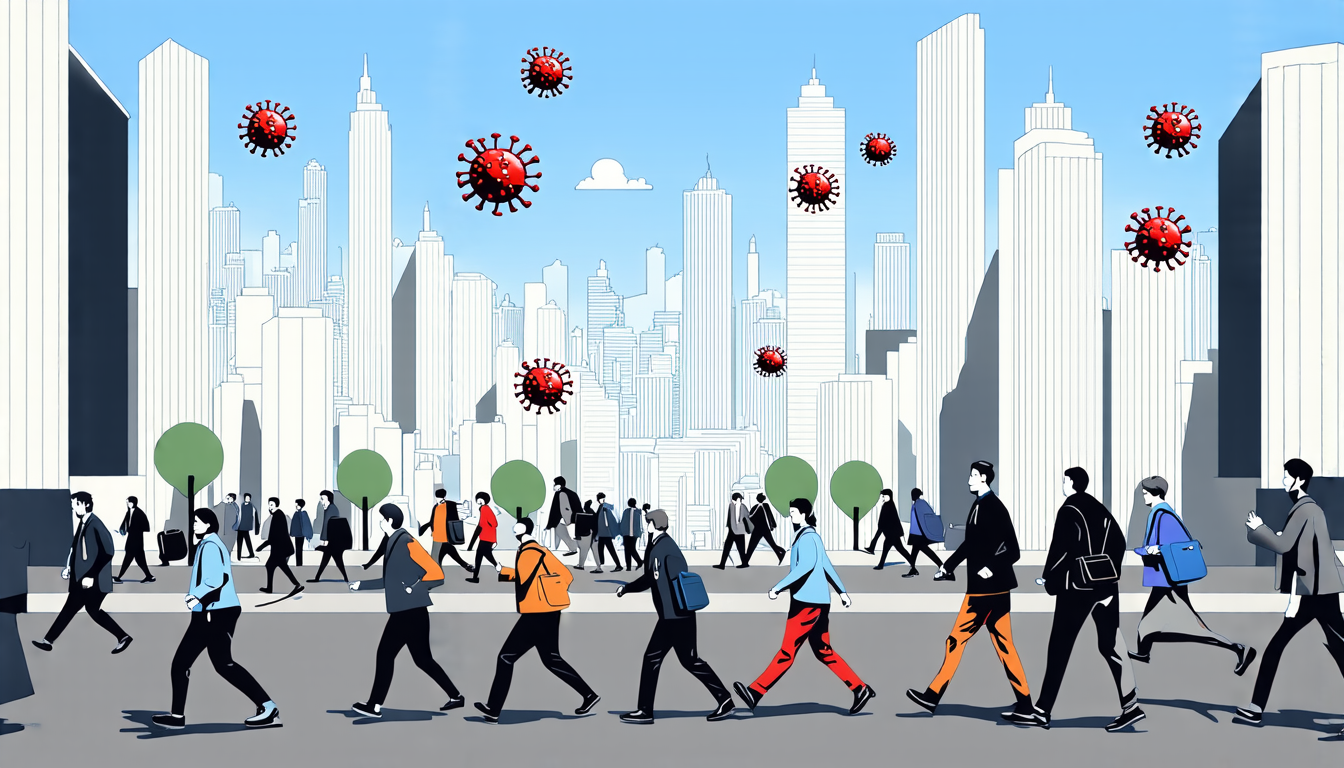
The researchers have developed a new mathematical model that takes into account the complex dynamics of disease transmission in populations, particularly in urban areas where people move around and interact with each other frequently. This model is an improvement over traditional compartmental models used to study disease spread, which assume that individuals transition between different states (such as being susceptible, infected, or recovered) at fixed rates.
In contrast, the new model incorporates a space-dependent fractional derivative, which allows it to capture the non-local transmission dynamics that occur when people move around and interact with each other. This is particularly important in urban areas where people may be exposed to a wide range of individuals who are infected or recovering from disease.
The researchers used this model to study the spread of COVID-19 in cities, finding that it was able to accurately predict the number of cases and deaths that occurred during the pandemic. They also found that the model was able to capture the complex dynamics of disease transmission in urban areas, including the way that disease can spread quickly through densely populated areas.
One of the key advantages of this new model is its ability to capture the non-local transmission dynamics that occur when people move around and interact with each other. This is particularly important in urban areas where people may be exposed to a wide range of individuals who are infected or recovering from disease.
The researchers also found that the model was able to accurately predict the number of cases and deaths that occurred during the pandemic, which could have been used to inform public health policy decisions.
Overall, this new mathematical model is an important step forward in our understanding of disease transmission in populations. It provides a more realistic and nuanced view of how disease spreads through urban areas, and it has the potential to be used to inform public health policy decisions and help mitigate the spread of disease.
Cite this article: “Advanced Mathematical Model Captures Complex Dynamics of Disease Transmission in Urban Areas”, The Science Archive, 2025.
Mathematical Model, Disease Transmission, Urban Areas, Non-Local Dynamics, Fractional Derivative, Covid-19, Pandemic, Public Health Policy, Disease Spread, Compartmental Models.





