

Wednesday 26 March 2025
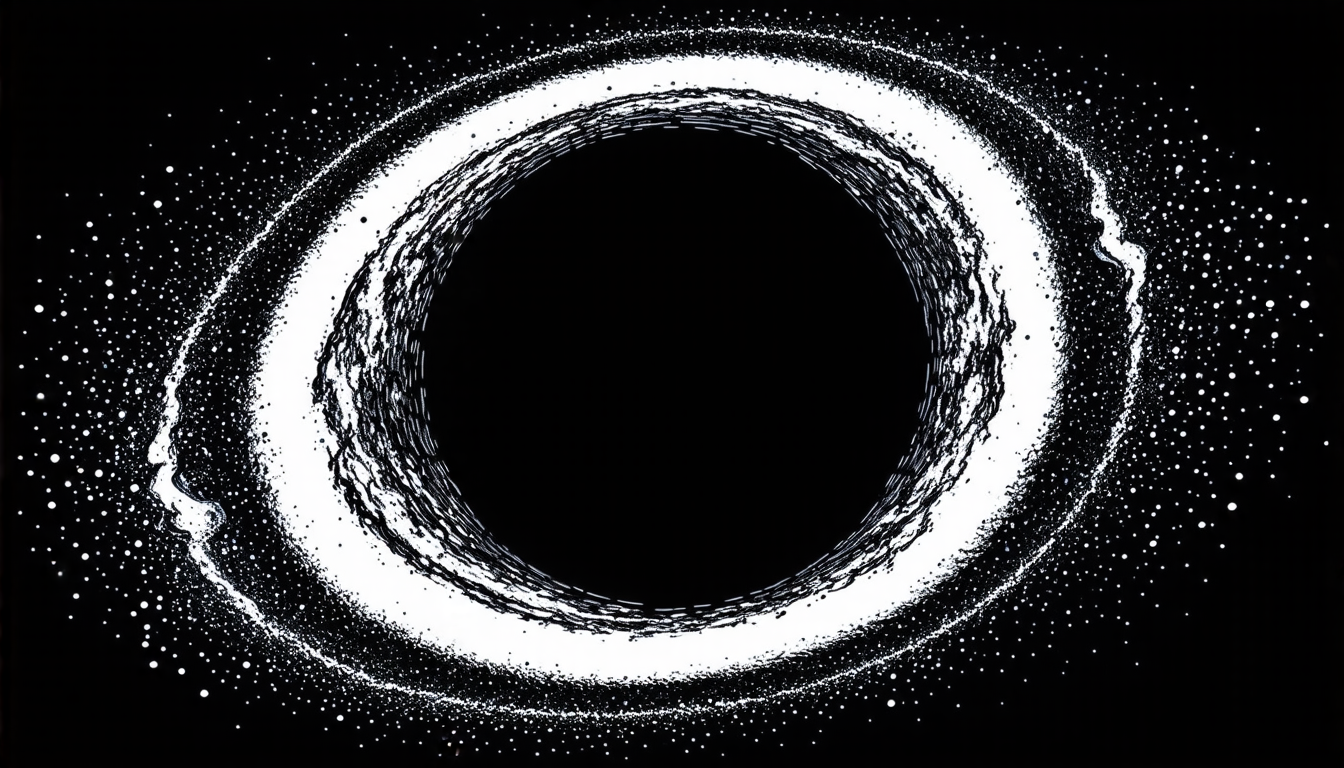
At the edge of our universe, there’s a region where gravity is so strong that it warps space and time in extreme ways. This is the domain of black holes, those cosmic monsters that have fascinated scientists for centuries. Now, researchers have made a fascinating discovery about what happens when particles near these behemoths get chaotic.
In recent years, scientists have been studying the motion of particles around black holes to better understand how they behave under such extreme conditions. One of the most intriguing findings is that the presence of a horizon – the point of no return for anything falling into a black hole – can induce chaos in particle motion. This may seem counterintuitive, as you’d expect the strong gravity near a black hole to be very structured and predictable.
However, researchers have found that as particles approach the event horizon, they start to exhibit unpredictable behavior, similar to what happens in chaotic systems on Earth. This means that even with precise knowledge of their initial conditions, it’s impossible to predict exactly where these particles will end up. It’s like trying to forecast the trajectory of a butterfly flapping its wings in a hurricane.
The team behind this study used complex mathematical models to simulate the behavior of particles near black holes. They discovered that as the horizon approaches, the particles’ motion becomes increasingly unstable and chaotic. This chaos is not just a local phenomenon; it’s a global effect that permeates the entire region around the black hole.
One of the most intriguing implications of this research is its connection to quantum mechanics, the branch of physics that deals with the smallest scales of matter. It turns out that the chaos near black holes may be linked to the way particles behave at the quantum level. This could have far-reaching consequences for our understanding of the universe and the behavior of particles in extreme environments.
The study also sheds light on a fundamental concept in physics known as entropy, which measures the disorder or randomness of a system. In the context of black holes, entropy is directly related to their surface area and temperature. The researchers found that the chaos near the horizon leads to an increase in entropy, which could have significant implications for our understanding of black hole thermodynamics.
In summary, this research has revealed a fascinating new aspect of particle motion near black holes – its chaotic behavior. This discovery not only deepens our understanding of these cosmic monsters but also has far-reaching implications for our understanding of quantum mechanics and the fundamental laws of physics.
Cite this article: “Chaos at the Edge of the Universe: Unraveling the Mysteries of Black Hole Physics”, The Science Archive, 2025.
Black Holes, Chaos Theory, Particle Motion, Gravity, Space-Time, Event Horizon, Quantum Mechanics, Entropy, Thermodynamics, Cosmology





