

Wednesday 26 March 2025
Scientists have made a significant breakthrough in the field of astrophysics, developing a new method for simulating complex celestial systems using artificial intelligence. The technique, known as reinforcement learning, allows researchers to optimize their simulations by adapting to changing conditions and making informed decisions about how to proceed.
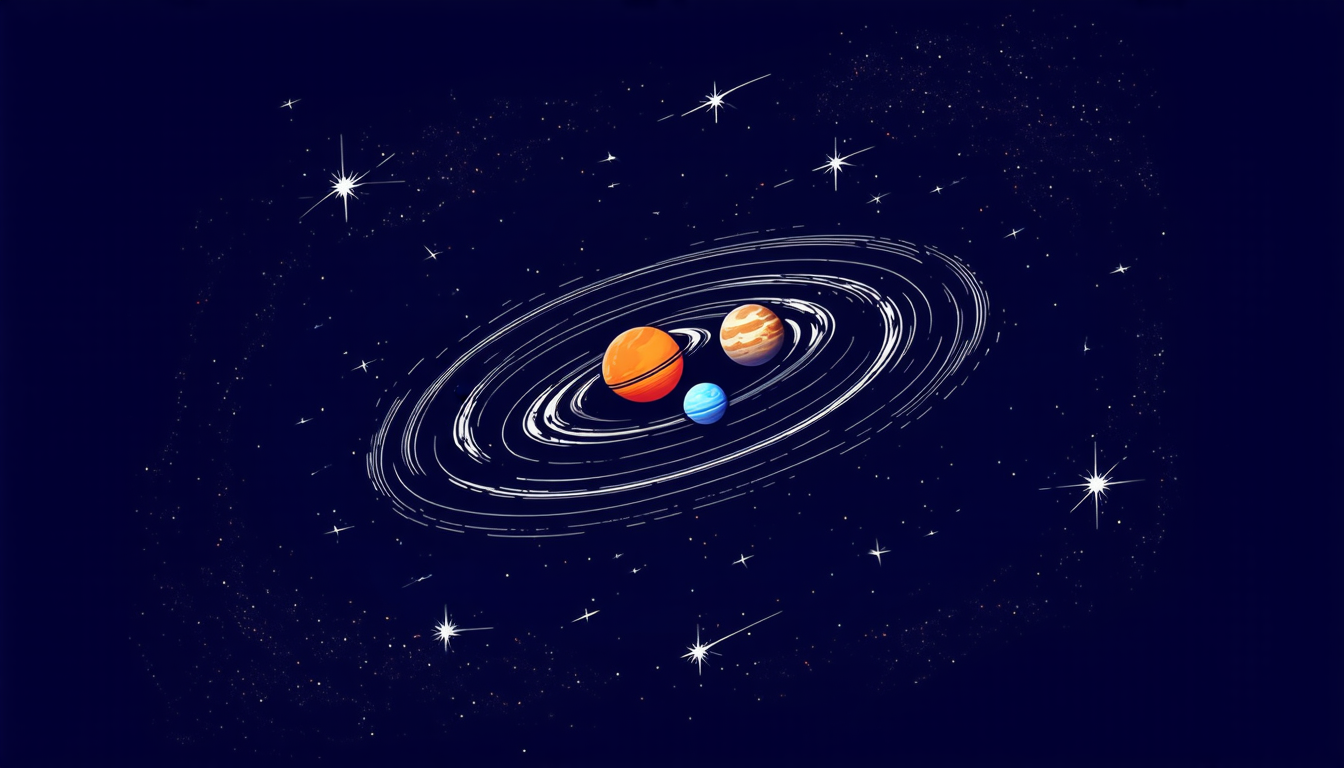
The approach was tested on a notoriously difficult problem: the chaotic gravitational three-body problem. In this scenario, three celestial bodies – such as stars or planets – orbit each other in complex ways, making it challenging for computers to accurately predict their movements over time. The new method uses machine learning algorithms to learn from its mistakes and adjust its approach accordingly.
The team behind the research used a neural network to make decisions about how to integrate the positions and velocities of the celestial bodies, taking into account the energy error – a measure of how well the simulation matches real-world observations. By optimizing this process, they were able to achieve better results than traditional methods, which rely on fixed time steps and can become less accurate as the simulation progresses.
The researchers also experimented with different types of reward functions, which determine how the neural network is incentivized to make decisions. They found that a combination of energy error and computation time – a measure of how long it takes to complete each step of the simulation – worked best. This approach allowed the algorithm to strike a balance between accuracy and efficiency.
The implications of this research are significant, as it could enable scientists to study complex astrophysical phenomena in greater detail than ever before. For example, they may be able to simulate the behavior of binary star systems or even entire galaxies with greater precision. The technique could also be applied to other fields, such as climate modeling or materials science.
One of the most impressive aspects of this research is its ability to adapt to changing conditions. In traditional simulations, the time step – the interval at which calculations are made – is fixed and cannot be adjusted mid-simulation. However, the new method can dynamically adjust the time step based on the complexity of the system being simulated.
This flexibility is crucial in astrophysics, where celestial bodies can suddenly change their orbits or collide with each other, requiring the simulation to adapt quickly to maintain accuracy. The researchers demonstrated this capability by simulating a chaotic three-body problem and showing how the algorithm adjusted its approach to maintain a stable energy error over time.
The team’s findings have significant implications for our understanding of the universe.
Cite this article: “Simulating the Universe: A New Approach to Astrophysical Modeling”, The Science Archive, 2025.
Astrophysics, Artificial Intelligence, Reinforcement Learning, Gravitational Three-Body Problem, Celestial Bodies, Neural Network, Simulation, Energy Error, Computation Time, Chaotic Systems





