

Wednesday 26 March 2025
The mysteries of the universe have long fascinated us, and scientists are constantly working to uncover its secrets. In a recent study, researchers have made significant progress in understanding the behavior of particles at the edge of black holes.
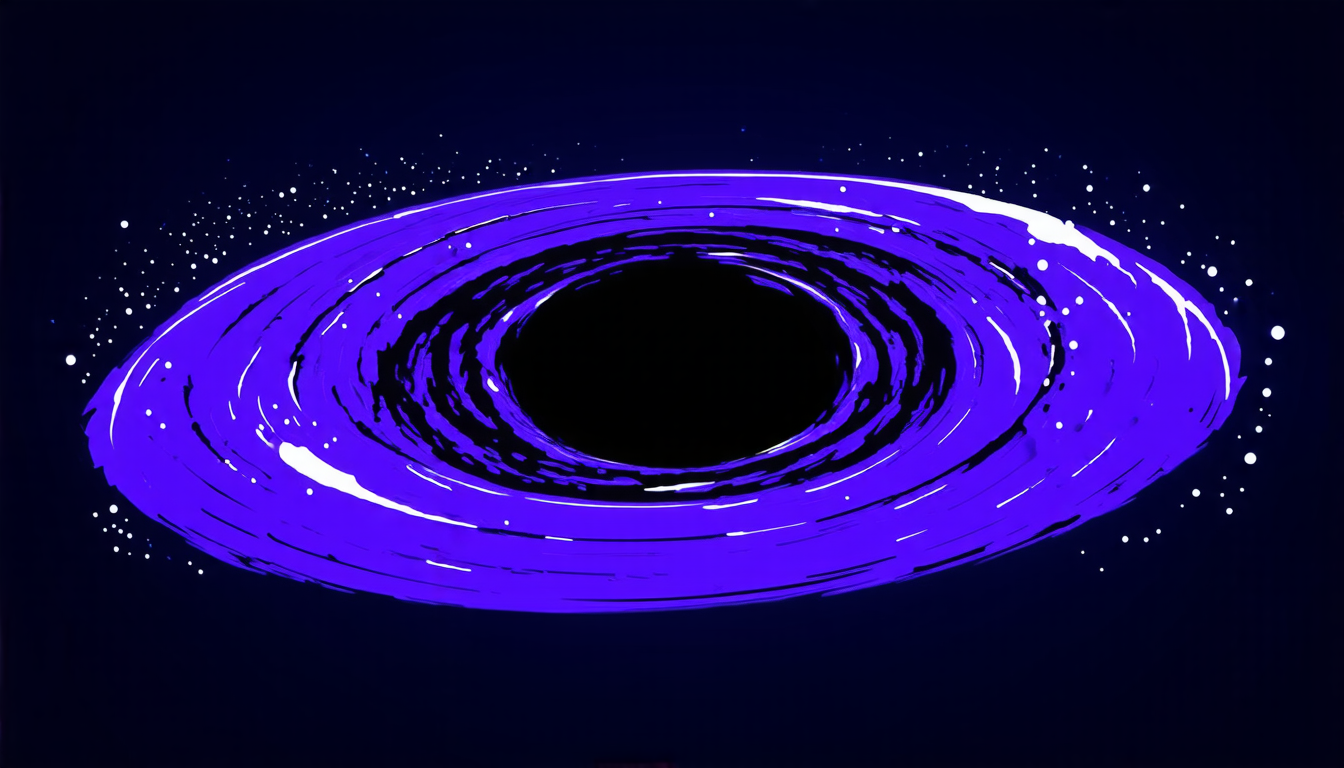
Black holes are regions in space where gravity is so strong that nothing, not even light, can escape once it gets too close. They are formed when massive stars collapse under their own weight, creating an intense gravitational pull. The event horizon marks the boundary beyond which anything that enters cannot leave.
One of the most intriguing aspects of black holes is the way they interact with particles near the edge. In recent years, scientists have discovered that particles can be pulled towards the event horizon, only to emerge from it at a different point in space-time. This phenomenon has been observed in simulations and has sparked intense interest among physicists.
The latest study focuses on the behavior of massless scalar fields, which are hypothetical particles that have no mass but still exhibit gravitational effects. Researchers used advanced numerical methods to simulate the interactions between these particles and black holes.
The results show that, as expected, the particles near the event horizon oscillate wildly due to the intense gravitational forces. However, what’s surprising is that these oscillations eventually give way to a power-law tail, where the particles’ behavior becomes increasingly predictable.
This phenomenon has significant implications for our understanding of the universe. For instance, it could shed light on the nature of black hole evaporation, which is still poorly understood. In theory, black holes emit radiation due to quantum effects near their event horizon. However, this process is extremely slow and difficult to observe directly.
The study’s findings also have implications for our understanding of Hawking radiation, a theoretical prediction made by Stephen Hawking in the 1970s. According to Hawking, black holes gradually lose mass over time due to quantum fluctuations near the event horizon. The new results suggest that this process may be more complex and nuanced than previously thought.
The discovery has sparked excitement among physicists, who are eager to learn more about the intricate dance between particles and black holes. Further research is needed to fully understand the implications of these findings, but they offer a fascinating glimpse into the mysteries of the universe.
In the near future, scientists plan to investigate other aspects of black hole behavior, including the role of spin in particle interactions and the impact of gravitational waves on the event horizon. These studies will undoubtedly shed more light on the complex and intriguing world of black holes.
Cite this article: “Unveiling the Secrets of Black Hole Behavior”, The Science Archive, 2025.
Black Holes, Particles, Event Horizon, Gravity, Space-Time, Scalar Fields, Hawking Radiation, Quantum Effects, Gravitational Waves, Particle Interactions





