

Wednesday 26 March 2025
A new study has shed light on the devastating consequences of a global financial collapse, revealing that even a limited disruption to international trade could have catastrophic effects on the world economy.
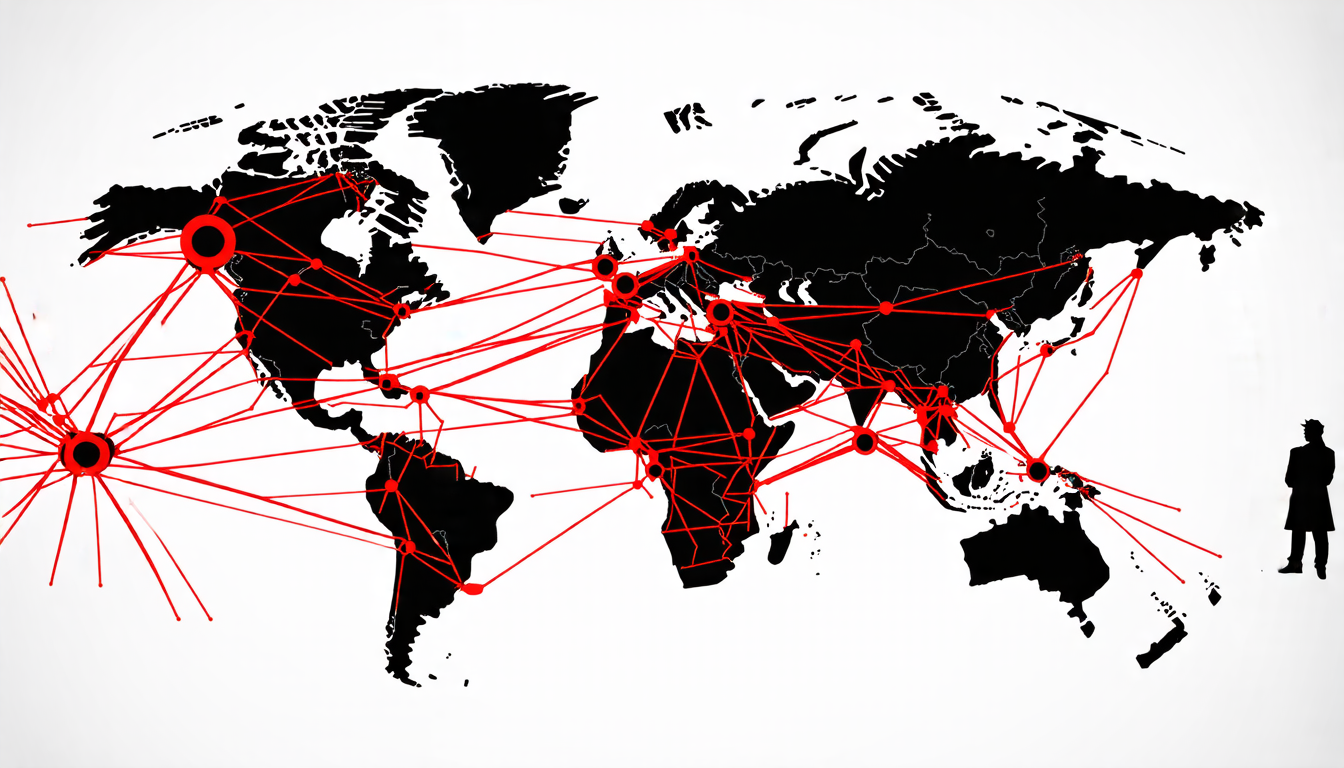
Researchers used complex network models to simulate the spread of financial shocks through the global trade system. They found that even a relatively minor initial disruption, such as a 2.7% reduction in India’s economic output, could trigger a cascade of failures that would ravage the global economy.
The study focused on the interconnectedness of international trade, using data from the International Monetary Fund to create a network model of the world’s trading relationships. The researchers then used this model to simulate the spread of financial shocks through the system, starting with a small initial disruption in one country and observing how it propagated to others.
The results were alarming: even a limited initial disruption could trigger a global economic collapse, with losses mounting rapidly as the shock wave spread from country to country. The researchers found that the total loss to the global economy could be as high as 11.6% of GDP in some scenarios, which is equivalent to trillions of dollars.
One of the key findings was that the collapse was not limited to the countries directly affected by the initial disruption. Instead, the shock wave spread rapidly to other parts of the world, causing widespread economic devastation.
The researchers also found that the type of trade relationship between countries played a crucial role in determining how quickly and far-reaching the financial shock would be. Countries with strong trade ties were more likely to be severely affected by an initial disruption, as the shock was more easily transmitted through their networks.
The study highlights the importance of understanding the complex relationships between different parts of the global economy. By analyzing these relationships and identifying the key vulnerabilities in the system, policymakers may be able to take steps to mitigate the risk of a catastrophic collapse.
The researchers’ findings are based on a combination of theoretical modeling and empirical analysis, using data from historical economic crises to inform their simulations. While the study is not without its limitations – for example, it assumes that countries will respond to an initial disruption by withdrawing from international trade, which may not always be the case – it provides valuable insights into the potential consequences of a global financial collapse.
The implications of the study are stark: even a limited disruption to international trade could have devastating consequences for the world economy.
Cite this article: “Global Financial Collapse: A Devastating Consequence of International Trade Disruption”, The Science Archive, 2025.
Global Financial Collapse, International Trade, Economic Shock, Network Models, Financial Stability, Gdp Loss, Trade Relationships, Economic Devastation, Catastrophic Collapse, Systemic Risk





