

Thursday 27 March 2025
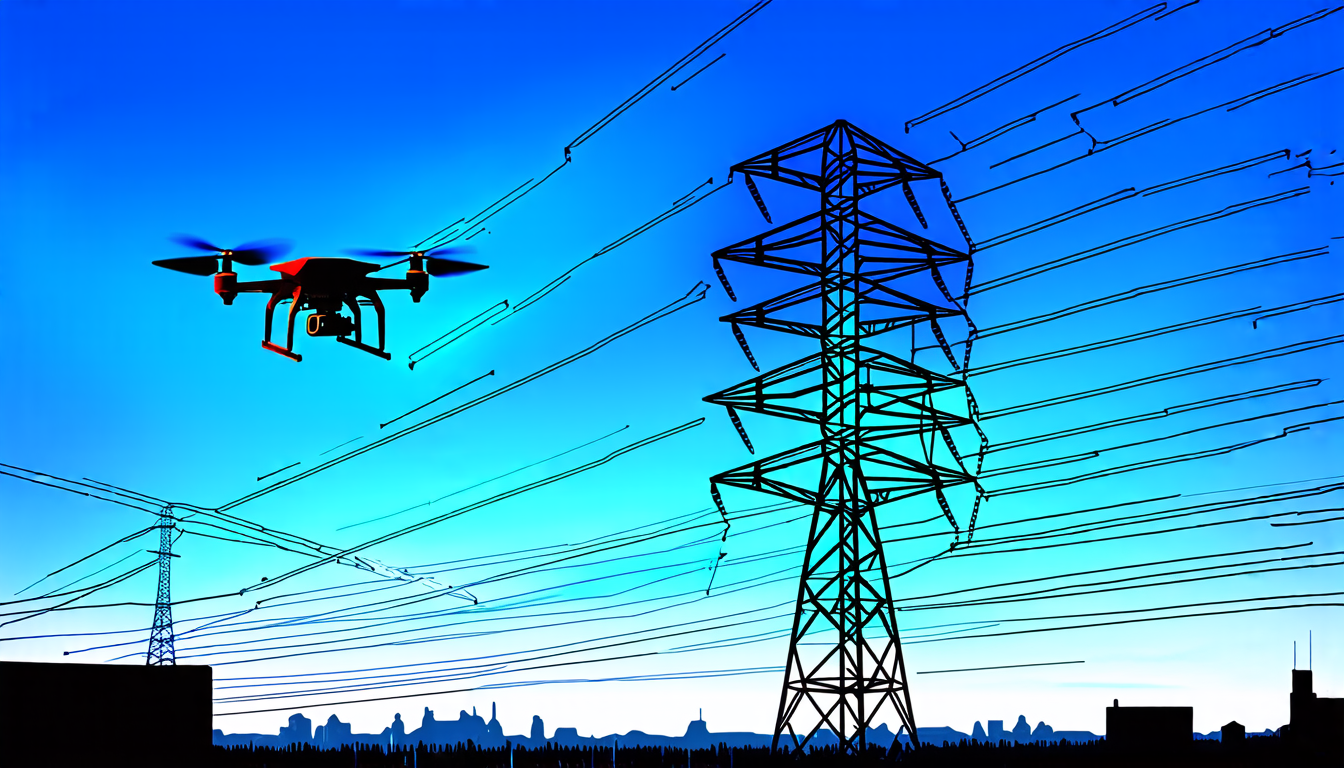
A recent study has made significant strides in developing a new technology that enables the automated inspection of power grids using unmanned aerial vehicles (UAVs) equipped with LiDAR sensors. The research aims to enhance the safety and efficiency of grid maintenance by leveraging advanced machine learning techniques.
Power grids are complex networks that require regular inspections to ensure their reliability and integrity. Traditional methods, such as manual observations or helicopter surveys, are resource-intensive and prone to human error. In recent years, UAVs have emerged as a promising solution for power grid inspection, offering the potential for faster, cheaper, and more accurate assessments.
The new technology developed by researchers uses 3D semantic segmentation models to analyze point cloud data collected by LiDAR sensors mounted on UAVs. Point clouds are essentially three-dimensional representations of objects created by scanning surfaces with LiDAR sensors. The models identify and classify various features in the point cloud, such as power lines, towers, and vegetation, allowing for automated inspection and detection of potential issues.
The researchers developed a dataset called TS40K, comprising 3D point clouds of rural terrain and electrical transmission systems. They trained several state-of-the-art 3D semantic segmentation models on this dataset, achieving impressive results in detecting critical grid components such as power lines and towers.
One of the key challenges in developing this technology is handling noisy data and extreme class imbalances, which are common issues when working with LiDAR point clouds. The researchers employed advanced techniques, including uncertainty flagging mechanisms, to address these challenges and ensure the accuracy of the models.
The potential benefits of this technology are substantial. Automated power grid inspection using UAVs and machine learning algorithms could reduce maintenance costs, minimize downtime, and enhance overall grid reliability. Moreover, the technology has the potential to be applied in various other domains, such as construction, mining, and environmental monitoring.
As the world becomes increasingly reliant on complex infrastructure systems like power grids, the need for efficient and accurate inspection methods will only continue to grow. This study represents an important step forward in developing a reliable and cost-effective solution for power grid inspection, paving the way for more widespread adoption of UAV technology in this domain.
Cite this article: “Automated Power Grid Inspection using Unmanned Aerial Vehicles and Machine Learning”, The Science Archive, 2025.
Power Grids, Unmanned Aerial Vehicles, Lidar Sensors, Machine Learning, 3D Semantic Segmentation, Point Cloud Data, Grid Inspection, Electrical Transmission Systems, Rural Terrain, Infrastructure Maintenance





