

Thursday 27 March 2025
A recent study has shed new light on the intricacies of molecular interactions, specifically in the realm of rotational quenching. This phenomenon occurs when a molecule collides with a buffer gas, causing its rotational energy to dissipate rapidly. Understanding the underlying mechanisms is crucial for the development of efficient cooling techniques, which are essential for various applications in quantum science and technology.
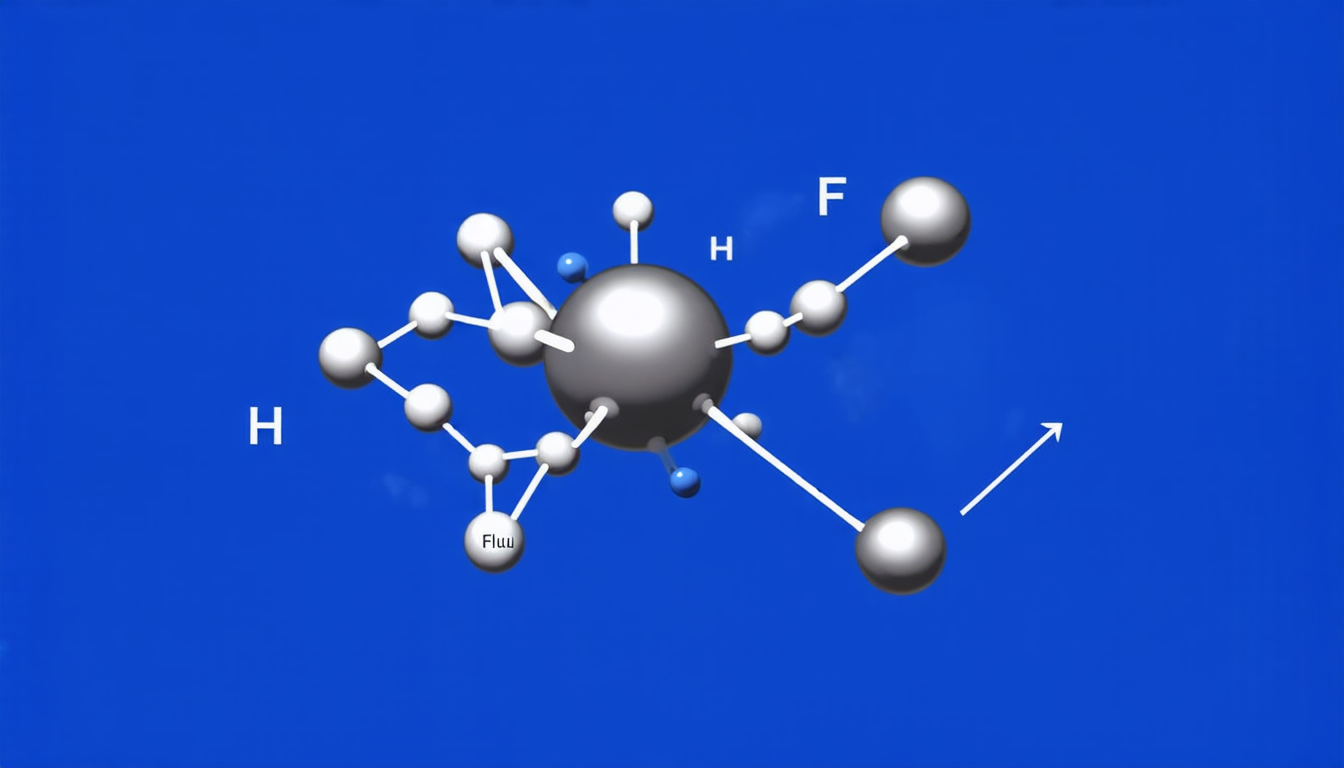
The researchers focused on monofluoride molecules, consisting of a metal atom bonded to a fluorine atom. They employed ab initio quantum chemistry methods to calculate the potential energy surfaces for these molecules interacting with helium gas. These calculations allowed them to determine state-to-state scattering cross sections and rate constants for rotational quenching.
The results revealed that the metal atom plays a significant role in determining the efficiency of rotational quenching. Molecules containing lighter metals, such as aluminum or magnesium, exhibit faster quenching rates compared to those with heavier metals like calcium or strontium. This is due to the varying strengths and anisotropies of the interaction potentials between the metal atom and helium gas.
The study also explored the temperature dependence of rotational quenching. The researchers found that at low temperatures, the quenching rate increases as the energy of the molecule decreases. However, above a certain threshold, the rate plateaus or even decreases. This behavior is attributed to the competition between thermalization and rotational relaxation processes.
The findings have implications for the development of buffer gas cooling techniques, which are essential for achieving ultracold temperatures in molecular gases. By understanding the optimal conditions for rotational quenching, researchers can design more efficient cooling systems that minimize energy losses and maximize the production of cold molecules.
In addition to its practical applications, this study also contributes to a deeper understanding of the fundamental physics underlying molecular interactions. The results provide new insights into the complex dynamics of rotational relaxation, which is critical for advancing our knowledge of quantum systems and their behavior.
The research highlights the importance of considering the specific properties of each molecule when designing cooling techniques. By tailoring these approaches to the unique characteristics of different molecules, researchers can achieve more precise control over the cooling process and unlock new possibilities in fields such as quantum computing, simulation, and chemistry.
Ultimately, this study demonstrates the power of theoretical modeling in advancing our understanding of complex physical phenomena. By combining cutting-edge computational methods with rigorous analysis, scientists can uncover hidden patterns and mechanisms that underlie the behavior of molecules at the atomic scale.
Cite this article: “Unraveling the Role of Metal Atoms in Rotational Quenching”, The Science Archive, 2025.
Molecular Interactions, Rotational Quenching, Buffer Gas Cooling, Quantum Science, Quantum Technology, Molecular Dynamics, Ab Initio Methods, Potential Energy Surfaces, Scattering Cross Sections, Rate Constants





