

Thursday 27 March 2025
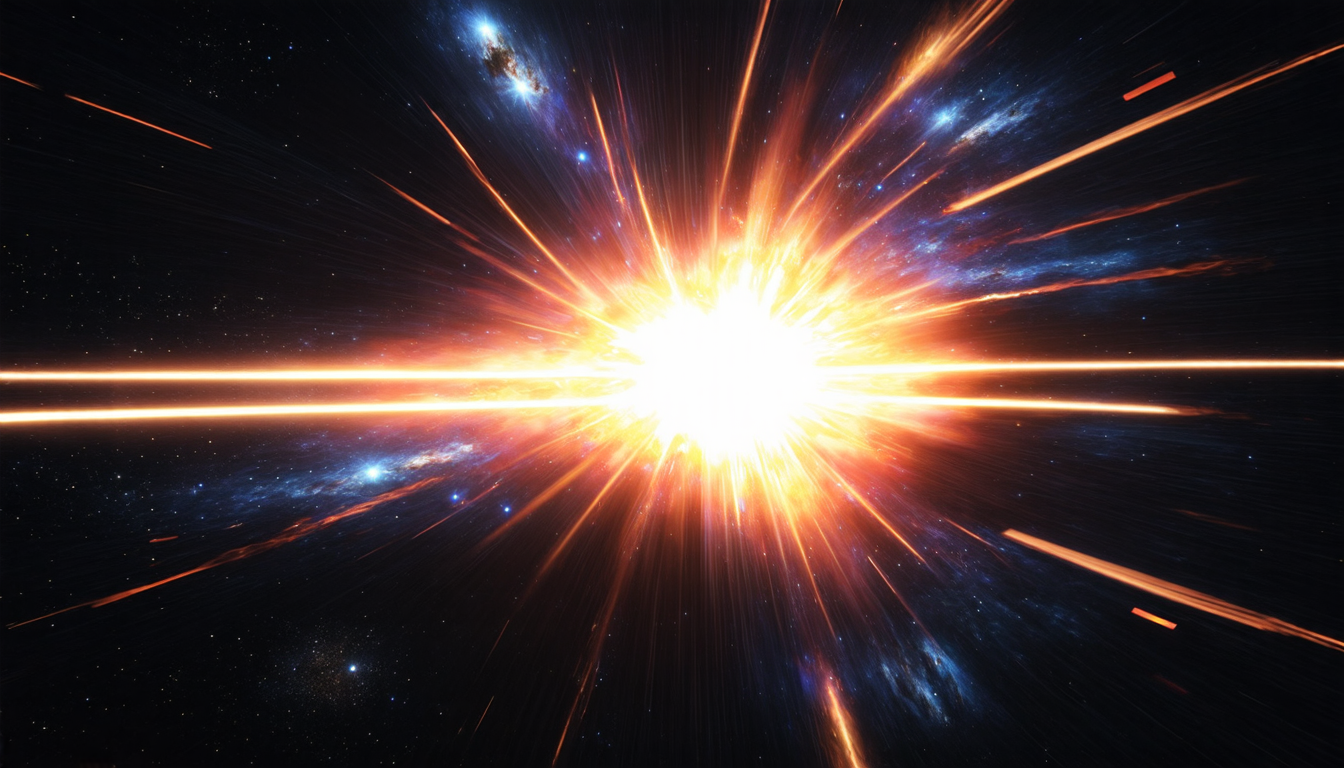
The most distant ultra-long gamma-ray burst (GRB) ever detected has just been observed, and it’s sending shockwaves through the scientific community. GRBs are incredibly powerful explosions that occur when massive stars collapse or when neutron stars or black holes merge. They can outshine entire galaxies for a brief moment, releasing as much energy as the sun would produce over its entire lifetime.
The new burst, designated GRB 220627A, is particularly remarkable because it lasted an unusually long time – about 20 minutes. Most GRBs last only a few seconds to a minute or two at most. This extended duration allows scientists to study the burst in unprecedented detail, gaining valuable insights into the physics of these cosmic events.
One of the most striking features of GRB 220627A is its double-pulse structure. The burst began with an initial pulse that lasted around 10 minutes, followed by a period of relative calm before another intense pulse struck. This unusual pattern has never been seen before in a GRB, and scientists are eager to understand what caused it.
The team behind the discovery used data from NASA’s Fermi Gamma-Ray Space Telescope to study the burst. They detected two distinct pulses of gamma radiation, each with its own unique characteristics. The initial pulse was more intense than the second one, but both were incredibly powerful, releasing enormous amounts of energy into space.
By analyzing the light curves and spectra of the burst, scientists can learn about the conditions surrounding the explosion. For example, the double-pulse structure may be a sign that the burst occurred in a dense environment, such as a star-forming region or a binary system. Alternatively, it could indicate that the explosion was powered by a magnetar, a type of neutron star with an extremely strong magnetic field.
The detection of GRB 220627A has also shed new light on the mysteries of gamma-ray bursts themselves. These events are thought to be the most powerful explosions in the universe, releasing more energy than entire galaxies. However, scientists still don’t fully understand what triggers these explosions or how they manage to produce such incredible amounts of energy.
As scientists continue to study GRB 220627A, they hope to uncover more secrets about this enigmatic burst and the physics that govern it. With its unique double-pulse structure and extended duration, this event offers a rare opportunity to probe the inner workings of a gamma-ray burst up close.
Cite this article: “Astounding Gamma-Ray Burst Reveals New Insights into Cosmic Explosions”, The Science Archive, 2025.
Gamma-Ray Bursts, Grb 220627A, Fermi Gamma-Ray Space Telescope, Nasa, Gamma Radiation, Neutron Stars, Black Holes, Massive Stars, Magnetar, Star-Forming Region, Binary System





