

Thursday 27 March 2025
The Hong-Ou-Mandel (HOM) effect, a fundamental phenomenon in quantum optics, has long been shrouded in mystery. This experimentally observed anticorrelation between two photons on a beam splitter has puzzled researchers for decades. Recently, a new approach to understanding this enigmatic effect has shed light on its underlying mechanisms.
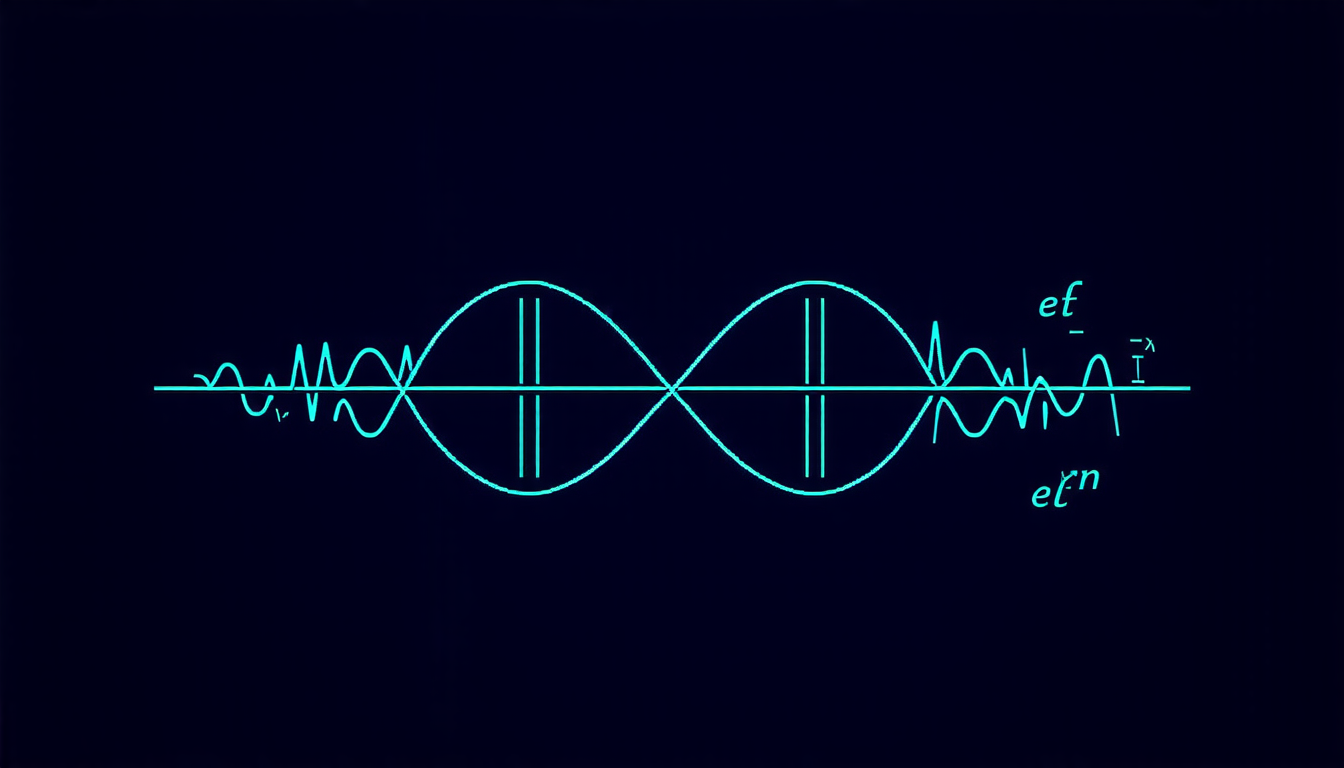
The HOM dip, as it’s also known, is the result of a phase-controlled interference between entangled photon pairs. These pairs are generated through spontaneous parametric down-conversion (SPDC), a process where high-intensity laser pulses interact with non-linear crystals to produce correlated photons. When these photons meet on a 50/50 beam splitter, they exhibit an anticorrelation in their intensities, resulting in the HOM dip.
Researchers have long struggled to explain this phenomenon, with some theories relying on particle-like behavior and others invoking wave-like properties. However, a new analysis has revealed that the key to understanding the HOM effect lies not in the photons themselves, but in the relative phase between them.
By treating the entangled photon pairs as coherent waves, researchers have been able to derive a general solution for the HOM dip. This approach reveals that the phase-controlled interference is responsible for the anticorrelation between the two photons on the beam splitter. In essence, the relative phase between the photons determines whether they will interfere constructively or destructively.
This new understanding has far-reaching implications for quantum optics and beyond. The coherence approach provides a unified framework for explaining not only the HOM effect but also other phenomena in quantum interference, such as two-photon interference with coherent pulses.
The significance of this research extends beyond the realm of fundamental physics. It has the potential to impact various fields, including quantum computing, communication, and cryptography. By better understanding the mechanisms underlying quantum interference, researchers can develop more efficient and secure methods for processing information.
In a significant departure from previous theories, this new analysis reveals that the HOM dip is not a result of particle-like behavior but rather an inherent property of coherent waves. This finding has important implications for our understanding of quantum mechanics and its applications in various fields.
The Hong-Ou-Mandel effect, once a mysterious phenomenon, has been demystified through a combination of theoretical and experimental work. The results have far-reaching implications for the development of new technologies that rely on quantum interference.
Cite this article: “Unraveling the Hong-Ou-Mandel Effect: A Coherent Wave Approach”, The Science Archive, 2025.
Quantum Optics, Hong-Ou-Mandel Effect, Entangled Photons, Beam Splitter, Spontaneous Parametric Down-Conversion, Phase-Controlled Interference, Coherent Waves, Quantum Interference, Particle-Like Behavior, Wave-Like Properties.
Reference: Byoung S. Ham, “Coherence analysis of phase-controlled HOM effects” (2025).





