

Thursday 27 March 2025
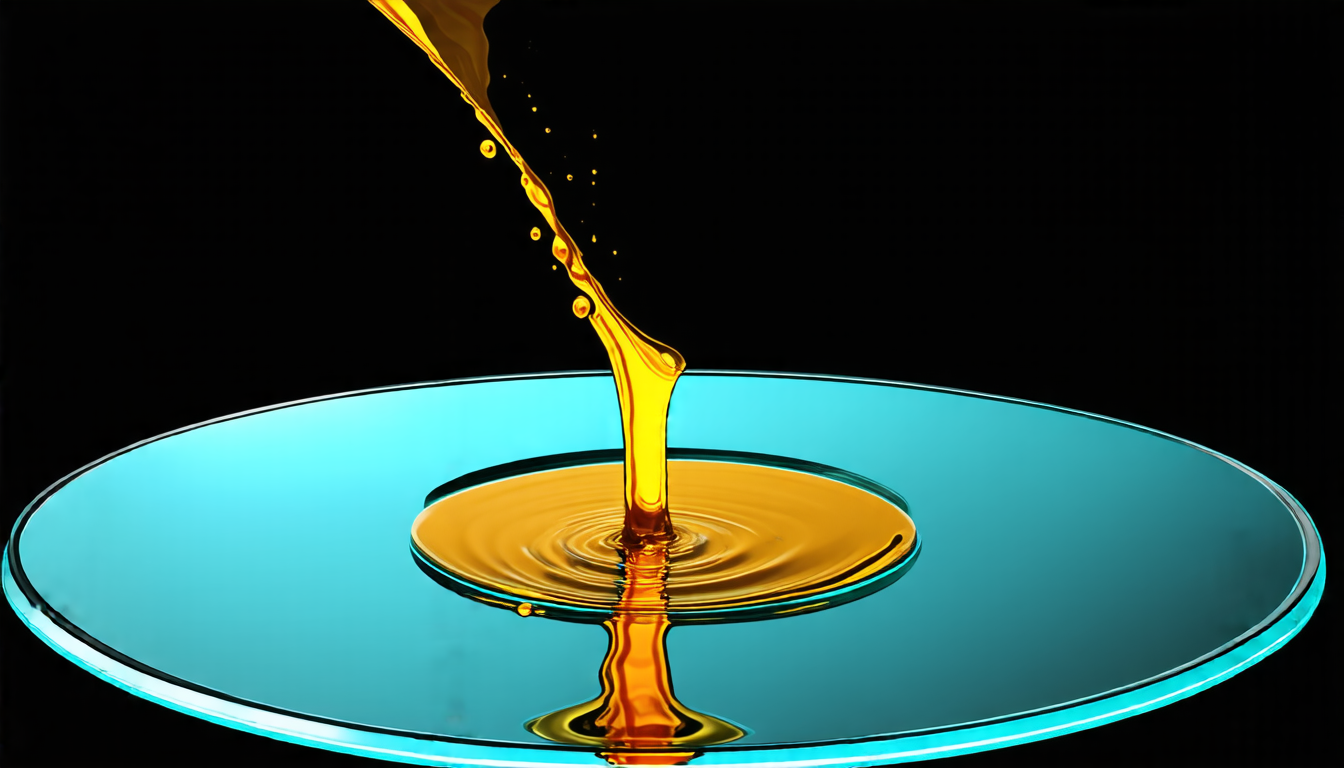
A team of researchers has made a significant breakthrough in understanding the behavior of thin liquid films, which are crucial in various industrial applications such as coating and heat transfer. By using a unique experimental setup, they were able to control the movement of a rivulet of oil on a glass plate and measure its effects on the deposited film.
The experiment involves injecting oil into an air-filled Hele-Shaw cell, which is essentially a narrow channel between two parallel plates. The oil forms a rivulet that moves along the channel, and by using speakers to push air into the cell, the researchers can impose a controlled movement on the rivulet. This allows them to study how the film behaves as it deposits onto the glass plate.
One of the key findings is that the deposited film’s height can be precisely predicted based on the capillary number, which takes into account the viscosity and surface tension of the oil, as well as its velocity. This is a significant improvement over previous studies, which often relied on empirical models or simplified assumptions.
The researchers also discovered that the film’s thickness decreases over time due to drainage, but they were able to measure this process with high accuracy using an interferometric method. This allowed them to quantify the relative contributions of capillary and gravitational forces to the film’s behavior.
Another important aspect of their study is the ability to predict how the film will behave in different situations. For example, by varying the velocity and amplitude of the rivulet’s movement, they were able to create films with specific thicknesses or patterns. This could have significant implications for industries that rely on coating or heat transfer, such as manufacturing or aerospace.
The researchers’ experimental setup is also noteworthy for its flexibility and precision. They used a combination of image processing and optical interferometry to measure the film’s height and profile, which allowed them to capture detailed information about its behavior over time.
Overall, this study represents an important step forward in understanding the complex dynamics of thin liquid films. By controlling the movement of the rivulet and measuring its effects on the deposited film, the researchers have gained valuable insights into the underlying physics of these systems. These findings could have significant practical applications across a range of industries, from manufacturing to aerospace engineering.
Cite this article: “Unveiling the Dynamics of Thin Liquid Films: A Breakthrough in Understanding Coating and Heat Transfer Processes”, The Science Archive, 2025.
Thin Film Dynamics, Rivulet Flow, Hele-Shaw Cell, Capillary Number, Surface Tension, Viscosity, Interferometry, Image Processing, Coating, Heat Transfer.





