

Thursday 27 March 2025
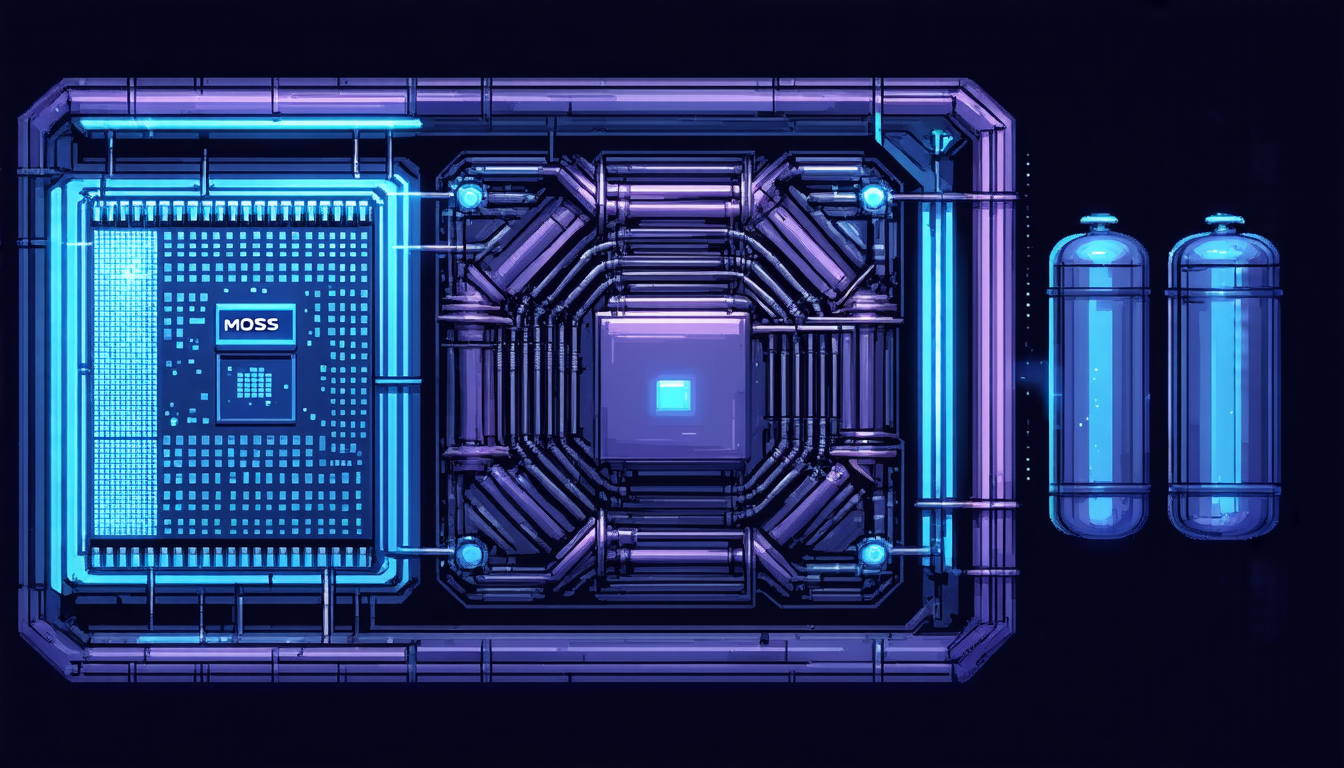
The quest for a better understanding of particle physics has led scientists to develop cutting-edge technology that enables them to detect and track subatomic particles with unprecedented accuracy. The latest innovation in this field is the MOnolithic Stitched Sensor (MOSS), a revolutionary chip designed to improve the detection efficiency and spatial resolution of the ALICE experiment at CERN’s Large Hadron Collider.
The MOSS chip is a masterclass in engineering, featuring 6.7 million pixels arranged on a single wafer-scale sensor. This innovative design allows for the creation of truly cylindrical layers, which are essential for achieving high-resolution tracking and vertexing performance. The chip is made up of ten repeated sensor units (RSUs) that can be independently powered and read out, enabling researchers to test and calibrate each unit separately.
The MOSS chip has undergone rigorous testing in the laboratory and in beam tests, where it was subjected to a barrage of particles and radiation. The results have been nothing short of impressive, with detection efficiencies exceeding 99% and fake hit rates below 0.1 pixel-1 s-1. These figures meet the stringent requirements for the ALICE experiment’s Inner Tracking System (ITS3) upgrade, which will allow scientists to study heavy-ion collisions at unprecedented levels of precision.
One of the key challenges in developing the MOSS chip was ensuring its reliability and radiation hardness. To address this issue, researchers designed the chip with multiple layers of interconnects and a unique stitching technique that allows for seamless integration of different components. This approach has proven successful, as the chip has demonstrated impressive resistance to radiation-induced damage.
The MOSS chip’s performance has also been tested under various conditions, including temperature fluctuations and radiation exposure. The results show that the chip can maintain its high detection efficiency and spatial resolution even in harsh environments, making it an ideal candidate for use in the ALICE experiment.
The development of the MOSS chip is a testament to the ingenuity and perseverance of scientists working at CERN. By pushing the boundaries of what is possible with semiconductor technology, researchers have created a tool that will enable them to make new discoveries about the fundamental nature of matter and the universe.
As the search for new knowledge continues, the MOnolithic Stitched Sensor chip stands ready to play a critical role in advancing our understanding of the cosmos.
Cite this article: “Revolutionizing Particle Detection: The MOSS Chip Breakthrough at CERN”, The Science Archive, 2025.
Particle Physics, Alice Experiment, Cern, Large Hadron Collider, Moss Chip, Semiconductor Technology, Detection Efficiency, Spatial Resolution, Radiation Hardness, Interconnects.
Reference: Livia Terlizzi, “Characterization Of MOSS For The ALICE ITS3 For The LHC Run 4” (2025).





