

Thursday 27 March 2025
The intricate dance of hyperbolic geometry has long fascinated mathematicians and scientists alike. Recently, a team of researchers made a significant breakthrough in understanding the distances between fixed points of irreducible type-1 actions on surfaces.
These actions are a fundamental concept in the study of Riemann surfaces, which describe complex geometric shapes that can be used to model everything from the fabric of spacetime to the intricate patterns found in nature. The team’s discovery has far-reaching implications for our understanding of these surfaces and the way they interact with each other.
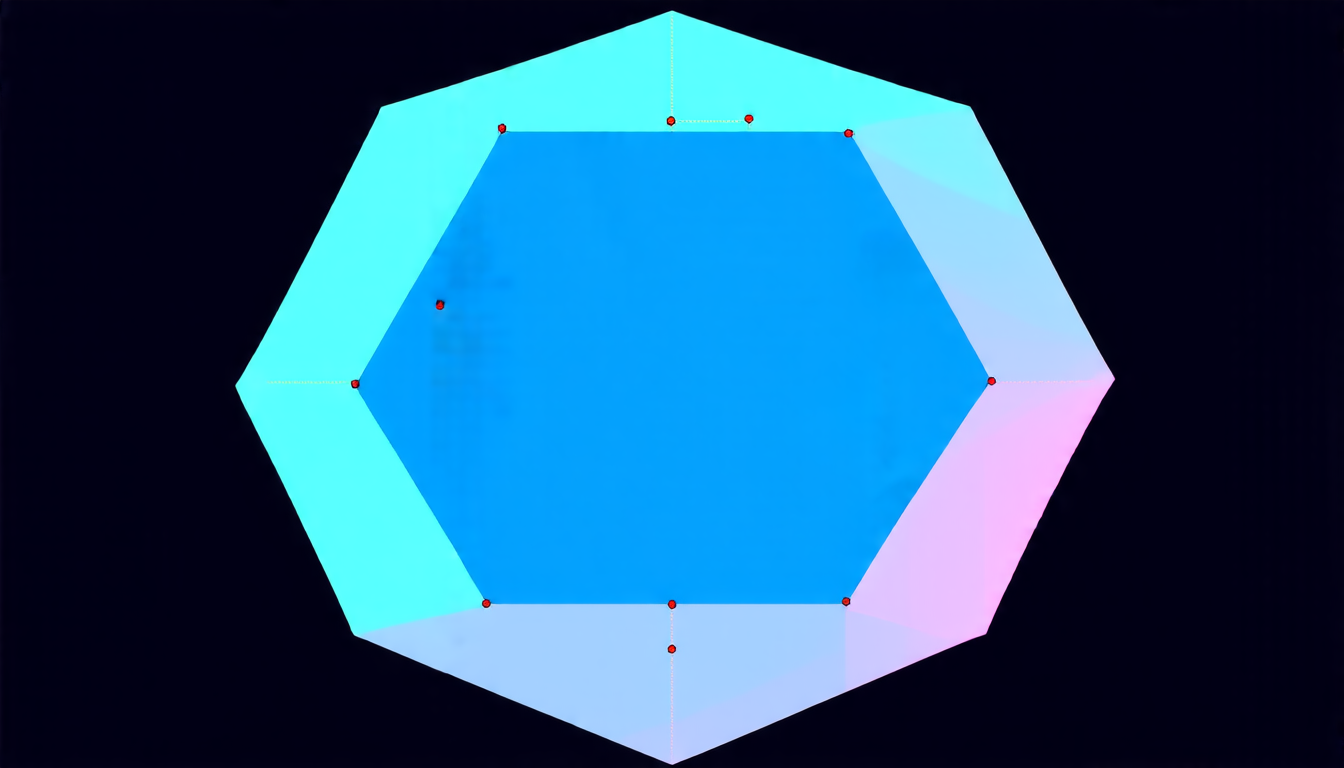
The researchers began by examining the properties of hyperbolic polygons, a type of geometric shape that plays a crucial role in the study of Riemann surfaces. By analyzing the relationships between these shapes, they were able to identify a new method for estimating the distance between fixed points of irreducible type-1 actions on surfaces.
This method involves using a combination of geometric and algebraic techniques to describe the properties of the polygons and the way they interact with each other. The team then used this information to develop a new algorithm for calculating the distance between fixed points, which is more accurate and efficient than previous methods.
One of the key advantages of the new algorithm is its ability to handle complex geometric shapes, such as those found in Riemann surfaces. This allows researchers to study these shapes in greater detail and gain a deeper understanding of their properties and behavior.
The implications of this breakthrough are significant, with potential applications in fields ranging from materials science to cosmology. For example, the new algorithm could be used to model the behavior of complex materials, such as those found in advanced composites or nanomaterials.
In addition, the discovery could also help scientists better understand the structure and evolution of spacetime itself. By studying the properties of Riemann surfaces and their interactions with each other, researchers may be able to gain a deeper understanding of the fundamental nature of reality.
Overall, the team’s breakthrough has significant implications for our understanding of geometric shapes and their role in the study of complex systems. As researchers continue to explore the properties and behavior of these shapes, they are likely to uncover even more surprising and fascinating insights that will help us better understand the world around us.
Cite this article: “Unlocking the Secrets of Hyperbolic Geometry”, The Science Archive, 2025.
Hyperbolic Geometry, Riemann Surfaces, Type-1 Actions, Fixed Points, Irreducible, Algebraic Techniques, Geometric Shapes, Materials Science, Cosmology, Spacetime





