

Thursday 27 March 2025
The quest for a more efficient and effective way to solve complex mathematical problems has led scientists to develop new methods that can tackle some of the most challenging equations in physics, engineering, and other fields.
One such method is a space-time finite element method that combines two approaches: the finite element method, which breaks down a problem into smaller pieces, and the time-dependent approach, which takes into account the dynamic nature of many real-world phenomena. By combining these two methods, scientists can create a new framework for solving complex problems more efficiently.
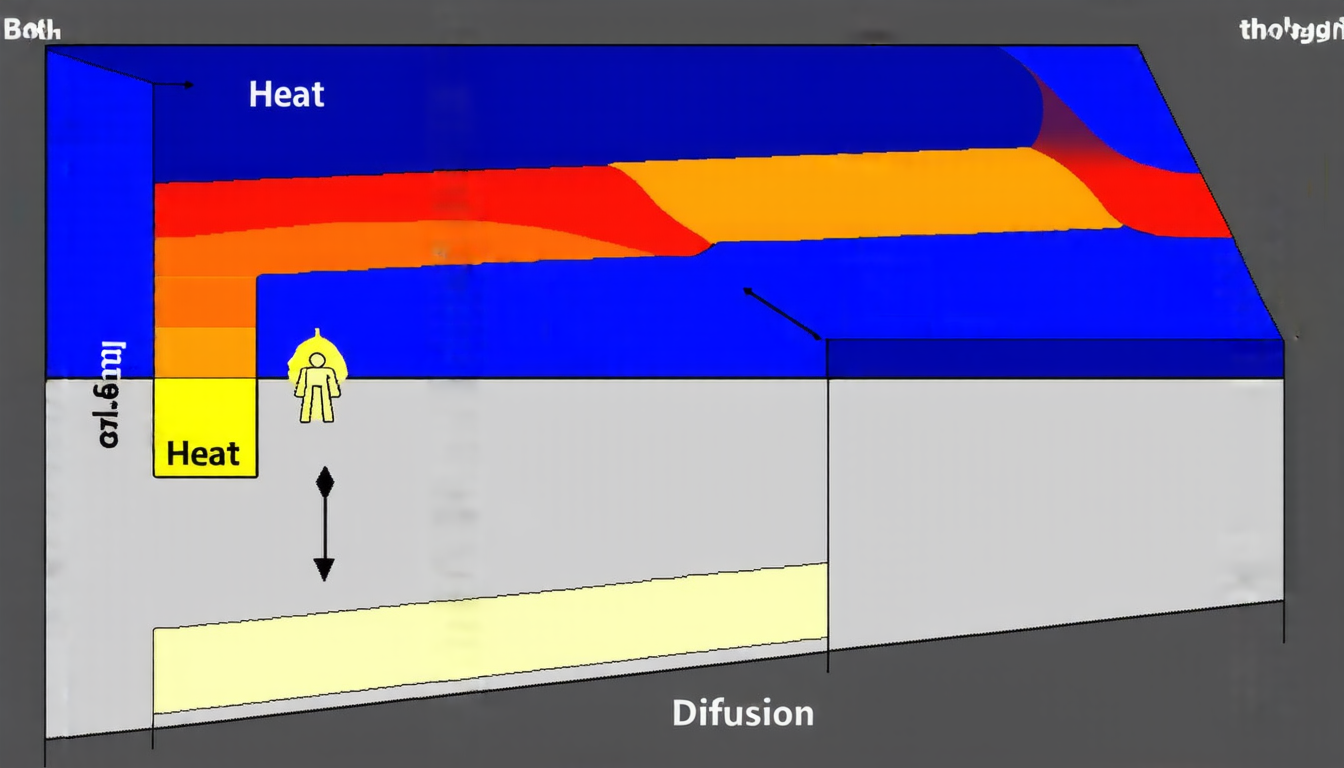
The researchers used this new method to solve several test cases, including the heat equation, a fundamental equation in physics that describes how heat diffuses through materials over time. They found that their method was able to accurately capture the behavior of the heat equation, even when the solution was highly complex and involved multiple scales of spatial and temporal variation.
One of the key advantages of this new method is its ability to handle problems with complex geometries and boundary conditions. In traditional finite element methods, these complexities can lead to difficulties in setting up the equations and solving them efficiently. The space-time finite element method, on the other hand, allows researchers to easily incorporate complex geometries and boundary conditions into their models.
The implications of this new method are far-reaching, with potential applications in fields such as climate modeling, materials science, and biomedical engineering. By allowing scientists to more accurately model complex phenomena, the space-time finite element method has the potential to revolutionize our understanding of the world around us.
In addition, the researchers used a technique called adaptive mesh refinement to further improve their results. This approach involves dividing the problem into smaller pieces and then refining those pieces that are most important for solving the equation accurately. By adaptively refining the mesh, scientists can achieve higher accuracy and efficiency than traditional methods.
The development of this new method is an exciting step forward in the field of computational mathematics, and it has the potential to greatly impact our ability to solve complex problems.
Cite this article: “Advancing Computational Mathematics: A New Framework for Solving Complex Equations”, The Science Archive, 2025.
Computational Mathematics, Finite Element Method, Space-Time Method, Heat Equation, Complex Geometry, Boundary Conditions, Climate Modeling, Materials Science, Biomedical Engineering, Adaptive Mesh Refinement.





