

Thursday 27 March 2025
The study of high-intensity laser beams has led to some astonishing discoveries in recent years. One area that has garnered significant attention is the phenomenon of quantum electrodynamics (QED) cascades, where the intense electromagnetic fields generated by these lasers can create an abundance of particles and antiparticles.
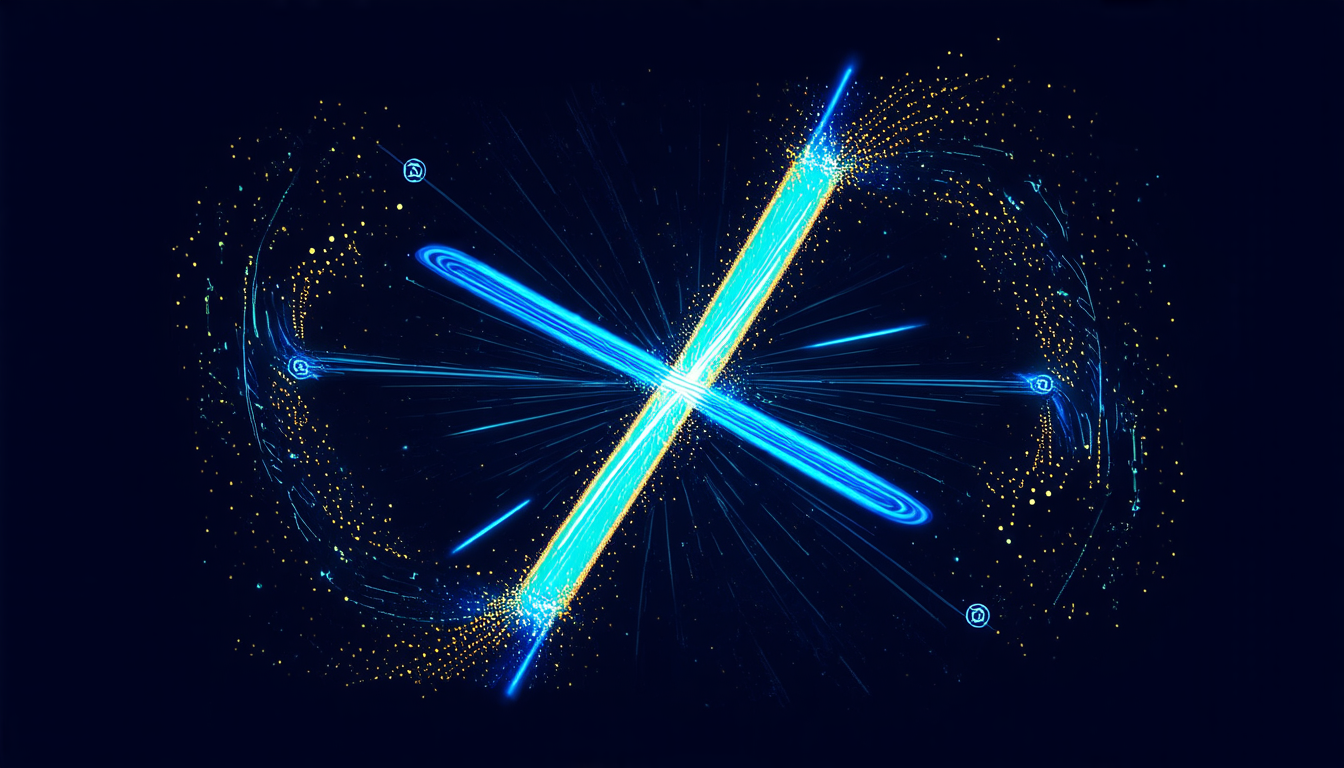
In a new paper published recently, researchers have delved deeper into this fascinating topic, shedding light on the dynamics of ultrarelativistic electrons in counterpropagating laser beams. These beams are essentially two laser pulses that travel in opposite directions, creating a unique environment for particle interactions.
The study begins by examining the behavior of electrons in such an environment. When these electrons interact with the intense electromagnetic fields generated by the lasers, they can gain energy and emit radiation. However, this process is not without its challenges, as the electrons must navigate the complex landscape of electric and magnetic fields to achieve this goal.
To better understand this phenomenon, the researchers employed a combination of analytical and numerical methods to solve the Dirac equation, which describes the behavior of relativistic particles like electrons. By using these methods, they were able to calculate the wave functions for the electrons in the presence of the laser beams, providing valuable insights into their dynamics.
One key finding of the study is that the spin dynamics of the electrons play a crucial role in the QED cascade process. The researchers found that the spin orientation of the electrons can affect the probability of particle creation, with certain orientations leading to a greater likelihood of pair production.
The study also highlights the importance of the relativistic nature of the electrons. As these particles approach the speed of light, their energy and momentum increase dramatically, leading to an enhancement of the QED cascade process.
In addition to providing new insights into the physics of high-intensity laser beams, this research has significant implications for a range of fields, from particle accelerators to astrophysics. The ability to create intense electromagnetic fields in the laboratory provides a unique opportunity to study phenomena that are difficult or impossible to observe naturally.
The findings of this study also underscore the potential of QED cascades as a tool for generating high-energy particles and radiation. This could have significant applications in areas such as medicine, materials science, and national security.
Overall, this research represents an important step forward in our understanding of the complex interactions that occur when high-intensity laser beams interact with matter.
Cite this article: “Unveiling the Dynamics of QED Cascades in Counterpropagating Laser Beams”, The Science Archive, 2025.
High-Intensity Lasers, Quantum Electrodynamics, Qed Cascades, Ultrarelativistic Electrons, Counterpropagating Laser Beams, Particle Interactions, Dirac Equation, Spin Dynamics, Relativistic Particles, Electromagnetic Fields.





