

Thursday 27 March 2025
A team of researchers has made significant progress in solving a long-standing problem in computer science: finding the most efficient way to cover a set of points using disks, or circular regions. This may seem like an abstract concept, but it has practical applications in fields such as robotics, sensor networks, and even agriculture.
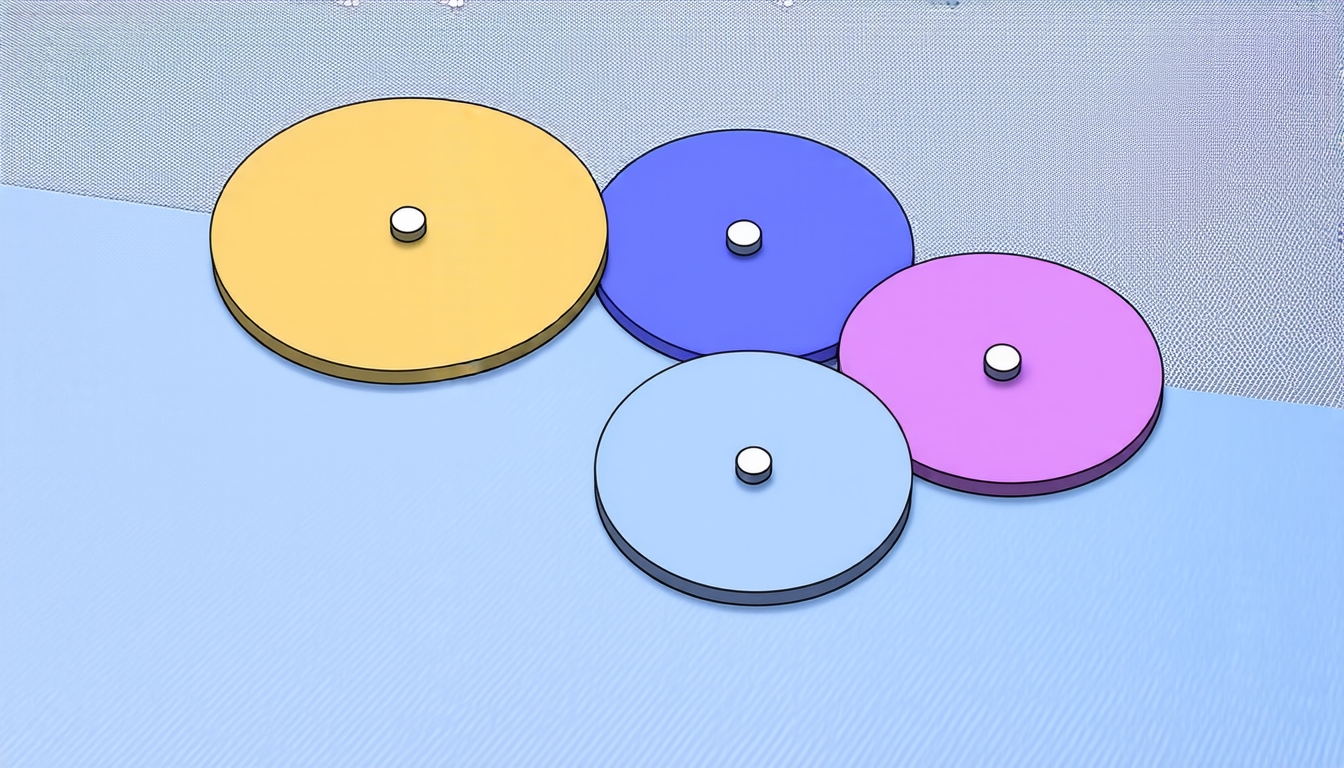
The problem is known as the multi-coverage problem, and it involves placing a limited number of disks over a set of points to ensure that each point is covered by at least a certain number of disks. This may sound simple, but it’s actually a complex optimization problem that requires finding the right balance between covering all the points and minimizing the total area of the disks.
The researchers used a combination of mathematical techniques and computer algorithms to develop a new solution to this problem. They started by identifying a set of candidate disk centers, or locations where the disks could be placed. Then, they used a type of mathematical programming called integer programming to find the optimal arrangement of disks that would cover all the points while minimizing the total area.
The team also developed a heuristic algorithm, which is a faster and more efficient way to solve the problem. This algorithm works by iteratively adjusting the positions and sizes of the disks until a good solution is found. While it’s not guaranteed to find the optimal solution, it’s much faster than the integer programming approach and can often produce very good results.
One of the key challenges in solving this problem is dealing with the separation constraints, which are requirements that ensure the disks don’t overlap or get too close to each other. The researchers developed a new technique for incorporating these constraints into their algorithm, which allowed them to solve larger instances of the problem than previously possible.
The applications of this technology are diverse and exciting. For example, in robotics, it could be used to design more efficient coverage patterns for autonomous vehicles or sensors. In agriculture, it could help farmers optimize their crop monitoring and pest control strategies by identifying the most effective placement of sensors or drones. And in sensor networks, it could improve the ability to detect and track targets while minimizing the number of sensors needed.
The researchers are already exploring new ways to apply their algorithm, including using it to design more efficient coverage patterns for wireless communication networks. With further development, this technology has the potential to transform a wide range of fields by providing faster, more efficient solutions to complex optimization problems.
Cite this article: “Efficient Disk Placement Algorithm Solves Multi-Coverage Problem”, The Science Archive, 2025.
Computer Science, Multi-Coverage Problem, Disks, Circular Regions, Robotics, Sensor Networks, Agriculture, Optimization Problem, Integer Programming, Heuristic Algorithm





