

Thursday 27 March 2025
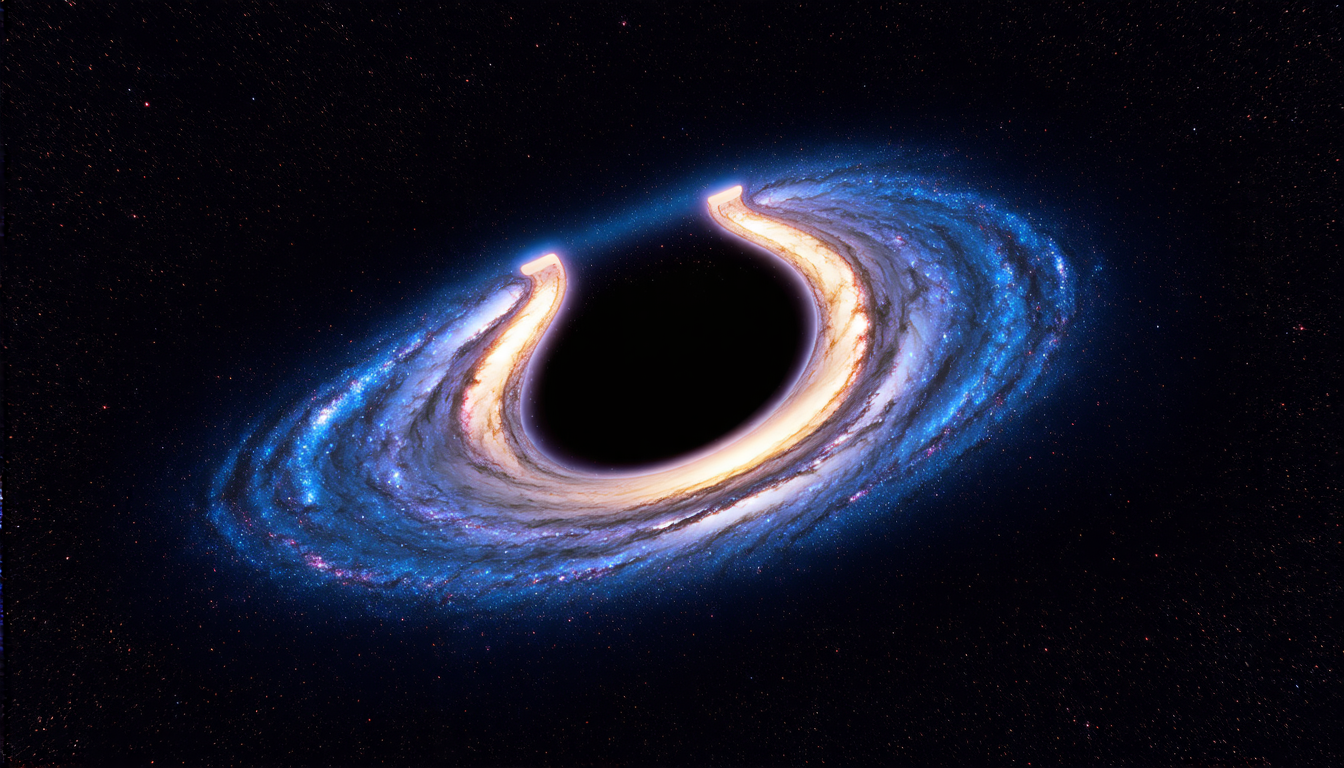
The Cosmic Horseshoe, a galaxy some 4 billion light-years away, has long been a fascination for astronomers. Its unique shape, resembling a horseshoe, is due to the gravitational lensing effect of a massive object at its center. Now, scientists have taken a closer look at this phenomenon and made a remarkable discovery.
Using advanced telescopes and sophisticated algorithms, researchers were able to reconstruct the mass distribution of the galaxy’s central region. They found that it harbors an ultramassive black hole (UMBH), with a mass of approximately 36 billion times that of our sun. This behemoth is one of the most massive known in the universe, and its presence has significant implications for our understanding of galaxy evolution.
The team used a combination of observations from the Hubble Space Telescope and spectroscopic data from the MUSE instrument to model the galaxy’s central mass distribution. They also employed a novel approach, combining 2D stellar dynamics with lens modeling to constrain the SMBH mass. This method allowed them to accurately determine the black hole’s mass, which is crucial for understanding its role in shaping the galaxy.
The discovery of such an enormous black hole has significant implications for our understanding of galaxy evolution. It suggests that supermassive black holes like this UMBH may have played a more important role in shaping the formation and growth of massive galaxies than previously thought. The team’s findings also highlight the importance of gravitational lensing as a tool for studying these enigmatic objects.
The researchers used observations from the Hubble Space Telescope to study the galaxy’s central region, taking advantage of its unique horseshoe shape caused by the gravitational lensing effect of the black hole. By analyzing the distortions and magnifications of background galaxies, they were able to map the mass distribution of the central region with unprecedented precision.
The team’s results provide valuable insights into the complex interplay between supermassive black holes and their host galaxies. The discovery of this UMBH in the Cosmic Horseshoe galaxy highlights the importance of continued astronomical research, as it opens up new avenues for understanding the evolution of massive galaxies and the role of supermassive black holes within them.
In a remarkable feat of scientific detective work, researchers have uncovered the secrets of the Cosmic Horseshoe’s central region. Their findings not only shed light on the enigmatic behavior of supermassive black holes but also underscore the importance of continued exploration into the mysteries of the universe.
Cite this article: “Unveiling the Secrets of the Cosmic Horseshoes Enormous Black Hole”, The Science Archive, 2025.
Galaxy Evolution, Supermassive Black Holes, Gravitational Lensing, Cosmic Horseshoe, Ultramassive Black Hole, Hubble Space Telescope, Muse Instrument, Stellar Dynamics, Lens Modeling, Galaxy Formation





