

Thursday 27 March 2025
The way liquids move through narrow tubes has fascinated scientists for decades. From the way water flows up a straw to the way blood circulates through our veins, understanding the dynamics of fluid flow is crucial for many fields, including medicine and engineering. Recently, researchers have made significant progress in modeling this phenomenon, shedding light on the intricate dance between surface tension and pressure that governs fluid motion.
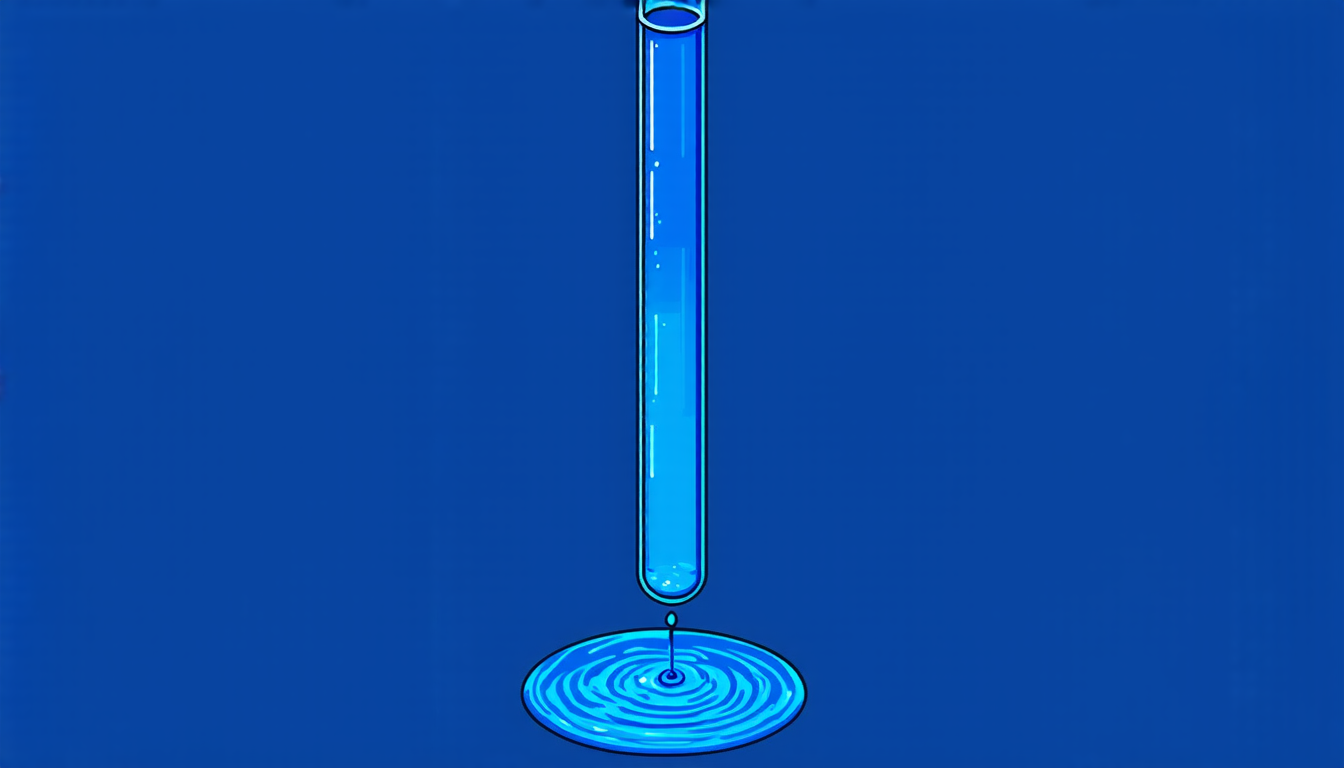
Washburn’s equation, named after its discoverer E.W. Washburn, describes the rate at which a liquid rises up a vertical tube when driven by capillary forces. These forces arise from the interactions between the liquid molecules at the interface with the tube walls. By studying this process, scientists aim to understand how fluids behave in narrow spaces and how they can be controlled.
To develop Washburn’s equation, researchers used a combination of mathematical techniques and physical principles. They started by considering the fundamental laws of physics that govern fluid flow: mass conservation, momentum balance, and energy balance. These laws describe how the density, velocity, and pressure of the fluid change over time and space.
By applying these laws to the specific problem of capillary rise, scientists derived a set of equations that describe the motion of the fluid as it rises up the tube. The resulting equation, Washburn’s equation, is a nonlinear partial differential equation that takes into account both the surface tension and pressure forces acting on the fluid.
One of the key features of this equation is its ability to capture the complex dynamics of capillary flow. In particular, it shows how the rate at which the liquid rises up the tube depends not only on the surface tension but also on the pressure gradient along the tube. This relationship has important implications for our understanding of fluid behavior in narrow spaces.
The development of Washburn’s equation has significant implications for various fields, including biology, chemistry, and engineering. For example, it can be used to design more efficient systems for transferring fluids through narrow tubes, such as in medical devices or chemical processing plants. It also provides a new framework for understanding the behavior of fluids in complex systems, such as those found in living organisms.
In addition to its practical applications, Washburn’s equation has shed light on some fundamental aspects of fluid dynamics. For example, it shows how the surface tension and pressure forces interact to shape the flow of the fluid. This interaction is crucial for understanding many natural phenomena, from the way water flows up a straw to the way blood circulates through our veins.
Cite this article: “Unraveling the Dynamics of Fluid Flow: Washburns Equation and its Significance”, The Science Archive, 2025.
Fluid Dynamics, Capillary Forces, Washburn’S Equation, Surface Tension, Pressure Gradient, Nonlinear Partial Differential Equations, Fluid Flow, Mass Conservation, Momentum Balance, Energy Balance





