

Thursday 27 March 2025
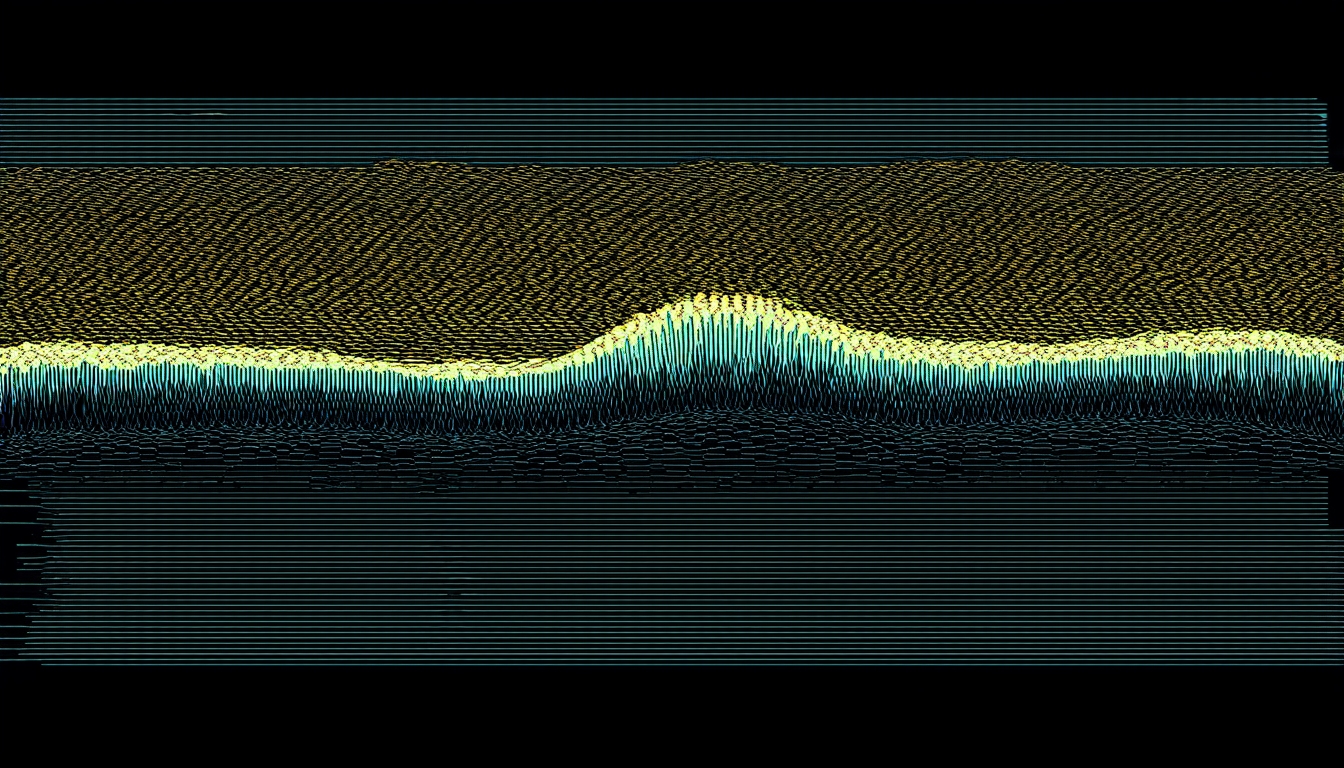
The quest for noise-free seismic data has long been a challenge for researchers and engineers in the field of geophysics. Seismic data, which is used to study earthquakes and other subsurface phenomena, is often plagued by random noise that can obscure important signals. But a new approach, based on a technique called triply Laplacian scale mixture modeling, may hold the key to suppressing this noise and unlocking new insights.
The problem of noise in seismic data is particularly vexing because it’s difficult to distinguish between the signal you’re trying to study and the random variations that are just noise. Traditional methods for addressing this issue rely on statistical models that assume a certain level of stationarity, or stability, in the signal. But these assumptions often break down when dealing with complex geological phenomena.
The new approach, which was developed by researchers at Jilin University and published recently in a scientific journal, takes a different tack. Instead of relying on statistical models, it uses a technique called Laplacian scale mixture modeling to separate the signal from the noise. This method is based on the idea that the noise in seismic data can be represented as a mixture of random variables with different scales.
The researchers used this approach to analyze a dataset of seismic data collected at a site in China. They found that by applying the Laplacian scale mixture model, they were able to suppress the noise and reveal subtle patterns in the data that had previously been obscured. These patterns, which are thought to be related to geological structures beneath the surface, could potentially be used to improve our understanding of earthquakes and other subsurface phenomena.
The implications of this work extend beyond the field of geophysics. The technique developed by the researchers could also be used in other fields where noisy data is a problem, such as medical imaging or audio processing. And the ability to suppress noise in seismic data could have significant practical applications, such as improving our ability to detect and predict earthquakes.
The research was funded by several government agencies, including the National Natural Science Foundation of China and the China Scholarship Council. The researchers plan to continue refining their technique and exploring its potential applications in the coming years.
In this approach, a new method is proposed to suppress noise in seismic data, which is based on triply Laplacian scale mixture modeling. This method can effectively separate signal from noise by considering different scales of random variables.
Cite this article: “Suppressing Noise in Seismic Data with Triply Laplacian Scale Mixture Modeling”, The Science Archive, 2025.
Seismic Data, Noise Suppression, Laplacian Scale Mixture Modeling, Triply Laplacian, Signal Processing, Geophysics, Earthquakes, Subsurface Phenomena, Statistical Models, Random Variables





