

Thursday 27 March 2025
Researchers have long relied on Q-learning, a fundamental concept in reinforcement learning, to help agents learn optimal behaviors in complex environments. However, a recent study has revealed that this approach may be fundamentally flawed, leading to instability and poor performance.
The problem lies in the structure of the true Q-function, which is typically approximated using function approximators such as neural networks. In simple terms, the true Q-function is not continuous, but rather exhibits discontinuities or sharp changes in value. This means that even with perfect knowledge of the environment, an agent may still struggle to learn optimal policies.
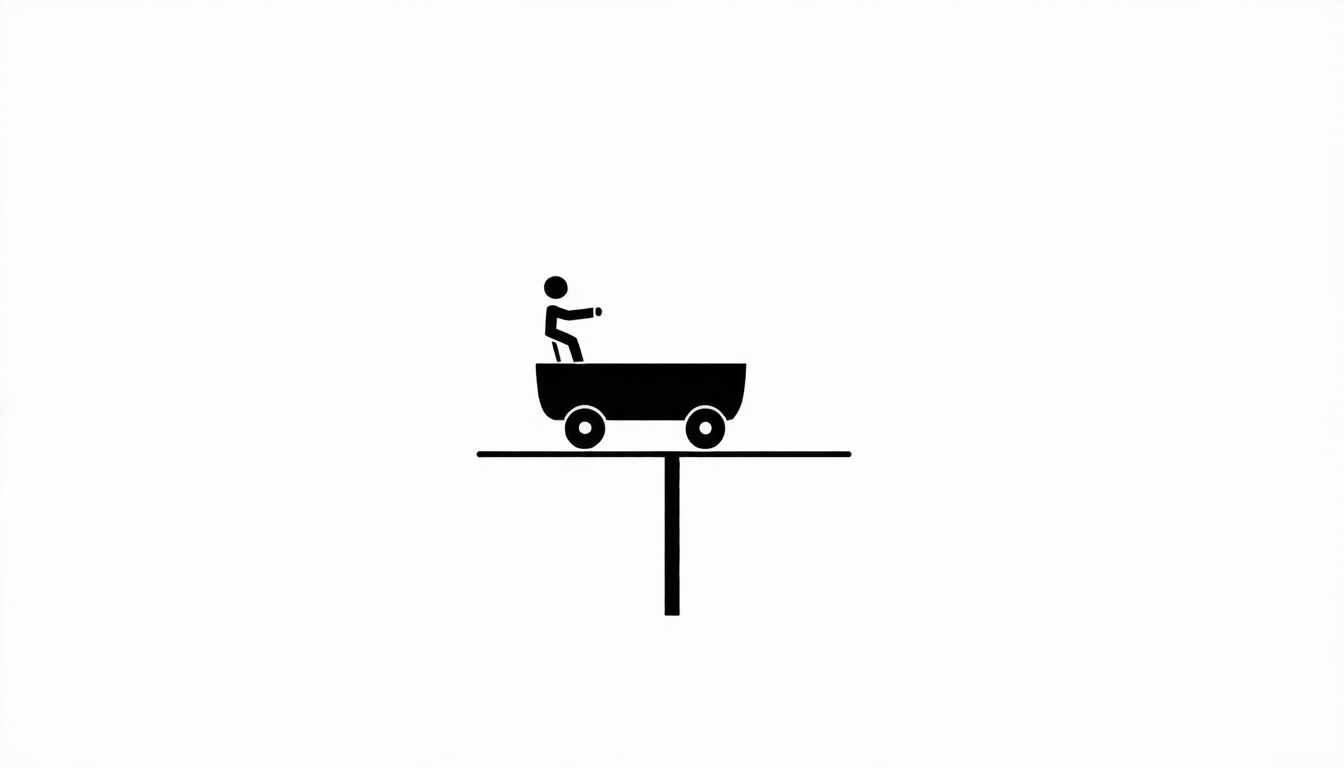
The study’s authors used a classic reinforcement learning benchmark, the cart-pole balancing task, to demonstrate this issue. They found that even after eliminating potential sources of error, such as imperfect transition models, the learned Q-functions still failed to capture the true structure of the environment.
One key finding was that the discontinuities in the true Q-function led to significant differences in policy performance between iterations. In other words, a successful policy learned in one iteration may not generalize well to subsequent iterations. This is because the true Q-function is inherently noisy and difficult to approximate accurately.
The authors also showed that this issue is not unique to Q-learning, but rather applies to any method that uses sample-based evaluation of return values or Q-functions. This includes many popular reinforcement learning algorithms, such as policy gradient methods and deep reinforcement learning approaches.
So what does this mean for the field of reinforcement learning? In short, it suggests that researchers may need to rethink their approach to approximating complex environments. Rather than relying solely on function approximators, they may need to develop new methods that can better capture the true structure of the environment.
The study’s findings also have implications for real-world applications of reinforcement learning. For example, in robotics or autonomous vehicles, an agent’s ability to learn optimal behaviors is critical. However, if the learned policies are unstable or prone to collapse, this could have significant safety and reliability implications.
Ultimately, the research highlights the need for a deeper understanding of the fundamental limitations of Q-learning and other reinforcement learning methods. By acknowledging these limitations, researchers can begin to develop more robust and effective approaches to solving complex problems in AI and robotics.
Cite this article: “Flaws in Reinforcement Learning: A Fundamental Limitation of Q-Learning”, The Science Archive, 2025.
Reinforcement Learning, Q-Learning, Function Approximators, Neural Networks, Cart-Pole Balancing Task, Policy Performance, Sample-Based Evaluation, Return Values, Q-Functions, Robotics





