
Thursday 27 March 2025
For centuries, mathematicians have been fascinated by geometric shapes and their properties. One of the most intriguing areas of study is the realm of configurations – collections of points and lines that meet certain criteria. Recently, a team of researchers has made significant progress in understanding the Gray configuration, a specific type of arrangement that has garnered attention from experts for its unique symmetries.
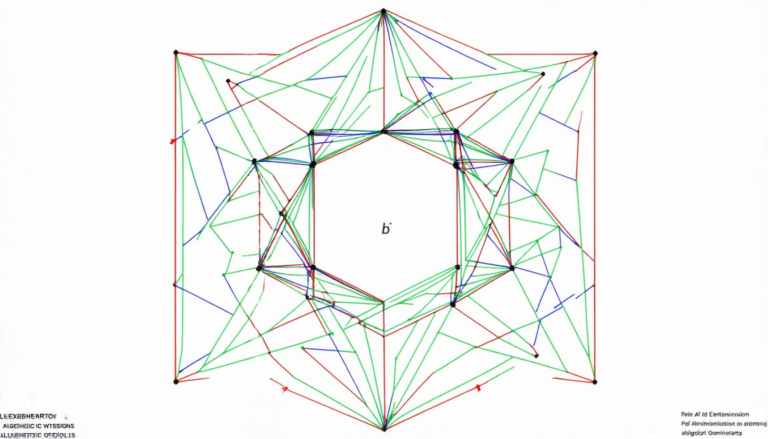
The Gray configuration is a 3-dimensional shape composed of 27 points and 81 lines. It’s a peculiar arrangement, with each point connected to three lines and each line passing through two points. This setup may seem simple, but it has led mathematicians down a rabbit hole of complexity and beauty.
One of the most striking aspects of the Gray configuration is its rotational symmetry. When viewed from different angles, the shape appears identical, with its lines and points aligned perfectly. This property makes it an ideal subject for study in graph theory, a branch of mathematics that examines the relationships between objects.
The researchers’ work focuses on geometric realizations – physical representations of the Gray configuration using straight lines or curved paths. Their findings reveal that there are two distinct ways to draw the Gray configuration with rotational symmetry. The first approach uses only straight lines, resulting in a symmetrical but imperfect representation. The second method employs curved paths, creating a more accurate and aesthetically pleasing depiction.
The team’s investigation also delves into the properties of the Gray configuration’s automorphism group – the set of transformations that leave the shape unchanged. This group contains subgroups with cyclic structures, which are essential for understanding the configuration’s symmetries.
One of the most intriguing implications of the researchers’ work is its connection to other areas of mathematics and geometry. The Gray configuration has been linked to combinatorial configurations, which describe the relationships between objects in a more abstract sense. This relationship opens up new avenues for exploration, potentially leading to breakthroughs in fields such as topology and graph theory.
The study of geometric shapes like the Gray configuration is not merely an exercise in mathematical curiosity. These shapes have real-world applications in fields like computer science, engineering, and architecture. By better understanding their properties and symmetries, researchers can develop new algorithms and models for solving complex problems.
As mathematicians continue to unravel the mysteries of the Gray configuration, they are also pushing the boundaries of our understanding of geometry and symmetry. The beauty of mathematics lies not only in its abstract concepts but also in its ability to describe and predict the world around us.
Cite this article: “Unveiling the Secrets of the Gray Configuration”, The Science Archive, 2025.
Geometry, Symmetry, Gray Configuration, Graph Theory, Automorphism Group, Combinatorial Configurations, Topology, Computer Science, Engineering, Architecture