

Friday 28 March 2025
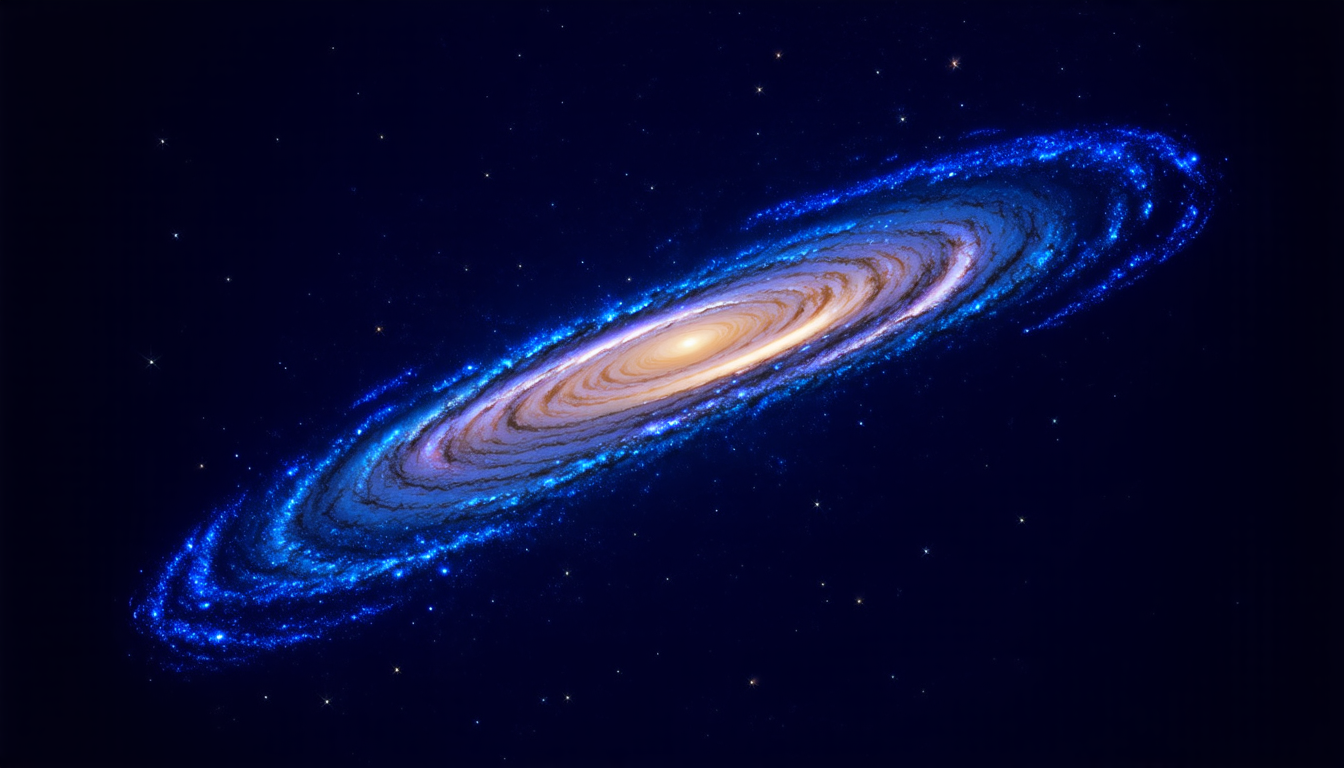
A team of astronomers has made a significant discovery, providing new insights into the fundamental laws of physics and the evolution of our universe. By analyzing data from observations of the Andromeda galaxy, also known as M31, scientists have been able to test the constancy of physical constants over time.
The fundamental constants of nature, such as the speed of light and the gravitational constant, are believed to be fixed and unchanging. However, some theories suggest that these constants may vary slightly over the course of cosmic history. Detecting such variations would provide crucial evidence for our understanding of the universe’s evolution and potentially reveal new physics beyond the Standard Model.
Researchers used simultaneous observations of hydrogen (H I) and hydroxyl (OH) lines in M31 to probe potential changes in fundamental physical constants at a look-back time of 2.5 million years. This is a critical timescale, as it bridges the gap between laboratory experiments and cosmological observations. By analyzing the spectra of these lines, scientists were able to constrain variations in the combination of constants known as mu alpha squared g0.64 p.
The results show that any changes in this combination are limited to an extremely small scale, with a precision of 3.6 x 10^-6. This is equivalent to a rate of change of approximately 1.4 x 10^-12 per year. These findings provide powerful new constraints on theories predicting variations in fundamental physical constants.
One of the key challenges in this research was eliminating potential systematic errors that could affect the accuracy of the results. To achieve this, scientists used simultaneous observations of multiple lines and carefully controlled for instrumental frequency registration accuracy and other sources of error.
The significance of these findings extends beyond the realm of pure physics. By testing the constancy of fundamental physical constants over time, researchers are also probing the evolution of our universe on a cosmic scale. Any variations in these constants could have implications for our understanding of the universe’s origins, its expansion, and even the nature of dark matter.
Future observations with next-generation facilities like the Square Kilometre Array (SKA) will likely further refine these constraints, potentially revealing new physics beyond the Standard Model. For now, however, this discovery represents a major milestone in the quest to understand the fundamental laws of the universe.
In the process of testing the constancy of physical constants, scientists are also gaining valuable insights into the evolution of our universe.
Cite this article: “Unlocking the Secrets of Cosmic Evolution: New Constraints on Fundamental Physical Constants”, The Science Archive, 2025.
Andromeda Galaxy, Fundamental Laws Of Physics, Physical Constants, Speed Of Light, Gravitational Constant, Cosmic History, Universe’S Evolution, Standard Model, Dark Matter, Square Kilometre Array.





