

Friday 28 March 2025
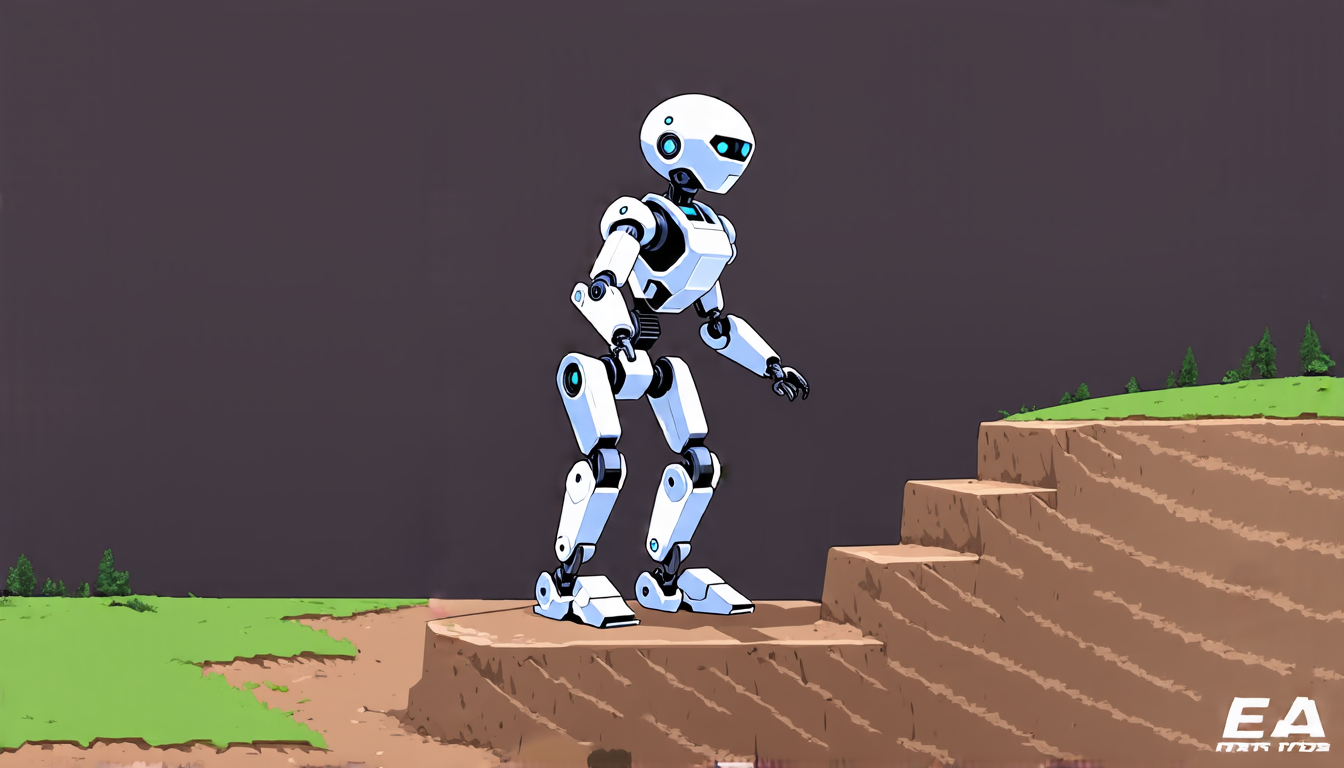
As robots continue to evolve, they’re becoming increasingly adept at navigating complex environments. But what happens when these robots encounter obstacles that are difficult or impossible for them to overcome? A team of researchers has developed a new system that enables humanoid robots to adapt to challenging terrain and obstacles by combining the strengths of both vision-based and proprioception-based policies.
The key innovation is a framework called VB-Com, which allows the robot to dynamically switch between these two types of policies depending on the situation. The vision-based policy relies on cameras and sensors to perceive its environment, while the proprioception-based policy uses data from the robot’s own movements and joint angles to inform its actions.
In simulations, VB-Com enabled the humanoid robots to successfully traverse challenging terrain, including gaps and hurdles, by switching between the two policies as needed. The system was also able to adapt to changes in the environment, such as new obstacles or shifting terrain.
One of the main challenges in developing this system was finding a way to effectively combine the strengths of both vision-based and proprioception-based policies. The researchers achieved this by using a neural network to learn a mapping between the robot’s observations and the optimal policy to follow.
The team also developed a novel reward function that encourages the robot to adapt to challenging terrain and obstacles while maintaining a smooth and efficient motion style. This reward function is based on a combination of factors, including the robot’s speed, acceleration, and joint angles, as well as its distance from the ground and the orientation of its feet.
The potential applications of VB-Com are vast. In addition to enabling humanoid robots to navigate complex environments with greater ease, it could also be used to develop more advanced autonomous systems, such as self-driving cars or drones.
As robots continue to become increasingly sophisticated, they’ll need to be able to adapt to a wide range of environments and situations. VB-Com is an important step towards achieving this goal, and its potential impact on the field of robotics could be significant.
The system was tested using two humanoid robot platforms, Unitree G1 and H1, which are designed for research and development in the field of humanoid robotics. The results showed that VB-Com enabled the robots to successfully navigate challenging terrain and obstacles, while also maintaining a smooth and efficient motion style.
Overall, VB-Com is an innovative system that has the potential to greatly improve the performance of humanoid robots in complex environments.
Cite this article: “Adaptive Robotics: Enabling Humanoid Robots to Navigate Complex Environments with VB-Com”, The Science Archive, 2025.
Humanoid Robots, Vb-Com, Robotics, Navigation, Obstacles, Terrain, Vision-Based Policy, Proprioception-Based Policy, Neural Network, Reward Function





