
Friday 28 March 2025
A team of mathematicians has made a significant breakthrough in understanding the properties of surface braid groups, which have implications for our comprehension of complex systems and their behavior.
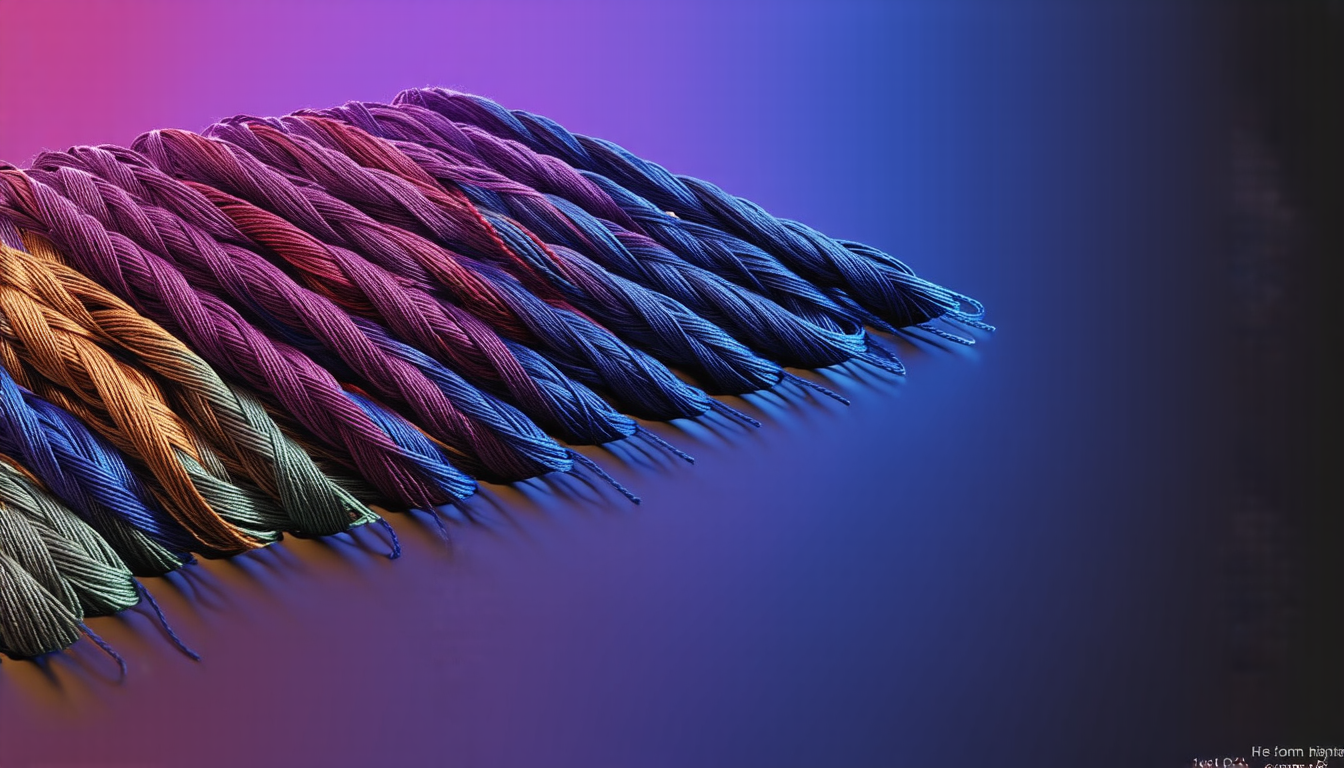
Surface braid groups are abstract mathematical structures that describe the way threads can be braided together on a surface. They’re used to model real-world phenomena like fluid dynamics, electrical circuits, and even the behavior of subatomic particles. However, these groups have proven difficult to study due to their complexity.
The researchers focused on a specific property called R∞-property, which describes the number of twisted conjugacy classes in a group. Twisted conjugacy classes are sets of elements that can be transformed into each other by applying a series of transformations. The R∞-property is important because it determines how many of these classes exist in a group.
The team discovered that surface braid groups exhibit the R∞-property, meaning they have an infinite number of twisted conjugacy classes. This finding has significant implications for our understanding of complex systems. For instance, it suggests that even seemingly simple systems can exhibit incredibly complex behavior when studied at a deeper level.
One of the key challenges in studying surface braid groups is their immense size. The groups are too large to be fully computed or analyzed by hand, making numerical methods essential. The researchers developed new computational techniques to tackle this problem, allowing them to study these groups in unprecedented detail.
The findings also have implications for other areas of mathematics and physics. For example, the R∞-property has been linked to the behavior of black holes and the structure of spacetime itself. Understanding the properties of surface braid groups can shed light on these fundamental questions.
The research demonstrates the importance of interdisciplinary collaboration between mathematicians and physicists. By combining their expertise, they were able to make a significant breakthrough that could have far-reaching implications for our understanding of complex systems.
In the future, this research may lead to new insights into the behavior of complex systems, allowing us to better understand and model real-world phenomena. It’s an exciting development that has the potential to revolutionize our understanding of the world around us.
Cite this article: “Unlocking the Secrets of Surface Braid Groups”, The Science Archive, 2025.
Mathematics, Physics, Surface Braid Groups, R∞-Property, Complex Systems, Twisted Conjugacy Classes, Black Holes, Spacetime, Interdisciplinary Collaboration, Computational Techniques