

Friday 28 March 2025
Scientists have long been fascinated by the peculiar properties of amino acids, the building blocks of life. Among these, cysteine stands out for its unique behavior when exposed to different environments. In a recent study, researchers have discovered that cysteine exhibits distinct fluorescent properties in water and heavy water.
Cysteine is one of the 20 essential amino acids found in proteins, playing a crucial role in various biological processes. Its sulfur-containing group allows it to form disulfide bonds with other cysteine molecules, giving it remarkable chemical reactivity. However, this reactivity also makes it challenging to study, as its interactions with water and other substances can be complex.
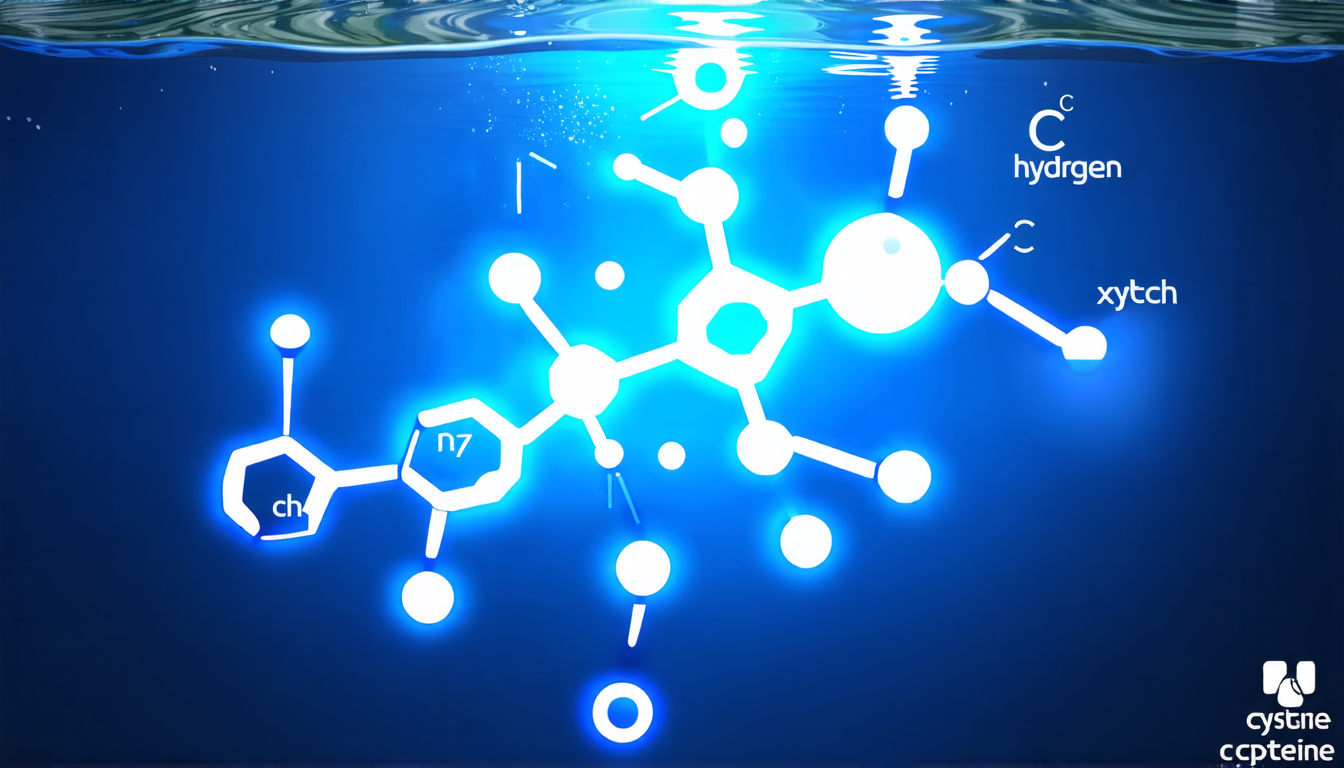
In the study, scientists explored the behavior of cysteine in both regular water (H2O) and heavy water (D2O), where deuterium replaces hydrogen atoms. They found that when exposed to D2O, cysteine exhibited a previously unknown photoluminescence property – it glows under certain wavelengths of light.
This phenomenon is attributed to the unique interactions between cysteine’s sulfur group and the heavier isotopes in D2O. The increased mass of deuterium modifies the way water molecules interact with cysteine, altering its electronic structure and leading to this extraordinary fluorescent response.
In contrast, when exposed to regular H2O, cysteine does not exhibit this photoluminescence property. This difference highlights the sensitivity of cysteine’s behavior to changes in its environment, demonstrating how even small variations can have significant effects on molecular interactions.
The discovery of cysteine’s fluorescence in D2O has implications for various fields, including biotechnology and materials science. For instance, this property could be exploited for the development of new sensors or biomarkers that detect specific biological processes.
Moreover, understanding the mechanisms behind cysteine’s behavior in different environments can provide valuable insights into the fundamental principles governing molecular interactions. This knowledge can be applied to other areas, such as the study of protein folding, where small changes in environmental conditions can significantly impact protein structure and function.
The study of cysteine’s photoluminescence properties in D2O is a testament to the power of interdisciplinary research. By combining expertise from chemistry, biology, and physics, scientists are able to uncover new phenomena that shed light on the intricate mechanisms governing molecular behavior.
Cite this article: “Cysteines Hidden Glow: Unveiling its Photoluminescent Properties in Heavy Water”, The Science Archive, 2025.
Amino Acids, Cysteine, Fluorescent Properties, Heavy Water, D2O, Photoluminescence, Molecular Interactions, Biotechnology, Materials Science, Protein Folding





