

Friday 28 March 2025
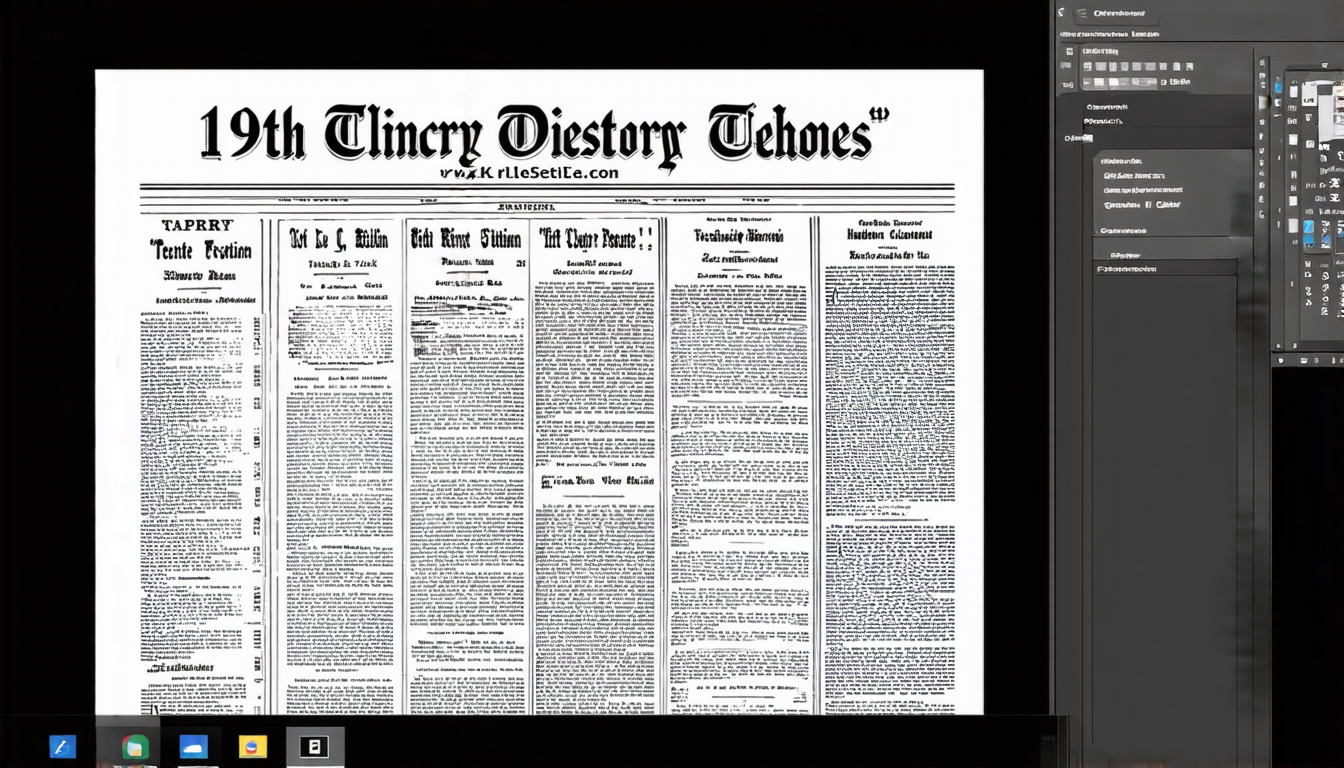
The digital archive of 19th-century English newspapers has been transformed into a treasure trove of information, thanks to a new method developed by researchers. This innovative approach uses image-to-text language models to decipher and transcribe the texts, making it possible to analyze and understand these historical documents like never before.
In the 19th century, newspapers were the primary means of disseminating news and information to the masses. However, many of these original papers have survived only in microfilm or digital formats, often with poor-quality scans that make reading and understanding the content a challenging task. The lack of access to these historical records has hindered researchers from fully exploring this period of significant social and political change.
To address this issue, the researchers developed a pre-trained image-to-text model called Pixtral 12B, which was trained on a vast dataset of images and corresponding text transcriptions. This model was then applied to the digitized 19th-century English newspapers, allowing for the automatic recognition and transcription of the texts.
The results are nothing short of remarkable. The researchers were able to achieve a median character error rate of just 1%, significantly lower than other OCR (optical character recognition) approaches. This means that the transcribed texts are incredibly accurate, making it possible to analyze and understand the content with unprecedented precision.
The implications of this breakthrough are far-reaching. Historians and researchers can now delve deeper into the past, exploring topics such as social change, politics, and cultural shifts in a more detailed and nuanced manner. The availability of high-quality transcriptions also opens up new possibilities for machine learning applications, allowing researchers to develop more sophisticated models that can analyze and make sense of large datasets.
One of the most significant benefits of this technology is its potential to democratize access to historical records. No longer will researchers be limited by their ability to physically access these documents or rely on manual transcription methods. Instead, they can now focus on analyzing and interpreting the data, leading to new insights and discoveries that can inform our understanding of the past.
The development of this technology also highlights the potential for collaboration between fields such as computer science, history, and linguistics. By combining cutting-edge machine learning techniques with historical research expertise, researchers can create innovative solutions that advance our knowledge in a wide range of areas.
In addition to its practical applications, this breakthrough also underscores the importance of preserving and digitizing historical documents.
Cite this article: “Unlocking the Past: A New Method for Transcribing 19th-Century Newspapers”, The Science Archive, 2025.
Here Are The Keywords: Historical Documents, 19Th-Century English Newspapers, Image-To-Text Language Models, Pixtral 12B, Ocr, Character Error Rate, Machine Learning, Data Analysis, Digitization, Preservation





