

Friday 28 March 2025
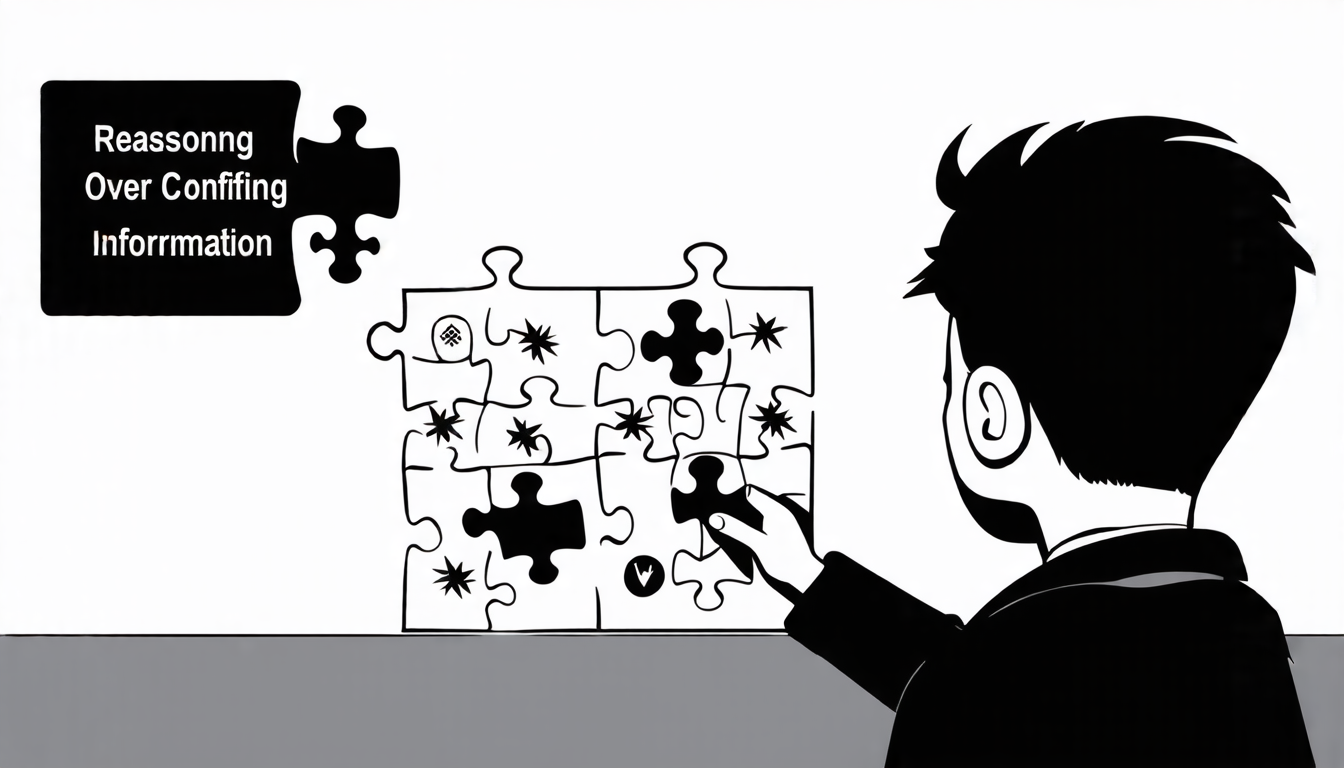
A team of researchers has developed a framework that enables large language models to better reason over multimodal information sources, such as images and text. The framework, called KOALA, applies targeted perturbations to image sources to study and improve the robustness of these models against different types of knowledge conflicts.
Large language models have made tremendous progress in recent years, but they often struggle when faced with conflicting information from multiple sources. For instance, if a model is asked to identify an object in an image, it may be unable to do so if the image has been manipulated or if the object’s properties are inconsistent across different sources.
KOALA addresses this issue by introducing three types of knowledge conflicts: parametric conflicts, which arise when the encoded knowledge in the model’s weights contradicts external information; source conflicts, which occur when two or more information sources provide contradictory information; and counterfactual conflicts, where a query cannot be answered with the given input information.
To tackle these conflicts, KOALA uses a novel approach that involves generating perturbed images to simulate real-world scenarios. The framework then fine-tunes large language models on these perturbed images, enabling them to better reason over multimodal information sources.
The results are impressive: KOALA-finetuned models outperform baseline models in identifying irrelevant images and answering questions based on incomplete information. In fact, the model’s performance improves significantly when faced with counterfactual conflicts, which is a challenging task that requires it to reason outside its training data.
One of the key advantages of KOALA is its ability to adapt to different domains and question types. For instance, the framework can be used to develop models that are specialized in image classification or object detection tasks. This adaptability makes KOALA a versatile tool for a wide range of applications, from visual question answering to multimodal language translation.
While KOALA has shown promising results, there is still much work to be done to ensure its widespread adoption. For instance, the framework requires significant computational resources and large amounts of labeled data to train effectively. Additionally, the model’s performance may degrade when faced with real-world scenarios that are vastly different from those encountered during training.
Despite these challenges, KOALA represents a significant step forward in the development of multimodal language models. Its ability to reason over conflicting information sources has the potential to revolutionize our understanding of language and cognition, and its adaptability makes it an exciting tool for researchers and developers alike.
Cite this article: “KOALA: A Framework for Reasoning Over Multimodal Information Sources”, The Science Archive, 2025.
Large Language Models, Multimodal Information, Image Processing, Knowledge Conflicts, Parametric Conflicts, Source Conflicts, Counterfactual Conflicts, Perturbations, Fine-Tuning, Multimodal Language Translation





