

Friday 28 March 2025
A team of researchers has developed a new algorithm that could help spacecraft land safely on the Moon by using visual information captured by cameras onboard. The system uses a combination of machine learning and mathematical techniques to estimate the position and attitude of the spacecraft in real-time, allowing it to make precise adjustments before landing.
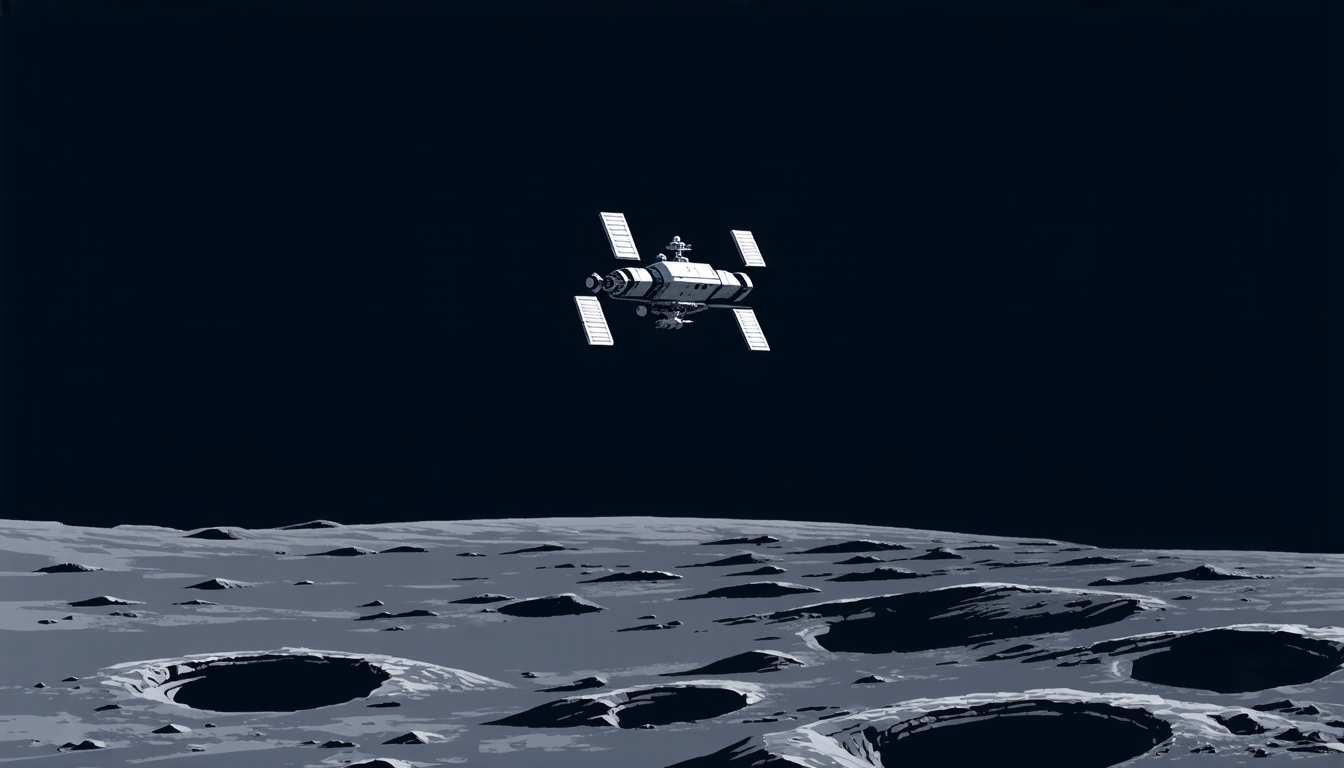
The algorithm works by identifying craters on the lunar surface and tracking their distance and direction from the spacecraft. By analyzing this data, the system can calculate the spacecraft’s position and orientation with high accuracy. This information is then used to adjust the spacecraft’s trajectory, ensuring a safe and controlled landing.
The researchers tested the algorithm using simulated scenarios of a spacecraft approaching the Moon’s surface. The results showed that the system was able to estimate the spacecraft’s position and attitude with an accuracy of just a few meters, even when faced with noisy or incomplete data.
One of the key challenges in developing this technology is dealing with the limited processing power available on spacecraft. To overcome this, the researchers used advanced mathematical techniques to optimize the algorithm’s performance, allowing it to run efficiently on existing hardware.
The potential benefits of this technology are significant. By providing a more accurate and reliable means of navigating the lunar surface, it could enable future missions to explore the Moon in greater detail and with greater precision. It could also pave the way for human settlements on the Moon, where precise landing and navigation would be crucial.
The algorithm is still in its early stages, but the researchers are optimistic about its potential. They plan to continue refining the system and testing it under a range of scenarios before deploying it on future missions. With further development, this technology could play a key role in unlocking the secrets of the Moon and opening up new possibilities for space exploration.
The algorithm’s ability to work with incomplete or noisy data is particularly significant, as it would allow it to function even when faced with unexpected challenges during a mission. This could include factors such as lunar dust storms or camera malfunctions, which could disrupt the normal functioning of the system.
By providing a more reliable and accurate means of navigating the lunar surface, this technology has the potential to revolutionize our understanding of the Moon and its history. It could also enable future missions to explore other celestial bodies with greater ease and precision, opening up new possibilities for space exploration.
The researchers’ focus on optimizing the algorithm’s performance for existing hardware is a key part of their approach.
Cite this article: “Algorithm Aids Lunar Landings with Precise Navigation”, The Science Archive, 2025.
Spacecraft, Moon, Algorithm, Machine Learning, Mathematical Techniques, Navigation, Lunar Surface, Precision Landing, Space Exploration, Optimization





