

Friday 28 March 2025
Scientists have made a significant breakthrough in understanding how stars are formed in our galaxy. By analyzing complex simulations, researchers have gained insight into the intricate processes that shape the birth of new stars.
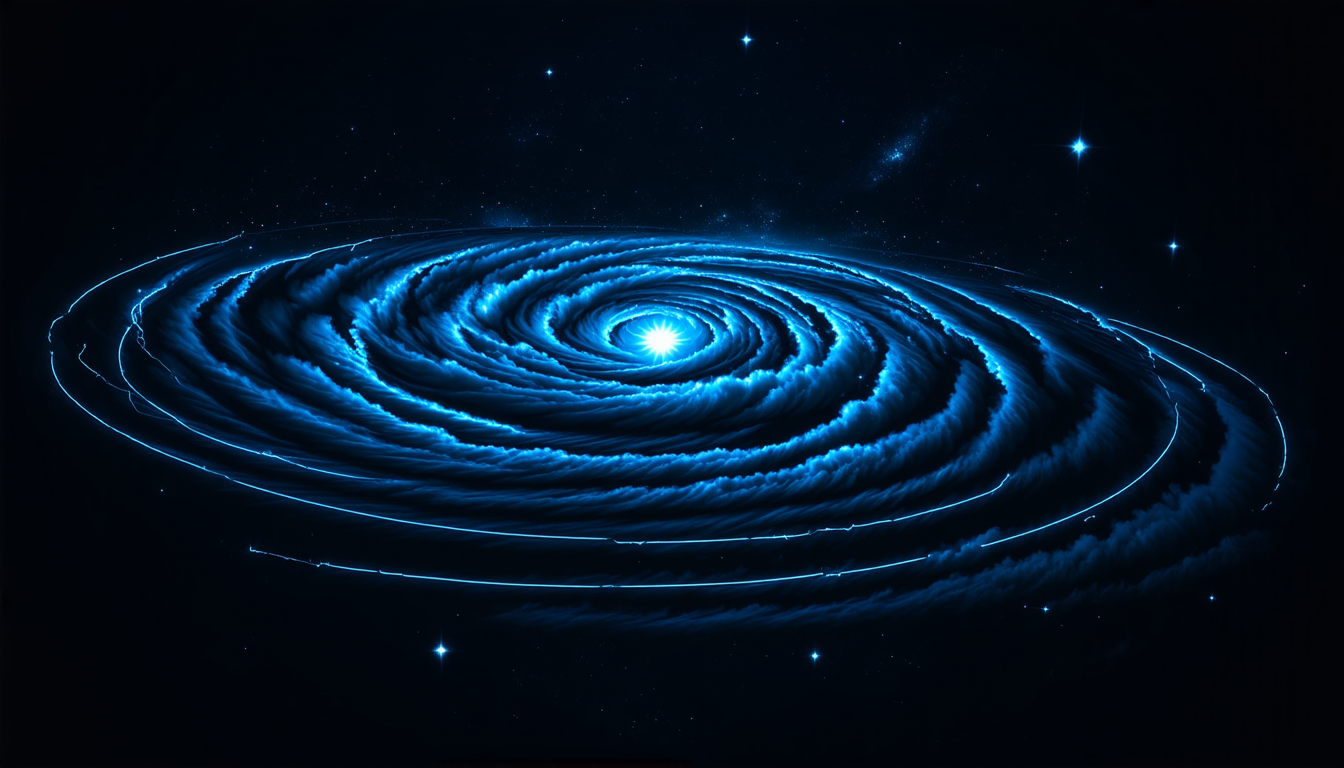
The process begins with dense clouds of gas and dust called molecular clouds, which collapse under their own gravity. As these clouds shrink, they spin faster and faster, causing them to flatten into disk-like shapes. At the center of this spinning disk, a protostar forms, gradually accumulating more mass as surrounding material falls towards it.
One of the key findings is that the majority of dense cores within these molecular clouds do not actually form stars. Instead, many of these cores disperse before reaching the critical density needed to spark star formation. This is likely due to external influences such as turbulence or nearby stellar winds disrupting their growth.
However, for those cores that do manage to reach this critical point, a complex interplay between gravity and magnetic fields determines whether they will collapse further and give rise to a protostar. The simulations suggest that the strength of the magnetic field plays a crucial role in shaping the outcome, with stronger fields inhibiting star formation.
The researchers have also identified distinct patterns in the properties of these dense cores, which can be used to predict their likelihood of forming stars. For example, cores with larger sizes and higher densities are more likely to collapse and form protostars. Similarly, those with lower magnetic field strengths are more susceptible to disruption by external influences.
These findings have significant implications for our understanding of the star formation process in general. They suggest that the formation of stars is a complex, multi-step process influenced by a range of factors, including the strength of magnetic fields and the presence of nearby stars.
The simulations also provide valuable insights into the properties of protostellar cores themselves. By analyzing the distribution of these cores within the molecular cloud, researchers can gain a better understanding of how they interact with their surroundings and shape the evolution of the star-forming region as a whole.
Overall, this research has shed new light on the intricate processes that govern the birth of new stars in our galaxy. By continuing to refine our understanding of these complex interactions, scientists hope to gain a deeper appreciation for the intricate dance between gravity, magnetism, and turbulence that shapes the universe around us.
Cite this article: “Unraveling the Mysteries of Star Formation in Our Galaxy”, The Science Archive, 2025.
Stars, Formation, Galaxy, Molecular Clouds, Protostars, Magnetic Fields, Gravity, Turbulence, Star-Formation, Simulations





