

Friday 28 March 2025
Radio telescopes, those giant dishes that help us explore the universe, are facing a new challenge: satellite interference. With the increasing number of low-earth orbit satellites in the sky, radio astronomers are finding it harder to study the cosmos without unwanted signals messing up their data.
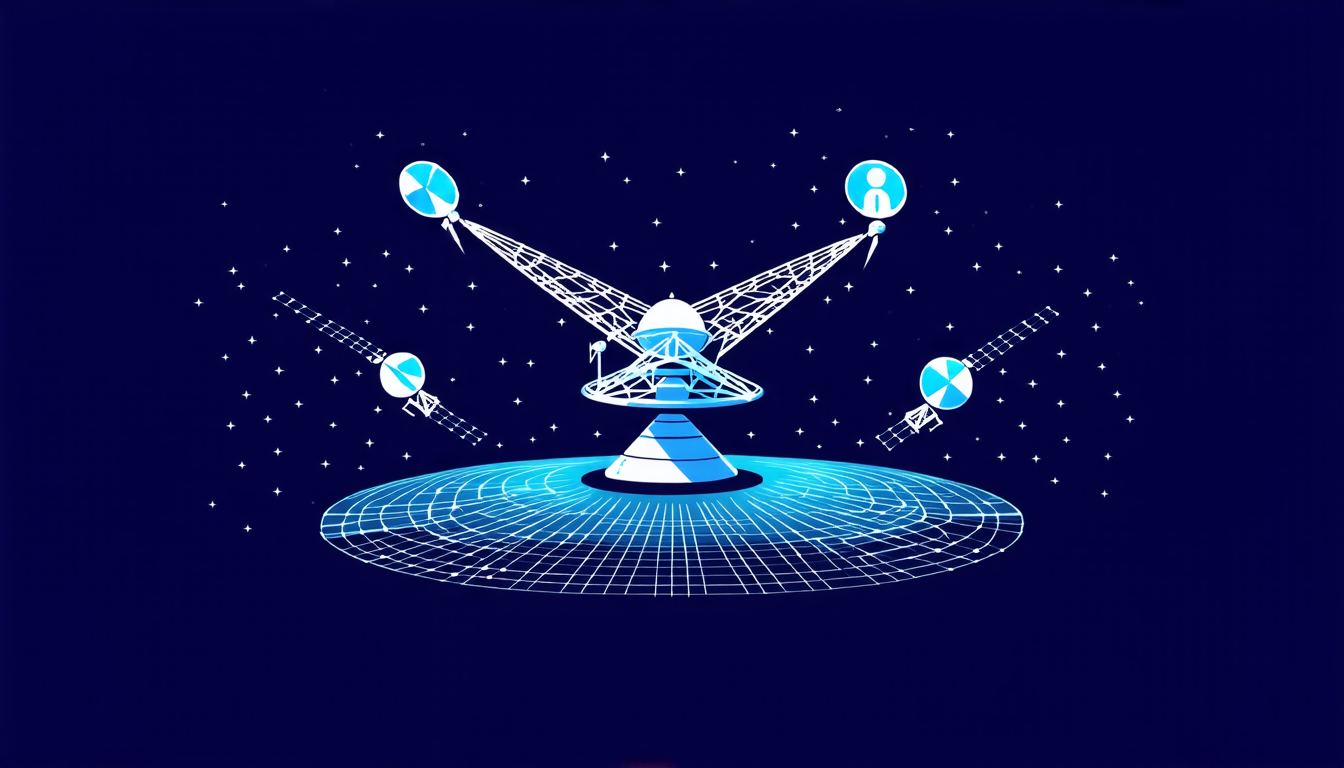
To combat this issue, scientists at the National Radio Astronomy Observatory (NRAO) have developed an innovative system called Operational Data Sharing (ODS). ODS is a platform that allows radio telescopes to share their operational information with satellite operators in real-time. This information includes details about when and where the telescope will be observing, as well as its precise location.
By sharing this data, satellite operators can adjust their transmissions to avoid interfering with the telescope’s observations. This is especially important for sensitive observations that require a quiet environment, such as studying black holes or searching for extraterrestrial life.
The ODS system has been successfully tested at the NRAO’s Green Bank Telescope (GBT) and the Very Large Array (VLA). In these tests, scientists worked with SpaceX to coordinate their satellite transmissions around the telescope’s observing schedule. The results showed a significant reduction in interference, allowing astronomers to collect high-quality data without interruptions.
The system works by using a shared database that contains information about the telescope’s operations, including its pointing direction and frequency of use. Satellite operators can access this database through an API (Application Programming Interface), which allows them to plan their transmissions accordingly.
One of the key features of ODS is its ability to adapt to changing circumstances. For example, if a satellite’s transmission pattern needs to change due to unexpected weather conditions or equipment failure, the system can quickly adjust to ensure that the telescope’s observations are not disrupted.
The success of ODS has far-reaching implications for radio astronomy and space exploration. By reducing interference, scientists will be able to collect more accurate data about the universe, which could lead to new discoveries and a deeper understanding of the cosmos.
In addition, the system’s adaptability makes it an attractive solution for other applications where dynamic spectrum sharing is required. This includes not only satellite communications but also terrestrial wireless networks and radar systems.
As the number of satellites in orbit continues to grow, the need for effective interference mitigation strategies will become increasingly important. The NRAO’s ODS system offers a promising solution that could help ensure the continued success of radio astronomy and other applications that rely on the availability of spectrum resources.
Cite this article: “Radio Telescopes Overcome Satellite Interference with Innovative Data Sharing System”, The Science Archive, 2025.
Radio Telescopes, Satellite Interference, National Radio Astronomy Observatory, Operational Data Sharing, Real-Time Sharing, Telescope Observations, Black Holes, Extraterrestrial Life, Api, Spectrum Sharing





