

Friday 28 March 2025
A team of researchers has made a significant breakthrough in developing a machine learning-based framework that can accurately classify an individual’s concentration levels during online learning sessions using electroencephalography (EEG) data. The study, published recently, demonstrates the potential of EEG-based methods to analyze and understand personalized learning experiences.
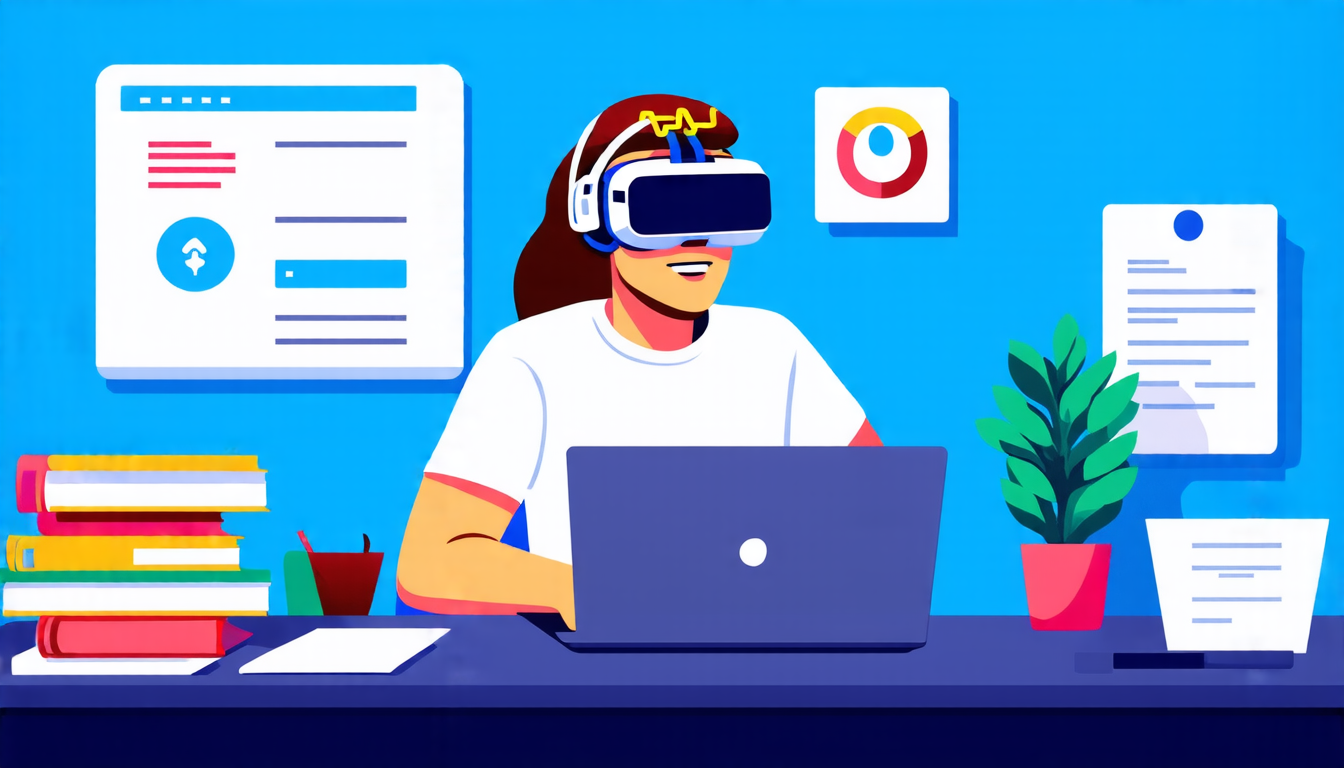
The researchers used a wearable EEG headband to record brain activity from a single participant while they engaged with educational content on both computers and virtual reality (VR) devices. The participant was asked to assess their own concentration levels after each video, classifying them into three categories: fully concentrated, moderately concentrated, or not concentrated.
To develop the machine learning model, the researchers first preprocessed the EEG data by applying band-pass filters to extract five frequency bands: delta, theta, alpha, beta, and gamma. They then extracted 50 statistical features from these bands, including mean values, squared values, variance, standard deviation, skewness, kurtosis, root mean square, entropy, activity, and mobility.
The next step was to select the most informative features using a top-k feature selection strategy with an interval of five features. The variation in validation accuracy over the number of selected features showed that the Support Vector Machine (SVM), Dense Neural Network (DNN), Random Forest (RF), Adaptive Boosting (AdaBoost), and Extreme Gradient Boosting (XgBoost) models all benefited from feature selection.
The RF model, which was found to be the most accurate, was then tested on unseen data to evaluate its robustness and stability. The results showed that the RF model achieved an area under the curve (AUC) of 1.00 for all classes in both non-VR and VR sessions, indicating excellent discrimination between the classes.
The study’s findings suggest that EEG-based methods can be used to analyze and understand personalized learning experiences. By using machine learning algorithms to classify concentration levels, educators and researchers may be able to develop more effective instructional design and support individualized learning pathways.
While the study’s sample size was limited to a single participant, it lays the groundwork for future research exploring the potential of EEG-based methods in educational settings. The use of VR devices in online learning environments is also an area that warrants further investigation, as it may provide new insights into how students engage with educational content.
Overall, this study highlights the promise of EEG-based methods in analyzing and improving personalized learning experiences.
Cite this article: “Deciphering Concentration Levels: A Machine Learning Approach Using EEG Data”, The Science Archive, 2025.
Eeg, Machine Learning, Online Learning, Concentration Levels, Brain Activity, Educational Content, Virtual Reality, Feature Selection, Classification, Personalized Learning





