

Friday 28 March 2025
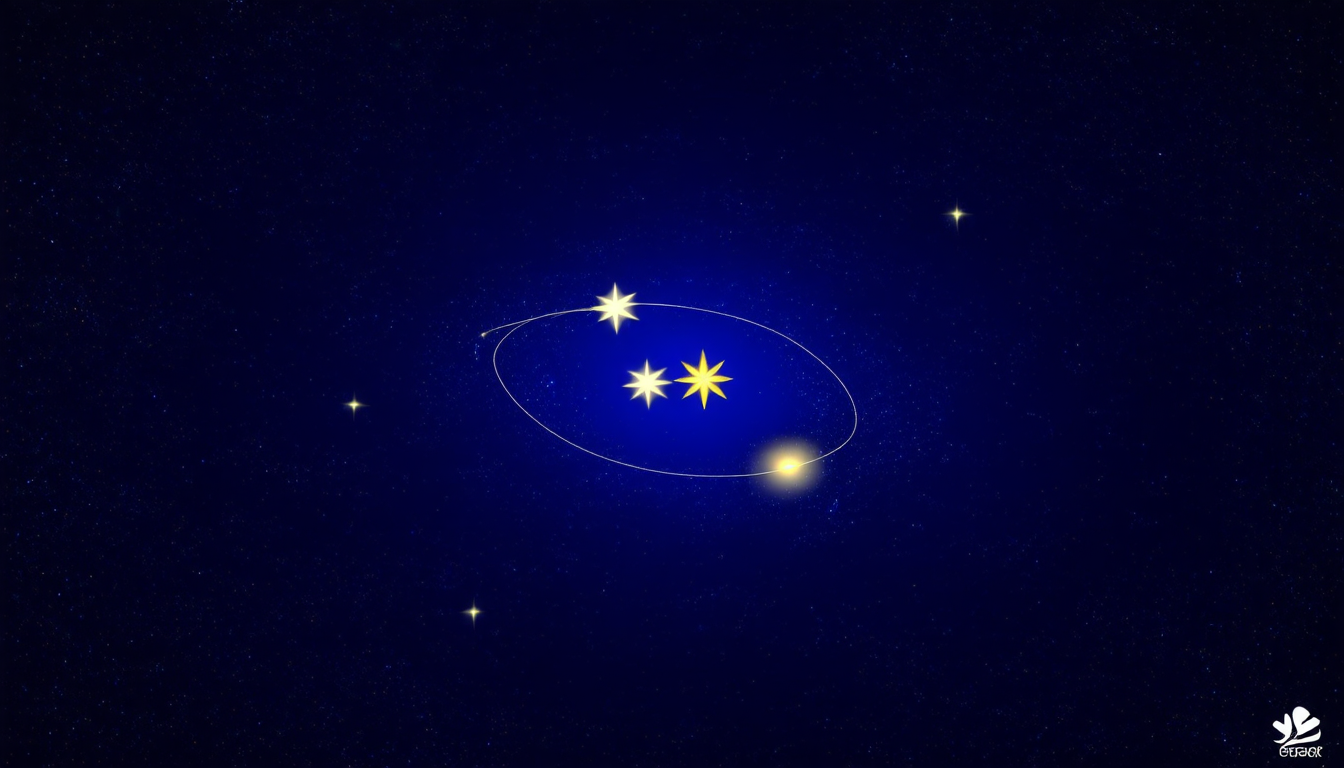
A team of astronomers has made a fascinating discovery about the supermassive black hole at the center of our galaxy, known as Sagittarius A* (Sgr A*). By analyzing the light emitted by this behemoth, researchers have found evidence of an eclipsing binary system, where two black holes are orbiting each other around the galactic center.
Sgr A* is a remarkable object, with a mass of approximately four million times that of our sun. Its gravity warps the fabric of spacetime, creating a region from which nothing, not even light, can escape. The Event Horizon Telescope (EHT) has imaged this black hole in unprecedented detail, revealing a shadowy silhouette surrounded by a bright ring.
The new study suggests that Sgr A* is not alone in its orbit around the galactic center. A secondary black hole, with a mass of about one thousand times that of our sun, is also present and playing a crucial role in shaping the light emitted by the primary black hole. This binary system is thought to be responsible for the observed brightness fluctuations and hotspots seen in the EHT images.
The researchers used complex computer simulations to model the behavior of these two massive objects as they orbit each other. They found that the secondary black hole’s gravitational influence causes the light from Sgr A* to bend and distort, creating the observed effects. This phenomenon is similar to how a binary star system can cause the light from one star to appear distorted due to the gravitational pull of its companion.
The presence of this eclipsing binary system has significant implications for our understanding of black hole formation and evolution in galaxies like our own. It also highlights the importance of considering the complex dynamics between multiple massive objects in these systems.
In addition to providing new insights into the behavior of Sgr A*, this discovery may have practical applications for astronomers studying other galaxies. By better understanding the interactions between black holes, researchers can improve their ability to detect and characterize such objects, ultimately shedding more light on the mysteries of the universe.
The search for answers about our cosmos is an ongoing endeavor that relies on innovative research and cutting-edge technology. The discovery of this eclipsing binary system at Sgr A* is a testament to human curiosity and ingenuity, as scientists continue to uncover the secrets hidden within the vast expanse of space.
Cite this article: “Double Trouble: Astronomers Discover Eclipsing Binary Black Hole System at Galactic Center”, The Science Archive, 2025.
Black Holes, Sagittarius A*, Eclipsing Binary System, Supermassive Black Hole, Event Horizon Telescope, Galactic Center, Binary Star System, Gravitational Influence, Light Distortion, Astrophysics





