

Friday 28 March 2025
Scientists have long been fascinated by the way particles move and interact in liquids, but a new study has shed light on a phenomenon that’s been puzzling researchers for years: why some mixtures of particles separate during drying, while others remain uniform.
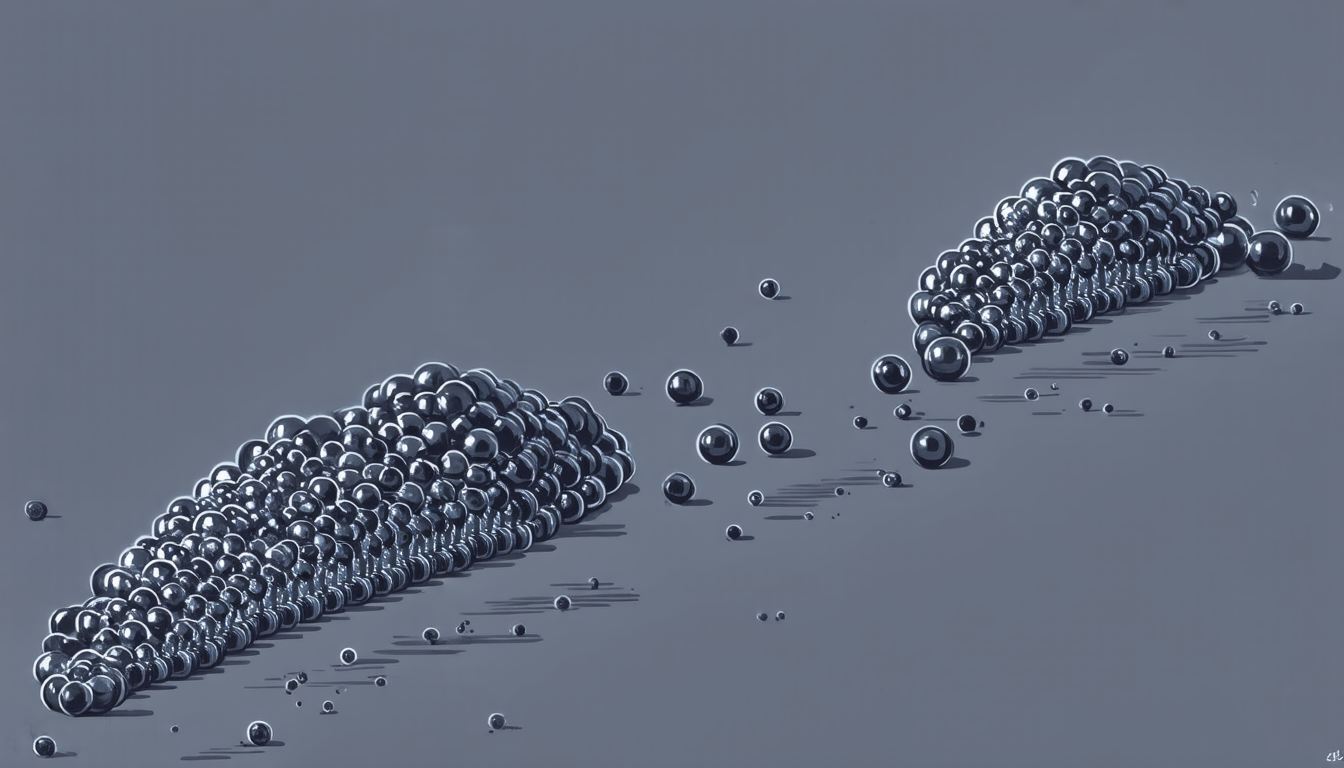
The research team used complex computer simulations to model the behavior of different types of particles as they dried. They found that the shape and surface area of the particles played a crucial role in determining whether they would separate or not.
In particular, the scientists discovered that when particles have very different surface areas, they tend to separate during drying. This is because the larger particles with more surface area are able to move more quickly through the liquid, leaving behind the smaller particles with less surface area.
The team also found that the size of the particles was not as important in determining whether they would separate or not. Instead, it was the difference in their surface areas that seemed to be the key factor.
One of the most interesting aspects of this research is its potential applications. For example, scientists could use this knowledge to create new materials with specific properties by carefully controlling the shape and size of the particles used.
The study also has implications for our understanding of natural phenomena, such as the way that sediment layers form in lakes and rivers. By better understanding how particles interact during drying, researchers may be able to gain insights into these complex processes.
Overall, this research provides new insights into the behavior of particles during drying and highlights the importance of considering the shape and surface area of particles when predicting their behavior.
Cite this article: “Unraveling the Mystery of Particle Separation During Drying”, The Science Archive, 2025.
Particles, Liquids, Drying, Separation, Simulation, Computer Modeling, Surface Area, Shape, Size, Materials Science





