

Friday 28 March 2025
The Earth’s magnetic field is a complex and dynamic entity, shaped by the constant flow of charged particles from the sun. But in rare instances, this field can take on an unusual shape, known as Alfvén wings. These formations occur when the solar wind – a stream of plasma emitted by the sun – interacts with the Earth’s magnetic field at just the right angle.
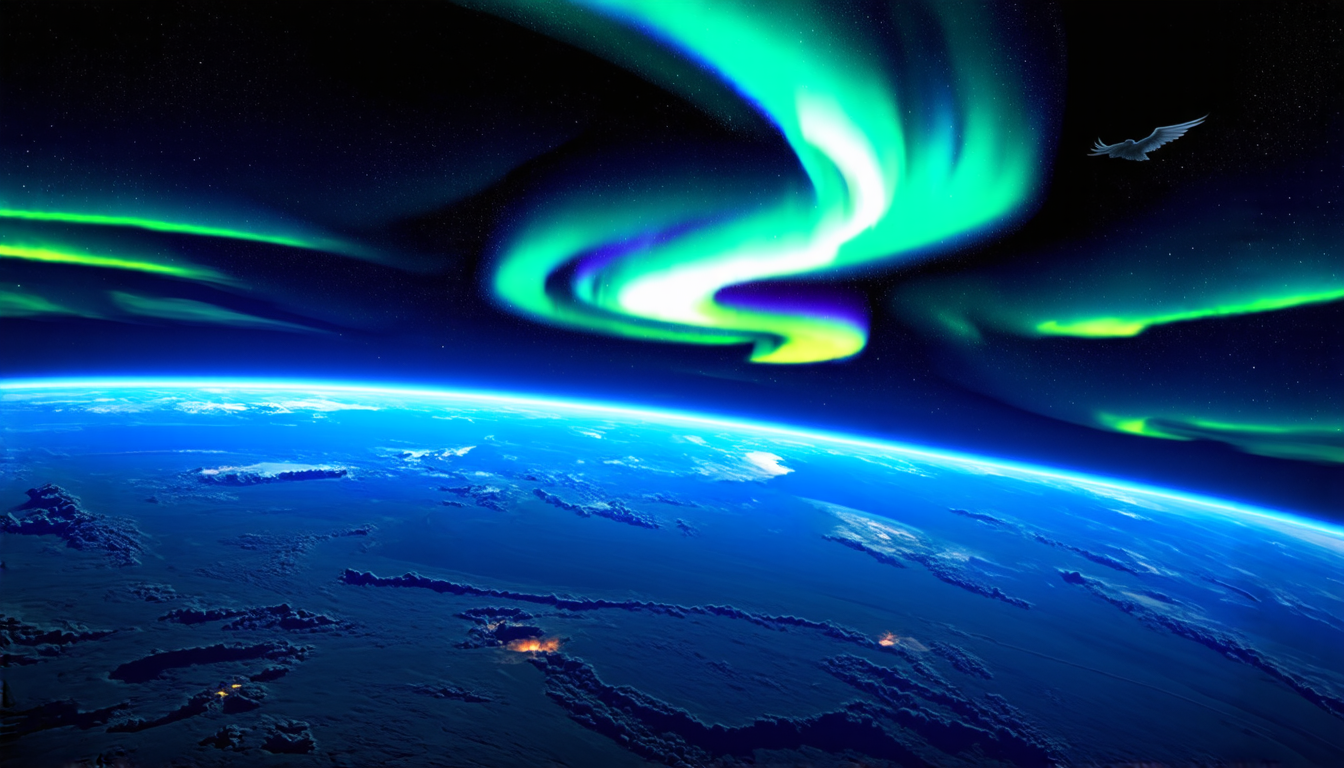
The resulting structure is like a pair of wings, with the solar wind flowing along them and generating powerful electric currents in the process. These currents can then drive spectacular displays of light in the aurora borealis, also known as the northern lights.
Recently, scientists have made significant progress in understanding Alfvén wings, using a combination of computer simulations and observations from spacecraft. They’ve found that these formations are more common than previously thought, and can occur even when the solar wind is relatively calm.
The research suggests that Alfvén wings play an important role in shaping our magnetic field, particularly during periods of intense solar activity. This could have significant implications for our understanding of space weather, which can affect everything from communication satellites to power grids on Earth.
One of the key findings is that Alfvén wings are more likely to form when the solar wind is flowing at a slower pace than usual. This allows the magnetic field to take on a more irregular shape, creating the conditions necessary for the formation of these unique structures.
The researchers used data from NASA’s Magnetospheric Multiscale (MMS) mission to study Alfvén wings in detail. The MMS spacecraft are equipped with instruments that can detect tiny changes in the magnetic field, allowing scientists to track the movement of charged particles and understand how they interact with the solar wind.
By analyzing this data, the researchers were able to recreate the conditions necessary for Alfvén wing formation using computer simulations. They found that these simulations accurately predicted the formation of Alfvén wings, and provided valuable insights into their behavior.
The study also highlights the importance of observing space weather in real-time, rather than relying on historical data or predictions based on statistical models. By analyzing recent observations, scientists can gain a better understanding of how our magnetic field responds to changes in the solar wind, and make more accurate forecasts about future events.
In the long term, this research could have significant implications for our ability to predict and prepare for space weather events.
Cite this article: “Unraveling the Mystery of Alfvén Wings: A Key to Understanding Space Weather”, The Science Archive, 2025.
Magnetic Field, Solar Wind, Alfvén Wings, Auroral Activity, Space Weather, Nasa, Magnetospheric Multiscale, Mms Mission, Plasma, Earth’S Magnetic Field.





