

Friday 28 March 2025
Scientists have long sought to develop more efficient and accurate methods for simulating complex physical phenomena, such as wave propagation in heterogeneous media. These simulations are crucial for understanding and predicting a wide range of natural processes, from seismic activity to fluid flow through porous rocks.
One major challenge has been the need to balance accuracy with computational efficiency. As problems become increasingly complex, traditional numerical methods can struggle to keep up, leading to lengthy computation times or reduced accuracy. To address this issue, researchers have turned to multiscale approaches, which divide complex systems into smaller, more manageable components and simulate each piece separately.
Now, a new technique has emerged that promises to revolutionize the field of numerical simulation. By combining advanced mathematical techniques with clever algorithmic innovations, scientists have developed a novel approach that can efficiently model complex wave phenomena while maintaining high accuracy.
The key innovation lies in the use of a partially explicit time discretization scheme, which allows for faster computation times without sacrificing precision. This is achieved by separating the time-dependent problem into two parts: an explicit component that can be solved quickly and accurately, and an implicit component that requires more computational resources but provides greater accuracy.
The new method also incorporates advanced spatial decomposition techniques, which enable scientists to break down complex systems into smaller pieces and simulate each piece separately. This approach allows for significant reductions in computation time while maintaining high accuracy.
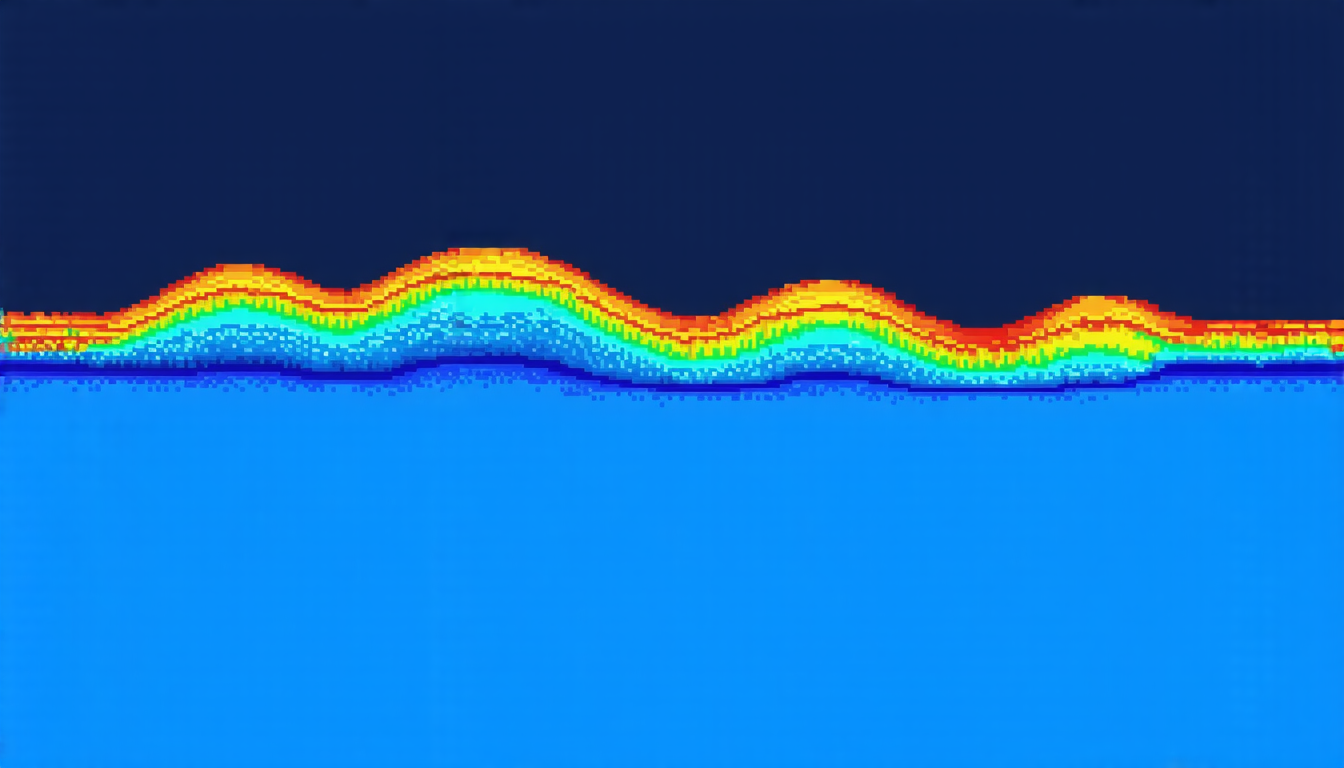
To test the new technique, researchers applied it to a range of challenging problems, including wave propagation through heterogeneous media and fluid flow through porous rocks. The results were impressive: the new method was able to accurately model complex phenomena with significantly reduced computational requirements compared to traditional methods.
The implications are far-reaching, with potential applications in fields such as geophysics, materials science, and biomedical engineering. By providing a more efficient and accurate way to simulate complex physical phenomena, this technique has the potential to transform our understanding of these processes and open up new avenues for research and innovation.
As scientists continue to push the boundaries of what is possible with numerical simulation, it’s exciting to think about the possibilities that this new method may unlock. By harnessing the power of advanced mathematics and clever algorithmic innovations, researchers are one step closer to unlocking the secrets of complex physical phenomena.
Cite this article: “Revolutionizing Numerical Simulation: A New Approach to Modeling Complex Physical Phenomena”, The Science Archive, 2025.
Numerical Simulation, Wave Propagation, Heterogeneous Media, Fluid Flow, Porous Rocks, Multiscale Approaches, Time Discretization, Spatial Decomposition, Geophysics, Materials Science





