

Friday 28 March 2025
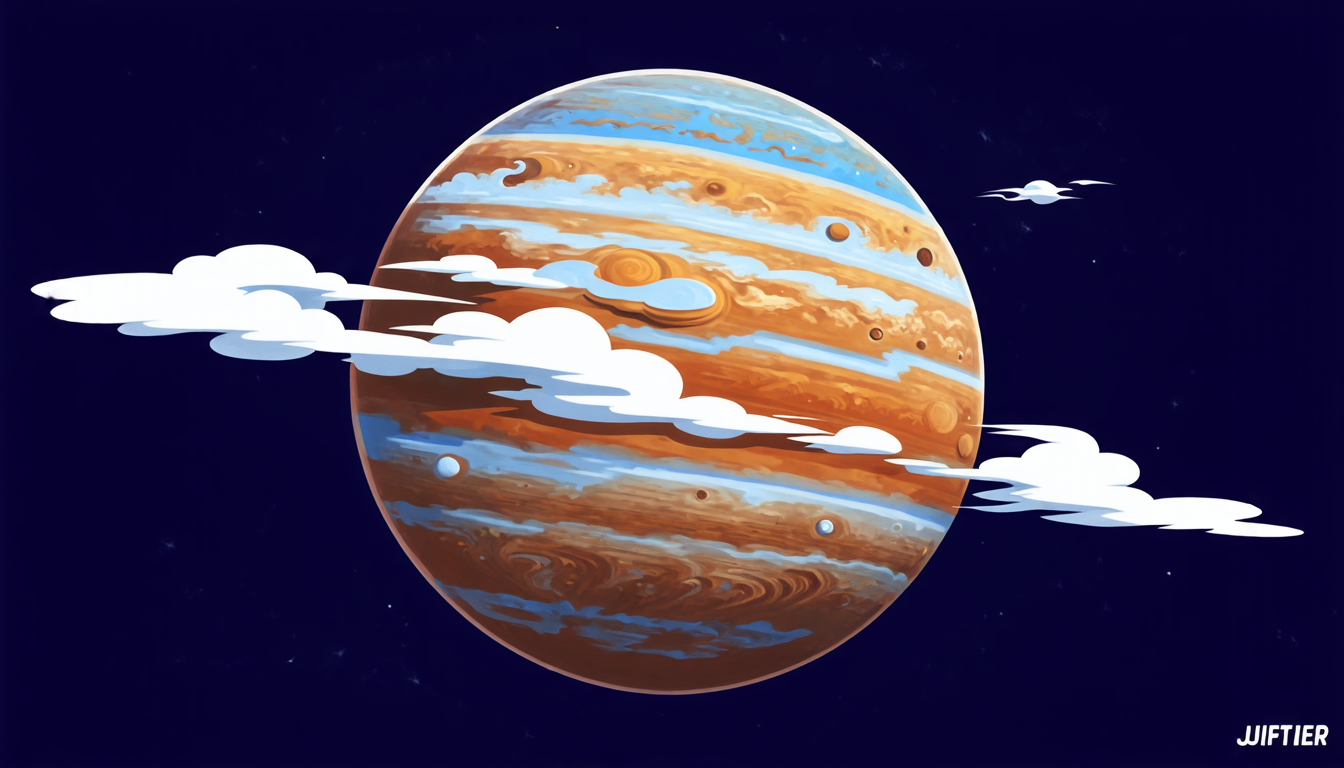
Jupiter’s atmosphere is a swirling cauldron of storm systems, but scientists have long struggled to understand how these massive tempests impact the planet’s deeper layers. A new study published in Nature Astronomy offers fresh insights into this mystery, using data from NASA’s Juno spacecraft to map the effects of giant storms on Jupiter’s troposphere.
The Juno mission has been orbiting Jupiter since 2016, equipped with a suite of instruments designed to probe the planet’s atmosphere and magnetic field. One of those instruments is the Microwave Radiometer (MWR), which uses radio waves to measure the temperature and composition of Jupiter’s clouds. By analyzing these measurements, researchers can reconstruct the atmospheric conditions in different regions of the planet.
In this new study, scientists focused on a particularly intense storm system that erupted in 2017, visible from Earth as a bright white plume stretching across Jupiter’s southern hemisphere. Using MWR data, they created detailed maps of the storm’s impact on the atmosphere, revealing two striking patterns.
Firstly, the team found that the storm caused a significant depletion of ammonia in the upper atmosphere, likely due to the condensation of water vapor and other gases as the storm system rose through the clouds. This ammonia scarcity had a knock-on effect on the atmospheric temperature, leading to a widespread heating of the upper layers.
The second key finding was the presence of a strong temperature anomaly deeper in the atmosphere, where the storm’s energy dissipated into the surrounding clouds. Here, the team detected significant cooling, likely caused by the adiabatic expansion of air as it rose through the clouds. This cooling effect helped to balance out the warming trend observed higher up.
By combining these findings with simulations and models, the researchers were able to reconstruct the complex dynamics at play during this storm event. They found that the storm’s energy release was linked to changes in atmospheric circulation patterns, which in turn influenced the distribution of heat and moisture throughout the troposphere.
These results offer valuable insights into the workings of Jupiter’s atmosphere, highlighting the intricate relationships between storms, clouds, and atmospheric circulation. The study also demonstrates the power of combining spacecraft data with theoretical models to shed light on complex astrophysical phenomena.
In the future, scientists hope to apply these techniques to other storm events in Jupiter’s atmosphere, as well as to similar systems on other gas giants like Saturn.
Cite this article: “Junos Insights into Jupiters Stormy Atmosphere”, The Science Archive, 2025.
Jupiter, Storm Systems, Troposphere, Nasa’S Juno Spacecraft, Microwave Radiometer, Atmospheric Conditions, Ammonia, Temperature Anomalies, Atmospheric Circulation, Saturn





