

Saturday 29 March 2025
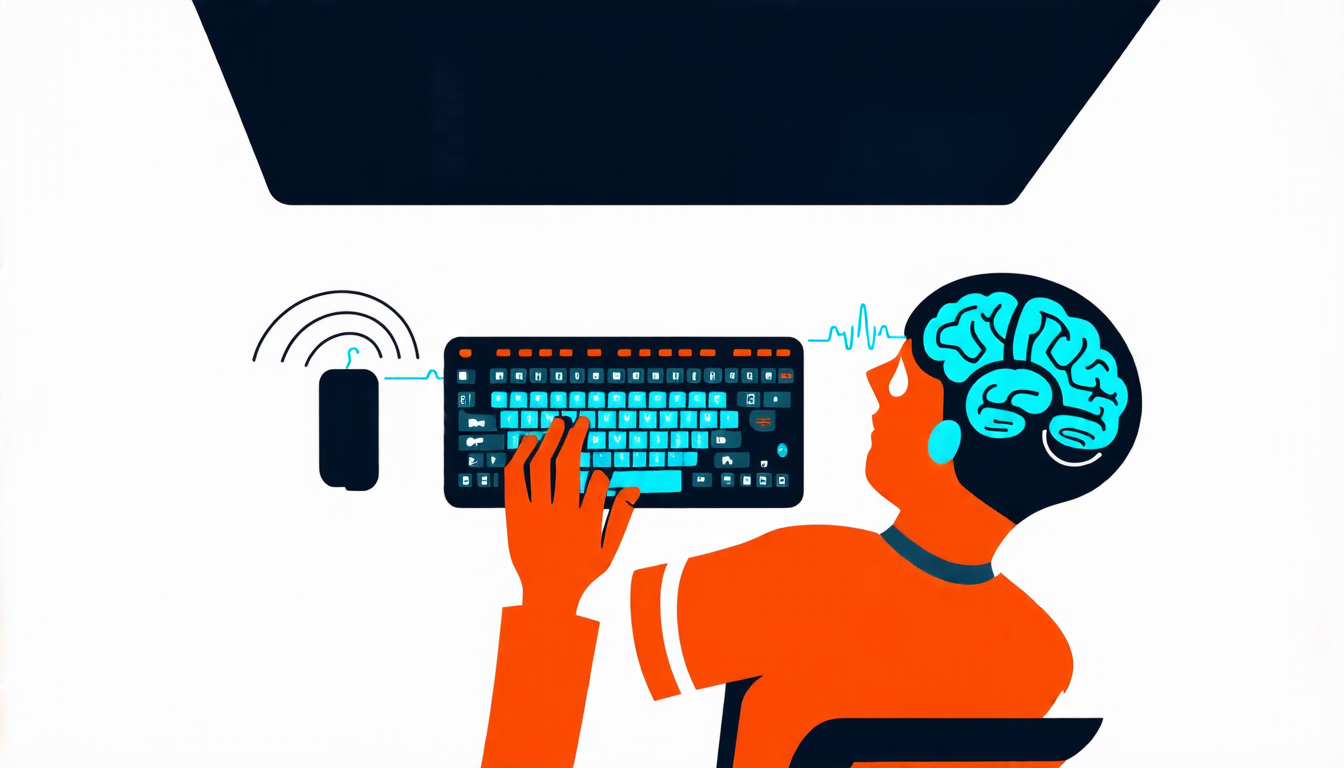
The latest breakthrough in brain-computer interfaces (BCIs) has taken a significant leap forward, allowing researchers to decode and transcribe sentences from brain activity without invasive surgery. This non-invasive approach, dubbed Brain2Qwerty, uses electroencephalography (EEG) or magnetoencephalography (MEG) to record neural signals while participants type out sentences on a QWERTY keyboard.
The research team, comprised of neuroscientists and engineers from Meta AI and the École Normale Supérieure, has been working on developing BCIs that can restore communication in individuals who have lost their ability to speak or move. While previous neuroprostheses required invasive surgery, Brain2Qwerty’s non-invasive approach eliminates the risks associated with neurosurgery.
The team used a deep learning architecture, dubbed Brain2Qwerty, which combines convolutional neural networks (CNNs) and transformers to decode sentences from brain activity. The model was trained on data from 35 healthy volunteers who were asked to type out brief memorized sentences after viewing them on a screen.
The results are impressive: with magnetoencephalography (MEG), the Brain2Qwerty model achieved an average character error rate (CER) of 32%, outperforming EEG-based models by a significant margin. For the top-performing participants, the CER dropped to just 19%, demonstrating the model’s ability to accurately transcribe sentences outside of its training set.
The team’s analysis suggests that the decoding process involves both motor processes and higher-level cognitive factors. This is consistent with previous research on typing behavior, which has shown that the brain processes language at multiple levels, from simple motor control to complex linguistic processing.
While Brain2Qwerty represents a significant step forward in BCI technology, there are still challenges to overcome before it can be used in practical applications. For example, the model’s performance varies significantly across participants, and further research is needed to understand why this is the case.
Despite these limitations, the potential implications of Brain2Qwerty are enormous. If successfully translated into a clinical setting, the technology could restore communication for individuals with severe paralysis or amyotrophic lateral sclerosis (ALS). It could also enable people with speech disorders to communicate more effectively, potentially improving their quality of life.
The next steps for the research team will be to refine the model and explore its potential applications in various contexts.
Cite this article: “Breakthrough in Brain-Computer Interfaces Enables Non-Invasive Sentence Decoding”, The Science Archive, 2025.
Brain-Computer Interfaces, Non-Invasive, Eeg, Meg, Deep Learning, Neural Networks, Transformers, Magnetoencephalography, Character Error Rate, Typing Behavior





